







Frequently Asked Questions
This page presents the most commonly asked questions from our users.
- How does the RAIS differ from the EPA RSL Calculator?
- How can I use the information on the RAIS?
- Is there a version of the RAIS I can download to my laptop?
- How are the toxicity values and chemical parameters maintained?
- How can I get further training on the RAIS and risk assessment?
- Where can I get more info on ecological risk assessment?
- Does the RAIS provide specific information regarding risk to children?
- Will changing the groundwater-soil system temperature automatically change the volatility status of my chemicals?
- How can I get the calculator output to print on one page?
- Are the tapwater outputs based on total (unfiltered) or dissolved (filtered) concentrations?
- Do the fish tissue and/or soil outputs apply to wet-weight or dry-weight data?
- The slope factors for benzene are actually ranges, yet the calculator output only shows a single number. Which number was chosen and why?
- Why do some of the outputs exceed a million parts per million (1E+06 mg/kg)? That's not possible!
- What is the preferred citation for information taken from this website?
- The cadmium numbers are labeled "food" and "water." Which do I use if I have another medium, such as soil?
- How was the copper RfD derived?
- For manganese, IRIS shows an oral RfD of 0.14 mg/kg-day, but the calculators use 0.024 mg/kg-day. Why?
- What toxicity values are used for TCE?
- How are total petroleum hydrocarbon (TPHs) considered in calculations?
- How are oral RfDs used to calculate dermal exposure?
If you have a question that is not found on this FAQ page or in a user guide, please use the contact us form at the bottom of the page.
- How does the RAIS differ from the EPA RSL Calculator?
- How can I use the information on the RAIS?
- Is there a version of the RAIS I can download to my laptop?
- How are the toxicity values and chemical parameters maintained?
- How can I get further training on the RAIS and risk assessment?
- Where can I get more info on ecological risk assessment?
- Does the RAIS provide specific information regarding risk to children?
- Will changing the groundwater-soil system temperature automatically change the volatility status of my chemicals?
- How can I get the calculator to print on one page?
- Are the tapwater outputs based on total (unfiltered) or dissolved (filtered) concentrations?
- Do the fish tissue and/or soil outputs apply to wet-weight or dry-weight data?
- The slope factors for benzene are actually ranges, yet the calculator output only shows a single number. Which number was chosen and why?
- Why do some of the outputs exceed a million parts per million (1E+06 mg/kg)? That's not possible!
- What is the preferred citation for information taken from this website?
- The cadmium numbers are labeled "food" and "water." Which do I use if I have another medium, such as soil?
- How was the copper RfD derived?
- For manganese, IRIS shows an oral RfD of 0.14 mg/kg-day, but the calculators use 0.024 mg/kg-day. Why?
- What toxicity values are used for TCE?
- How are total petroleum hydrocarbon (TPHs) considered in calculations?
- How are oral RfDs used to calculate dermal exposure?
For chemicals, the RAIS includes more land uses and exposure pathways than the RSLs. The RAIS also provides default exposure parameters for the recreator land use and fish ingestion. The RAIS includes more toxicity values, including: all CalEPA, all OPP, draft ATSDR, ATSDR addendum, Retired PPRTVs, and values withrawn from HEAST and IRIS. For the vast majority of land uses, media, and exposure routes, the RAIS and EPA RSLs will give the same answers. For radionuclides, the RAIS and EPA radionuclide calculators share many land uses, media, and exposure routes. The RAIS attempts to stay in sync with the rapidly changing EPA radionuclide calculator slope factors, gamma adjustment factors, and PRG output options.
The information on the RAIS can be used for teaching material and performing risk assessments that comply with EPA guidance. Feel free to use the information; it is available to the public. Please give proper credit to the RAIS and the team from Oak Ridge National Laboratory, however, where you see fit. Also, the databases we maintain are updated on a quarterly basis or sooner, so you may need to "time-stamp" any information you download.
No, the RAIS databases are solely an internet service. If you wish to have a stand alone software package for your laptop or desktop PC that performs many tasks similar to the RAIS, please download SADA (Spatial Analysis and Decision Assistance). This software was developed with the same databases and equations used by the RAIS. Spatial Analysis and Decision Assistance (SADA) is free software that incorporates tools from environmental assessment fields into an effective problem solving environment. These tools include integrated modules for visualization, geospatial analysis, statistical analysis, human health risk assessment, cost-effective analysis, sampling design, and decision analysis.
The toxicity values are updated in real time for IRIS, PPRTV, and HEAST. Other toxicity sources like ATSDR, OPP, and CalEPA are updated semiannually. The What's New link will tell you when a value has been updated. Besides toxicity values, we also maintain Regulatory ARARS and other
The RAIS Team has developed one to five day risk assessment courses that use the RAIS and EPA calculators. We can modify these courses to meet any client's needs. Contact an RAIS representative. Please remember the RAIS already has 2 online training platforms: 1) What is Risk Assessment? and 2) RAIS Main Tutorial.
Please go to the RAIS ecological benchmark page. Here, you will find links to ecological screening benchmarks and the ORNL Environmental Science Division website. This website should be helpful in providing information about water, soil, and air exposures for many ecological endpoints.
The easy answer is "yes it does." The real answer is "yes and no". "Yes" in the sense that the exposure to the child is considered in the equations for a total lifetime of exposure and the child's exposure for soil and milk ingestion is separately considered. The "no" part of the answer relates to the fact that there are few environmental studies on child acute exposures, and the RAIS reflects the current state of knowledge and does not present a standardized approach for acute child risk assessment for any/all chemicals. Some individual chemicals, e.g. lead, pesticides (indoor use), or radionuclides, will have specific approaches to assess child risks. If you wish to further investigate, there are several diverse regulations on child risk assessment (EPA, FQPA, CPSC, etc.).
No. When changing the groundwater-soil system temperature, the criteria that determines whether a chemical is volatile or not may also change. The Henry's Law constants and vapor pressures that are used in RAIS calculations are based on standard laboratory conditions of 25°C. When the groundwater-soil system temperature is changed, the Henry's Law constants and vapor pressures will change accordingly. A volatile chemical at 25°C may not be volatile at a lower temperature. Conversely, a nonvolatile may become volatile at temperatures above 25°C. When the groundwater-soil system temperature is changed, the RAIS calculators will provide the user with recalculated Henry's Law constants and vapor pressures. These values can be compared to the volatility status requirements presented in the user's guide. The RAIS calculators do not automatically change the volatility status of a chemical to reflect the user's change of the groundwater-soil system temperature. In site-specific user-provided mode of the calculator, the user may change the volatility status of a chemical, if deemed appropriate. Changing the volatility status can impact the inclusion of dermal exposure to soil, inhalation of volatiles during household use of water, and the soil to groundwater Method 1 calculations.
Historically, this was an issue for the RAIS calculator. Now, calculator results can be accessed in PDF or Spreadsheet files. Output links are available at the top of calculator results pages.
The tapwater outputs do not address total vs. dissolved components in the drinking water; this is a sampling issue. The tapwater outputs are for the concentration in the water at the tap, regardless of how the water gets there or is sampled. The decision about whether to use total or dissolved data in a risk assessment is a site-specific one; consult your regional risk assessor.
The fish outputs represent the concentration that can be consumed at the rate indicated in the Technical Background Document. Therefore, wet or dry weight is not an inherent assumption of the output numbers. Rather, users should consider whether their population of interest is more likely to consume the fish using a preparation method that is better simulated by a wet or dry weight. (For example, consumption of raw or fried fish would be more likely represented by wet weight, whereas consumption of smoked or dried fish might be better represented by dry weight.) In other words, the use of a site-specific sample as wet or dry weight should be governed by its representativeness for the population of interest.
The soil outputs are based on dry weight because the soil intake rates are based on dry weight. Most soil data is typically reported as dry weight. As always, please consult your institution's risk assessor when applying the outputs to site-specific data.
The upper end of the slope factor range was chosen. This is because the outputs are a screening tool, and the consequences of screening out a chemical that could pose a significant risk are more serious than the consequences of carrying the chemical through to the next step of the risk assessment. (At each step of the risk assessment, the risk is further refined using site-specific analysis. Chemicals can always be eliminated from the risk assessment at a later step than the initial screening, if appropriate.)
For certain low-toxicity chemicals, the outputs exceed possible concentrations at the target risks. Many years ago, these outputs were rounded to the highest possible concentration, or 1.0E+06 ppm. This type of truncation has been discontinued so that users can adjust the outputs to a different target risk whenever necessary. For example, when screening chemicals at a target HQ of 0.1, noncarcinogenic outputs may simply be divided by 10. Such scaling is not possible when outputs are rounded. Users who are interested in truncation can also consult the Soil Screening Guidance for a discussion of Csat, the saturation concentration, which reflects physical limits on soil concentrations.
Outputs may also exceed a non-risk based 'ceiling limit' concentration of 1.0E+05 mg/kg (max) for relatively less toxic inorganic and semivolatile contaminants. The ceiling limit of 1.0E+05 mg/kg is equivalent to a chemical representing 10% by weight of the soil sample. At this contaminant concentration (and higher), the assumptions for soil contact may be violated (for example, soil adherence and wind-borne dispersion assumptions) due to the presence of the foreign substance itself.
The calculator, if operated in site-specific mode, will give the option to apply the Csat substitution rule as well as the option to apply the theoretical ceiling limit.
The Risk Assessment Information System (Insert specific tool url) (Insert specific date accessed).
"Food" is for food and soil use; "water" is for water only. Further, the cadmium RfDs on IRIS are based on the same study. The food RfD incorporates a 2.5% absorption adjustment; the water RfD incorporates a 5% absorption adjustment. For another medium such as soil, the risk assessor should choose the number whose absorption factor most closely matches the expected conditions at the site. For example, if the expected absorption of cadmium from soil is 3%, the food-based number would be a good approximation. In most cases, the expected absorption is unknown and the RfD for food should be used for soil screening without making any changes to the value.
Currently, the RfD is 0.04 mg/kg-day with a reference of HEAST. Actually, HEAST presents a concentration in drinking water screening level of 1.3 mg/L. In order to use the value to assess oral exposures to other media, we "back out" the adult exposure assumptions (e.g., body weight of 70 kg, ingestion rate of 2 L/day) that go into the calculation of a drinking water screening level.
The IRIS RfD includes manganese from all sources, including diet. The explanatory text in IRIS recommends using a modifying factor of 3 when calculating risks associated with non-food sources, and the RAIS follows this recommendation. IRIS also recommends subtracting dietary exposure (default assumption in this case is 5 mg). Thus, the IRIS RfD has been lowered by a factor of 2 x 3, or 6. The RAIS now reflects manganese for "non-food" sources.
It is recommended that your institutional risk assessor be consulted when evaluating TCE in any medium, especially when less than chronic exposure scenarios are considered. The Superfund program issued a Compilation of Information Relating of Early/Interim Actions at Superfund Sites and the TCE IRIS Assessment memo in August 2014. Several regions have issued their own guidance as well.
IRIS has recently released a Toxicity Assessment for TCE. IRIS suggests that the kidney risk be assessed using the mutagenic equations and the liver and non-Hodgkin lymphoma (NHL) be addressed using the standard cancer equations. In order to make the calculator display the correct results for TCE, the standard cancer and mutagen equations needed to be combined. Since TCE requires the use of different toxicity values for cancer and mutagen equations, it was decided to make a toxicity value adjustment factor for cancer (CAF) and mutagens (MAF). The adjustments were done for oral (o) and inhalation (i). These adjustment factors are used in the TCE equation images presented in section 4 of the User Guide. The equations used to generate adjustment factors are presented below. The adjustment factors are based on the adult-based toxicity values, and these are the cancer toxicity values presented in the Generic Tables.
TCE toxicity value adjustment factor equations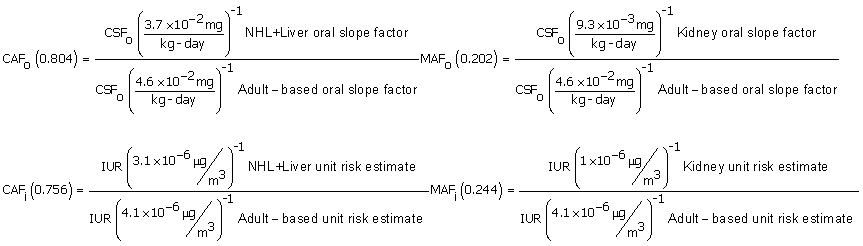
Traditionally, hydrocarbon-impacted soils at sites contaminated by releases of petroleum fuels have been managed based on their total petroleum hydrocarbon (TPH) content. TPH is a term intended to refer to the total mass of hydrocarbons present without identifying individual compounds. In practice, TPH is defined by the analytical method that is used to measure the hydrocarbon content in contaminated media. To the extent that the hydrocarbon extraction efficiency is not identical for each method, the same sample analyzed by different TPH methods will produce different TPH concentrations.
The hazard and health risk assessments typically conducted to support risk management decisions at contaminated sites generally require some level of understanding of the hydrocarbon chemical composition in the contaminated media. Traditional TPH measurement techniques, however, provide no specific information about the detected hydrocarbons. Because TPH is not a consistent entity, the assessment of health effects and development of toxicity values for mixtures of hydrocarbons are problematic. In fact, many risk assessors prefer to analyze and assess the individual chemical constituents rather than rely on TPH data; consult with your regional risk assessor for site-specific recommendations. In cases where TPH data are used, more details about the provisional TPH toxicity values are provided below.
In 2009, the Superfund Health Risk Technical Support Center (NCEA-Cincinnati) published a document that provides the data, methods, and assumptions for deriving Provisional Peer-Reviewed Toxicity Values (PPRTVs) for six fractions of petroleum hydrocarbons. The carbon ranges and representative compounds for the RfDs, RfCs, and chemical-specific parameters are listed in the table below. The carbon ranges used, are not intended to screen against DRO, GRO, ORO and RRO analysis.
The six TPH fractions were assigned representative compounds for determination of toxicity values and chemical-specific parameters. (An average of the chemical-specific parameters for 2-methylnaphthalene and naphthalene was calculated for the medium aromatic fraction, because 2-methylnaphthalaene represents the RfD and naphthalene represents the RfC.) In addition, there are nine accompanying derivation support documents for n-hexane, benzene, toluene, ethylbenzene, xylenes, commercial or practical grade hexane, midrange aliphatic hydrocarbon streams, white mineral oil, and high-flash aromatic naphtha.
| TPH Fractions | Number of Carbons | Equivalent Carbon Number Index | Representative Compound (RfD/RfC) |
|---|---|---|---|
| Low aliphatic | C5-C8 | EC5-EC8 | commercial hexane* |
| Medium aliphatic | C9-C18 | EC>8-EC16 | hydrocarbon streams** |
| High aliphatic | C19-C32 | EC>16-EC35 | white mineral oil |
| Low aromatic | C6-C8 | EC6-EC<9 | benzene |
| Medium aromatic | C9-C16 | EC9-EC<22 | 2-methylnaphthalene/naphthalene |
| High aromatic | C17-C32 | EC>22-EC35 | fluoranthene |
*Both commercial hexane and n-hexane were considered, but commercial hexane was selected for the RfC as the value was derived more recently (2009 vs. 2005) and is more protective
(0.6 mg/m3 vs. 0.7 mg/m3). The PPRTV paper recommends using this value, unless it is known that n-hexane accounts for >53% of the fraction. See p. 20 of the PPRTV.**Medium aliphatic representative compound was not listed in the PPRTV paper, so n-nonane was selected to represent the chemical-specific parameters.
Within the Superfund program, when TPHs are considered in the site characterization, they are assessed in supplemental health risk assessments only for potential noncancer health effects. Therefore, starting with the May 2014 update, cancer toxicity values are no longer used. Combining TPH and individual constituent cancer risks would be overly protective.
Oral RfDs can only be used to calculate dermal exposure if an gastrointestinal absorption factor (GIABS) is applied.
Dermal RfD = Oral RfD x GIABS
Dermal SF = Oral SF/GIABS