







What's New
March 2024
A Dioxin Equivalent Concentration Calculator has been added to the RAIS Chemical Tools under the Chemical Toxicity Menu. This tool will simultaneously calculate the dioxin toxicity equivalent concentration (TEQ) in soil, water, and biota using toxicity equivalent factors (TEFs). Enter the exposure point concentration for each congener, and the form will automatically generate the dioxin TEQ.
A PAH Equivalent Concentration Calculator has been added to the RAIS Chemical Tools under the Chemical Toxicity Menu. This tool will simultaneously calculate the PAH relative potency concentration (RPQ) in soil, water, and biota using relative potency factors (RPFs). Enter the exposure point concentration for each congener, and the form will automatically generate the PAH RPQ.
November 2023
Chemicals with new toxicity values due to PPRTV updates are:
- Aluminum salts of inorganic phosphates has a new screening chronic and subchronic RfD,
- Aluminum metaphosphate has a new screening chronic and subchronic RfD,
- Monoaluminum phosphate has a new screening chronic and subchronic RfD,
- Phosphoric acid, aluminum salt (1:1) [aluminum phosphate] has a new screening chronic and subchronic RfD,
- Phosphoric acid, aluminum sodium salt (1:X:X) [sodium aluminum phosphate acidic (acidic SALP)] has a new screening chronic and subchronic RfD,
- Sodium aluminum phosphate (anhydrous) has a new screening chronic and subchronic RfD,
- Sodium aluminum phosphate (tetrahydrate) has a new screening chronic and subchronic RfD,
- Trialuminum sodium tetra decahydrogenoctaorthophosphate (dihydrate) has a new screening chronic and subchronic RfD,
- Triphosphoric acid, aluminum salt (1:1) [aluminum triphosphate] has a new screening chronic and subchronic RfD,
- Fluorene has a new subchronic RfD, and
- Methylcyclohexane has a new screening subchronic RfD and screening chronic RfC.
Chemicals with new toxicity values due to ATSDR updates are:
- Acrylonitrile has a new DRAFT subchronic RfC and acute, subchronic, and chronic RfD and the acute RfC was archived,
- Beryllium has a new FINAL chronic RfC and the subchronic RfC was archived,
- Chloromethane has a new FINAL acute, subchronic, and chronic RfC,
- 1,2-Dichloroethylene, trans has a new DRAFT acute RfC and subchronic RfD and the subchronic RfC was archived,
- 1,2,3,6,7,8-Hexachlorodibenzofuran has a new FINAL subchronic RfD,
- Methyl tert-Butyl Ether (MTBE) has a new FINAL acute, subchronic, and chronic RfC and subchronic RfD,
- Nickel has a new DRAFT subchronic and chronic RfC,
- N-Nitrosomethylamine has a new FINAL acute RfD,
- 1,2,3,7,8-Pentachlorodibenzofuran has a new FINAL subchronic RfD,
- 2,3,4,7,8-Pentachlorodibenzofuran has a new FINAL acute, subchronic, and chronic RfD, and
- Vinyl Acetate has a new DRAFT acute, subchronic, and chronic RfC.
Chemicals with toxicity changes due to the EPA Office of Research and Development (ORD) (ORD Human Health Toxicity Value for Perfluoropropanoic Acid and ORD Human Health Toxicity Value for Lithium bis [(trifluoromethyl)sulfonyl]azanide)) are:
- Bis(trifluoromethylsulfonyl)amine (TSFI) has a new chronic RfD
- Lithium bis[(trifluoromethyl)sulfonyl]azanide has a new chronic RfD, and
- Perfluoropropanoic acid (PFPrA) has a new chronic RfD.
Chemicals with toxicity changes due to the State of Wisconsin Department of Health Services are:
- Perfluorooctadecanoic acid (PFODA) has a new chronic RfD,
- Perfluorotetradecanoic acid (PFTetA) has a new chronic RfD,
- Perfluorododecanoic acid (PFDoDA) has a new chronic RfD, and
- Perfluoroundecanoic acid (PFUDA) has a new chronic RfD.
Other changes:
- Sodium Acid Pyrophosphate was changed to Sodium pyrophosphate
- DDD was changed to Dichlordiphenyldichloroethane (DDD)
- DDE was changed to Dichlorophenyldichloroethylene (DDE)
- DDT was changed to Dichlorophenyltrichloroethane (DDT)
- JP-4 was changed to Jet propulsion fuel 4 (JP-4)
- JP-5 was changed to Jet propulsion fuel 5 (JP-5)
- JP-7 was changed to Jet propulsion fuel 7 (JP-7)
- JP-8 was changed to Jet propulsion fuel 8 (JP-8)
- Potassium salts of inorganic phosphates was provided an EPA ID of E524680403
- Sodium salts of inorganic phosphates was provided an EPA ID of E524680404
- Aluminum salts of inorganic phosphates was provided an EPA ID of E524680405
- TCMTB was changed to Thiocyanic acid, (2-benzothiazolylthio)methyl ester (TCMTB)
- In site-specific mode for the construction worker land use, the PRG and RISK calculators now return the higher value of the mass-limit subchronic volatilization factor (VFmlim-sc) and the unlimited subchronic volatilization factor ( VFulim-sc) when the mass limit VF option is selected.
- In site-specific mode for the soil to groundwater land use, the PRG and RISK calculators now return the higher value of the mass limit-based RSL (method 2) and the partition model-based RSL (method 1) when the mass limit option is selected.
Due to the growing number of PFAS, a concerted effort was made to populate the missing chemical-specific parameters in our database and revisit existing parameters to promote consistency. Specifically, it was decided that for boiling point, melting point, vapor pressure, and water solubility, data gaps in the ion form could use surrogate values from the acid form. Data gaps in parameters for the salt forms were not given surrogate values from the acid forms.
October 2023
An Oak Ridge National Laboratory Technical Memorandum titled, "An Overview of the Risk Assessment Information System" ORNL/TM-2023/3036 was published. This paper provides a referenceable point in time for the advances made in the 27-year history of the RAIS.
September 2023
The RAIS Main Tutorial has been extensively updated.
The Portsmouth Background Data has been updated to include several new sources of soil and groundwater values.
The Toxicity Profile page has been removed because the profiles were out of date. If one is needed, contact Fred Dolislager.
April 2023
The Chemical Data Profile Tool now presents the soil-water partition coefficient (Kd) values used from our hierarchy of sources.
Chemicals with toxicity changes due to Cal EPA updates in the consolidated table of OEHHA/ARB approved risk assessment health values (CONTABLE), reference exposure levels (REL), and toxicity criteria database (TCD) are:
- 1-Bromopropane has a new inhalation unit risk,
- Bromoacetic acid has a new chronic RfD,
- Chloroacetic acid has a new chronic RfD,
- Dibromoacetic acid has a new chronic RfD and oral slope factor,
- Dichloroacetic acid has a new chronic RfD and oral slope factor, and
- Trichloroacetic acid has a new chronic RfD and oral slope factor.
Chemicals with new toxicity values due to ATSDR updates are:
- Cobalt has lost its chronic RfC and subchronic RfD (the profile is now DRAFT),
- Alpha Hexachlorocyclohexane has lost its chronic and subchronic RfD (the profile is now DRAFT),
- Beta Hexachlorocyclohexane has lost its subchronic RfD (the profile is now DRAFT),
- Gamma Hexachlorocyclohexane (Lindane) has lost its chronic and subchronic RfD (the profile is now DRAFT), which was more protective than the IRIS chronic RfD value that will now be used,
- 1,1,1-Trichloroethane has lost its subchronic RfC and RfD (the profile is now DRAFT), and
- Vinyl Chloride has lost its subchronic RfD and chronic and subchronic RfC (the profile is now DRAFT), which was more protective than the IRIS chronic RfC value that will now be used.
Chemicals with new toxicity values due to PPRTV updates are:
- Isobutyl alcohol has a new chronic and subchronic screening RfC and
- Perylene has a new screening chronic and sub chronic RfD and a new screening chronic and subchronic RfC.
Chemicals with new toxicity values due to IRIS updates are:
- Ammonium perfluorohexanoate has a new chronic and subchronic RfD,
- Perfluorohexanoate has a new chronic and subchronic RfD,
- Perfluorohexanoic acid (PFHxA) has a new chronic and subchronic RfD, and
- Sodium Perfluorohexanoate has a new chronic and subchronic RfD.
Chloro-1,3-butadiene, 2- was changed to Chloro-1,3-butadiene, 2- (Chloroprene).
Some chemical properties have also changed.
- Cyclohexene, a component of the TPH aliphatic low fraction, has multiple new parameters,
- TPH aliphatic low fraction has multiple new parameters due to the Cyclohexene update, and
- Perfluorooctanesulfonic acid (PFOS), Potassium perfluorobutanesulfonate, Potassium perfluorooctanesulfonate, and Perfluorohexanesulfonic acid (PFHxS) have multiple new parameters from new sources.
March 2023
The Ecological Benchmark Tool for Chemicals and Ecological Benchmark Tool for Radionuclides have updated values from the LANL ECORISK 4.3 release.
January 2023
Chemicals with new toxicity values due to IRIS updates are:
- Perfluorobutanoic acid (PFBA): new chronic and subchronic RfD
- Ammonium perfluorobutanoate: new chronic and subchronic RfD
- Potassium heptafluorobutanoate: new chronic and subchronic RfD
- Sodium perfluorobutanoate: new chronic and subchronic RfD
- Perfluorobutanoate: new chronic and subchronic RfD
Chemicals with new toxicity values due to PPRTV updates are:
- Sodium salts of inorganic phosphates: new chronic and subchronic RfD
- Potassium salts of inorganic phosphates: new chronic and subchronic RfD
- Phosphoric acid: new chronic and subchronic RfD
- Polyphosphoric acid: new chronic and subchronic RfD
- Monosodium phosphate: new chronic and subchronic RfD
- Disodium phosphate: new chronic and subchronic RfD
- Trisodium phosphate: new chronic and subchronic RfD
- Sodium acid pyrophosphate: new chronic and subchronic RfD
- Tetrasodium pyrophosphate: new chronic and subchronic RfD
- Sodium tripolyphosphate: new chronic and subchronic RfD
- Sodium trimetaphosphate: new chronic and subchronic RfD
- Sodium polyphosphate: new chronic and subchronic RfD
- Sodium hexametaphosphate: new chronic and subchronic RfD
- Monopotassium phosphate: new chronic and subchronic RfD
- Dipotassium phosphate: new chronic and subchronic RfD
- Tripotassium phosphate: new chronic and subchronic RfD
- Tetrapotassium phosphate: new chronic and subchronic RfD
- Potassium tripolyphosphate: new chronic and subchronic RfD
Chemicals with toxicity changes due to Cal EPA updates in the consolidated table of OEHHA/ARB approved risk assessment health values (CONTABLE), reference exposure levels (REL), and toxicity criteria database (TCD) are:
- Aniline hydrochloride: new IUR and ISF (SURROGATE value from latest ConTable)
- Arsenic acid: new chronic, subchronic, and acute RfC; chronic RfD; IUR, ISF, and OSF (SURROGATE value from latest ConTable)
- Arsenic pentoxide: new chronic, subchronic, and acute RfC; chronic RfD; IUR, ISF, and OSF (SURROGATE value from latest ConTable)
- Arsenic trioxide: new chronic, subchronic, and acute RfC; chronic RfD; IUR, ISF, and OSF (SURROGATE value from latest ConTable)
- Arsine: new chronic, subchronic, and acute RfC and chronic RfD (SURROGATE value from latest ConTable)
- Calcium arsenate: new chronic, subchronic, and acute RfC; chronic RfD; IUR, ISF, and OSF (SURROGATE value from latest ConTable)
- Calcium arsenate: new chronic, subchronic, and acute RfC; chronic RfD; IUR, ISF, and OSF (SURROGATE value from latest ConTable)
- Gallium arsenide: new chronic, subchronic, and acute RfC; chronic RfD; IUR, ISF, and OSF (SURROGATE value from latest ConTable)
- Actinolite: new IUR and ISF (SURROGATE value from latest ConTable)
- Amosite: new IUR and ISF (SURROGATE value from latest ConTable)
- Anthrophyllite: new IUR and ISF (SURROGATE value from latest ConTable)
- Chrysotile: new IUR and ISF (SURROGATE value from latest ConTable)
- Crocidolite: new IUR and ISF (SURROGATE value from latest ConTable)
- Tremolite: new IUR and ISF (SURROGATE value from latest ConTable)
- Direct blue 218: new IUR and ISF (SURROGATE value from latest ConTable)
- 3,3'-Dimethylbenzidine dihydrochloride: new IUR and ISF (SURROGATE value from latest ConTable)
- Beryllium sulfate: new chronic RfC and RfD (SURROGATE value from latest ConTable)
- Beryllium sulfate (tetrahydrate): new chronic RfC and RfD, IUR, and ISF (SURROGATE value from latest ConTable)
- Beryllium oxide: new chronic RfC and RfD, IUR, and ISF (SURROGATE value from latest ConTable)
- Bromate: new IUR and ISF (SURROGATE value from latest ConTable)
- Cadmium chloride: new chronic RfC and RfD, IUR, and ISF (SURROGATE value from latest ConTable)
- Cadmium succinate: new chronic RfC and RfD, IUR, and ISF (SURROGATE value from latest ConTable)
- 1-chloro-4-(trifluoromethyl)benzene (PCBTF) : new IUR and ISF (SURROGATE value from latest ConTable)
- Chromium III: new chronic, subchronic, and acute RfC (REL)
- T-Butyl chromate (VI): new chronic RfC and RfD, IUR, ISF, and OSF (SURROGATE value from latest ConTable)
- Cobalt carbonate: new IUR and ISF (SURROGATE value from latest ConTable)
- Cobalt carbonyl: new IUR and ISF (SURROGATE value from latest ConTable)
- Cobalt hydroxide: new IUR and ISF (SURROGATE value from latest ConTable)
- Cobalt oxalate: new IUR and ISF (SURROGATE value from latest ConTable)
- Cobalt (II) oxide: new IUR and ISF (SURROGATE value from latest ConTable)
- Cobalt (III) oxide: new IUR and ISF (SURROGATE value from latest ConTable)
- Cobalt sulfide: new IUR and ISF (SURROGATE value from latest ConTable)
- Cobalt acetate (tetrahydrate): new IUR and ISF (SURROGATE value from latest ConTable)
- Cobalt chloride (hexahydrate) : new IUR and ISF (SURROGATE value from latest ConTable)
- Cobalt hydrocarbonyl: new IUR and ISF (SURROGATE value from latest ConTable)
- Cobalt nitrate (hexahydrate) : new IUR and ISF (SURROGATE value from latest ConTable)
- Cobalt octoate: new IUR and ISF (SURROGATE value from latest ConTable)
- Cobalt sulfate: new IUR and ISF (SURROGATE value from latest ConTable)
- Cobalt sulfate (heptahydrate) : new IUR and ISF (SURROGATE value from latest ConTable)
- Calcium cyanide: new chronic and acute RfC (SURROGATE value from latest ConTable)
- Potassium cyanide: new chronic and acute RfC (SURROGATE value from latest ConTable)
- Sodium cyanide: new chronic and acute RfC (SURROGATE value from latest ConTable)
- 2,4-Dinitrotoluene, sulfurized: new IUR and ISF (SURROGATE value from latest ConTable)
- Modified hydrogen fluoride (MHF): new chronic and acute RfC and chronic RfD (SURROGATE value from latest ConTable)
- Selenium hexafluoride: new chronic and acute RfC and chronic RfD (SURROGATE value from latest ConTable)
- Sodium aluminum fluoride: new chronic RfC and RfD (SURROGATE value from latest ConTable)
- Sodium fluoride: new chronic RfC and RfD (SURROGATE value from latest ConTable)
- Manganese cyclopentadienyl tricarbonyl: new chronic and subchronic RfC (SURROGATE value from latest ConTable)
- 2-Methylcyclopentadienyl manganese tricarbonyl l: new chronic and subchronic RfC (SURROGATE value from latest ConTable)
- Nickel chloride: new chronic, subchronic, and acute RfC; chronic RfD; IUR, and ISFNic (SURROGATE value from latest ConTable)
- Nickel hydroxide: new chronic, subchronic, and acute RfC; chronic RfD; IUR, ISF, and OSF (SURROGATE value from latest ConTable)
- Nickel nitrate (Nickel (II) nitrate): new chronic, subchronic, and acute RfC; chronic RfD; IUR, ISF, and OSF (SURROGATE value from latest ConTable)
- Nickel sulfate: new chronic, subchronic, and acute RfC; chronic RfD; IUR, ISF, and OSF (SURROGATE value from latest ConTable)
- Polymeric (oligo) hexamethylene-1,6-diisocyanate (HDI): new chronic, subchronic, and acute RfC (SURROGATE value from latest ConTable)
- Biuret: new chronic, subchronic, and acute RfC (SURROGATE value from latest ConTable)
- Diisocyanurate: new chronic, subchronic, and acute RfC (SURROGATE value from latest ConTable)
- HDI prepolymer: new chronic, subchronic, and acute RfC (SURROGATE value from latest ConTable)
- Isocyanurate: new chronic, subchronic, and acute RfC (SURROGATE value from latest ConTable)
- Uretdione (HDI) (Uretidone): new chronic, subchronic, and acute RfC (SURROGATE value from latest ConTable)
- Silica, crystalline (respirable), in the form of cristobalite: new chronic RfC (SURROGATE value from latest ConTable)
- Silica, crystalline (respirable), in the form of quartz: new chronic RfC (SURROGATE value from latest ConTable)
October 2022
Chemicals with new toxicity values due to PPRTV updates are:
- Total Petroleum Hydrocarbons Aliphatic Low has new chronic and subchronic RfDs and RfCs and a new screening IUR
- Total Petroleum Hydrocarbons Aromatic Low has dropped all RfDs and RfCs
- Total Petroleum Hydrocarbons Aromatic Medium has new chronic and subchronic RfDs and RfCs
- Total Petroleum Hydrocarbons Aromatic High has new chronic and subchronic RfDs and RfCs and new OSF and IUR
- cis-1,2-dichloroethylene has new screening chronic and subchronic RfCs
- Dibenzothiophene has a new screening subchronic RfD and the chronic screening RfD was dropped
October 2022
Chemicals with new toxicity values due to PPRTV updates are:
- Total Petroleum Hydrocarbons Aliphatic Low has new chronic and subchronic RfDs and RfCs and a new screening IUR
- Total Petroleum Hydrocarbons Aromatic Low has dropped all RfDs and RfCs
- Total Petroleum Hydrocarbons Aromatic Medium has new chronic and subchronic RfDs and RfCs
- Total Petroleum Hydrocarbons Aromatic High has new chronic and subchronic RfDs and RfCs and new OSF and IUR
- cis-1,2-dichloroethylene has new screening chronic and subchronic RfCs
- Dibenzothiophene has a new screening subchronic RfD and the chronic screening RfD was dropped
Chemicals with new toxicity values due to ATSDR updates are:
- Acetone subchronic RfD and acute RfC have been added (final)
- Aldrin chronic and acute RfDs have been added (final)
- 2-Chlorophenol subchronic RfD has been added (final)
- 4-Chlorophenol subchronic RfD has been added (final)
- Copper DRAFT subchronic and acute RfDs have replaced previous final values
- DDD,p,p' subchronic, chronic, and acute RfDs have been added (final)
- DDE,p,p' subchronic, chronic, and acute RfDs have been added (final)
- DDT,p,p' subchronic, chronic, and acute RfDs have been added (final)
- 1,1-Dichloroethene subchronic and chronic RfCs and chronic RfD have been added (final)
- 2,4-Dichlorophenol subchronic RfD has been added (final)
- Dieldrin subchronic and chronic RfDs have been added (final)
- Disulfoton subchronic and acute RfCs and subchronic and chronic RfDs have been added (final)
- Ethylene Oxide subchronic and acute RfCs have been added (final)
- Mercuric chloride DRAFT subchronic and acute RfDs have replaced previous final values
- Mercury DRAFT chronic RfC has replaced previous final value
- Methylmercury DRAFT chronic RfD has replaced previous final value
- Nitrobenzene is a new chemical in ATSDR; DRAFT subchronic, chronic, and acute RFCs and subchronic and acute RfDs have been added
- Pentachlorophenol chronic and acute RfDs have been added (final)
- 2,3,4,6-Tetrachlorophenol subchronic and acute RfDs have been added (final)
- 2,4,5-Trichlorophenol subchronic RfD has been added (final)
- 2,4,6-Trichlorophenol subchronic RfD has been added (final)
Chemicals with new toxicity values due to OPP updates are:
- Metadata have been added/updated for all chemicals from the 2021 OPP update
- Asulam and MCPB chronic RfDs were corrected
Chemicals with toxicity changes due to Cal EPA updates are:
- Chromium III water soluble compounds chronic, and acute RfCs were added
Section 5.11 in the chemical PRG and RISK calculators User's Guides were updated with new information on TPH representative compounds for toxicity and chemical parameters. Of particular interest, the aromatic medium fraction is no longer represented by a PAH and therefore no longer has an ABS. The aromatic high fraction is now considered a mutagen based on benzo[a]pyrene being the new representative compound.
August 2022
The Ecological Benchmark search tool was updated to improve the EPA Region 6 (TCEQ), California, Illinois, New Jersey, Ohio, Washington, UK, and Florida benchmarks. The User's Guide was also updated accordingly. Additionally air benchmarks were added from Region 6, and the search tool pick list was reorganized.
The Toxicity Metadata Search Tool was updated to streamline the selection by toxicity type. For instance, if chronic RfD is selected, all the metadata associated with the chronic RfD is returned automatically.
The Radionuclide Groundwater Transport Calculator has been completely reprogrammed. Now the radionuclide properties are automatically loaded. Select your radionuclides, enter the soil concentration, and the groundwater concentration is calculated via methods currently used in RAIS and EPA PRG and risk calculators.
May 2022
The RAIS chemical toxicity value source hierarchy has been updated to reflect the hierarchies as described in the Chemical PRG and Risk Calculator's User's Guides. A comparison of changes resulting from this maintenance activity are available here.
April 2022
Several PFAS compounds have been assigned toxicity values by the EPA recently. In many cases, the source provided subchronic values that EPA has recommended be used as chronic values. Additionally, acid forms have been assigned the same toxicity and chemical parameters as the ion form. They are:
- Perfluorohexanesulfonate - chronic and subchronic oral RfDs from ATSDR
- Perfluorohexanesulfonic acid (PFHxS) - chronic and subchronic oral RfDs from ATSDR
- Perfluorononanoate - chronic and subchronic oral RfDs from ATSDR
- Perfluorononanoic acid (PFNA) - chronic and subchronic oral RfDs from ATSDR
- Perfluorobutanesulfonate - chronic and subchronic oral RfDs from PPRTV
- Perfluorobutanesulfonic acid (PFBS) - chronic and subchronic oral RfDs from PPRTV
- Potassium perfluorobutanesulfonate - chronic and subchronic oral RfDs from PPRTV
- Perfluorooctanesulfonate - chronic and subchronic oral RfDs from ATSDR
- Perfluorooctanesulfonic acid (PFOS) - chronic and subchronic oral RfDs from ATSDR
- Potassium perfluorooctanesulfonate - chronic and subchronic oral RfDs from ATSDR
- Perfluorooctanoate - chronic and subchronic oral RfDs from ATSDR; oral slope factor from EPA OW HA
- Perfluorooctanoic acid (PFOA) - chronic and subchronic oral RfDs from ATSDR; oral slope factor from EPA OW HA
- Hexafluoropropylene oxide dimer acid (HFPO-DA) - chronic and subchronic oral RfDs from EPA OW
- Hexafluoropropylene oxide dimer acid ammonium salt - chronic and subchronic oral RfDs from EPA OW
December 2021
The PRG Calculator, Risk Calculator, and toxicity retrieval tools have now been programmed to accommodate the subchronic substitution as outlined in the EPA memo. The memo recommends how to address the situation when a subchronic RfD or RfC is more protective than the chronic value. EPA evaluated 21 analytes for RfDs and 11 analytes for RfCs where the chronic value was larger (less protective) than the subchronic value. This analysis resulted in the EPA recommending the substitution of 5/11 of the RfCs and 14/21 of the RfDs. Please consult the memo for details on exclusion and inclusion of specific chemicals.
November 2021
Chemicals with new toxicity values due to IRIS updates are:
- Ethyl Tertiary Butyl Ether (ETBE) has new chronic oral noncancer, chronic inhalation noncancer, and inhalation cancer, and
- tert-Butyl Alcohol (tBA) has a new chronic RfD, chronic RfC, and oral slope factor.
Chemicals with new toxicity values due to ATSDR updates are:
- Acetone chronic RfC was dropped.
Chemicals with new toxicity values due to PPRTV updates are:
- Ammonium Salts of Inorganic Phosphates has a new screening subchronic RfD,
- Benzo(e)pyrene has new screening chronic and subchronic RfDs and RfCs,
- Bromo-2-chloroethane, 1- has new screening chronic and subchronic RfDs and RfCs,
- Calcium Salts of Inorganic Phosphates has a new screening subchronic RfD,
- Dinitroaniline, 3,5- has new screening chronic and subchronic RfDs and RfCs,
- Toluenediamine, 2,3- has new screening chronic and subchronic RfDs,
- Toluenediamine, 3,4- has new screening chronic and subchronic RfDs, and
- Pentaerythritol Tetranitrate (PETN) has new chronic and subchronic RfDs and screening oral slope factor.
Chemicals with toxicity changes due to Cal EPA updates are:
- Nickel refinery-dust oral cancer removed,
- Nickel acetate oral cancer removed,
- Nickel carbonate oral cancer removed,
- Nickel hydroxide oral cancer removed,
- Nickel carbonyl oral cancer removed, and
- Nickel oxide oral cancer removed,
Chemicals with new toxicity values due to OPP updates are:
- Acephate has a new chronic RfD,
- Chlorpropham has a new chronic RfD,
- Cyhalothrin chronic RfD was dropped,
- Cypermethrin chronic RfD was added,
- Butanoic acid, 4-(2,4-dichlorophenoxy)- chronic RfD was dropped,
- Fomesafen chronic RfD was updated,
- Oxyfluorfen chronic RfD was updated,
- Imazalil chronic RfD was updated,
- Norflurazon chronic RfD was updated,
- Oryzalin chronic RfD was updated,
- Pirimiphos, Methyl chronic RfD was updated, and
- Thiophanate, Methyl chronic RfD was updated.
The inorganic phosphate PPRTVs were retired, pending updates. The new PPRTVs for ammonium and calcium phosphates only provided subchronic values.
The calculator, in site-specific mode for the mass-limit volatilization factor (VF) option, now returns the higher value of the mass-limit and the standard VF calculation method.
An EPA memo recommends how to address the situation when a subchronic RfD or RfC is more protective than the chronic value. EPA evaluated 21 analytes for RfDs and 11 analytes for RfCs where the chronic value was larger (less protective) than the subchronic value. This analysis resulted in the EPA recommending the substitution of 5/11 of the RfCs and 14/21 of the RfDs. Please consult the memo for details on exclusion and inclusion of specific chemicals. The PRG Calculator and Risk Calculator tools have not been programmed to accommodate this substitution. The User-provided option will allow you to replicate the RSLs.
October 2021
The RAIS Ecological Benchmark tool has undergone extensive updates. Every source has been revised and new sources added. The new User's Guide details these sources.
A new radionuclide ecological screening benchmark tool has been added. This tool shares the same User's Guide as the chemical tool. Look for Section 5. Radionuclides.
June 2021
The Ecological Benchmark Tool EPA ECO-SSL database was updated to remove plant values for vanadium, iodine, and lithium.
April 2021
The toxicity and parameter search tools for chemicals and radionuclides have been updated to include a multitude of new parameters and toxicity values. In addition to the new parameters, the variable labels have been updated and the parameter source hierarchies have been slightly altered.
New PFAS have been added to the database and parameters for 100 PFAS from 3M were included.
The Chemical Data Profile Tool metadata output has been updated.
Technical chlordane oral noncancer toxicity is now used as surrogates for alpha (cis)- and gamma (trans)-chlordane according to a memo from EPA.
Chemicals with new toxicity values due to PPRTV updates are:
- Perfluorobutane Sulfonic Acid (PFBS),
- Perfluorobutanesulfonate, and
- Potassium Perfluorobutane Sulfonate.
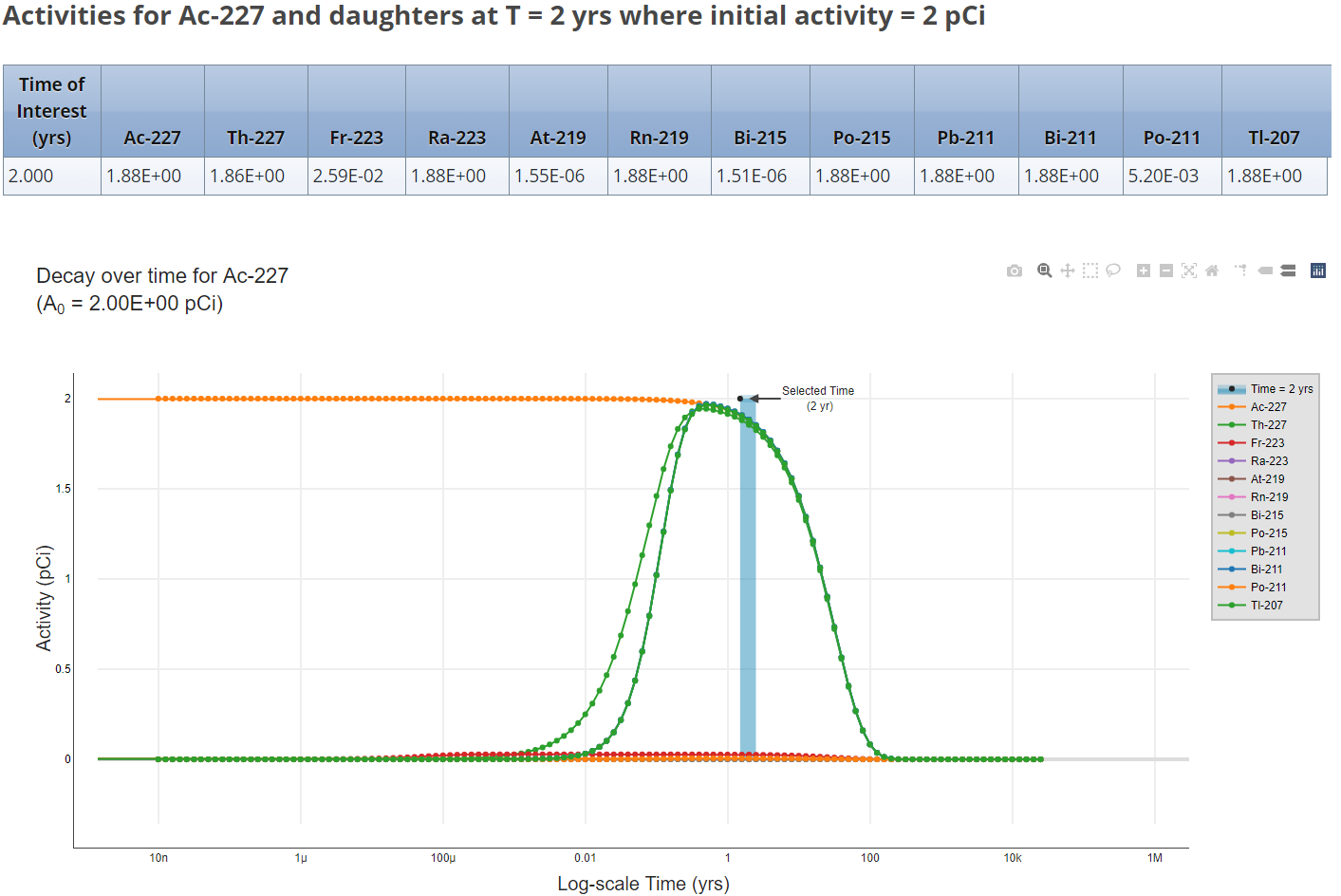
The Radionuclide Decay Chain Tool has been updated to include a decay chain table with branching fractions and decay modes. The graphic output has also been updated to give a table of the activity of each chain member at the timepoint entered by the user.
A new ecological benchmark search tool has been added that includes updated EPA Region IV benchmarks. As additional benchmark sources are updated, they will be included in this new tool.
The save file features in the chemical and radionuclide PRG and risk tools were updated to allow the user to add chemicals to existing saved runs.
December 2020
The Federal Ambient Water Quality Criteria have been updated in the ARAR tool.
November 2020
The RAIS Radionuclide Decay Chain tool was recently upgraded in conjunction with the addition of a new peak PRG output option to the EPA's Radionuclide PRG Calculator. The RAIS Radionuclide Decay Chain tool allows the user to enter a timepoint of interest and a beginning parent activity for any isotope. Upon submission the calculator returns a table with the activities of each chain member at the timepoint entered as well as an interactive graph of the state of the chain over time. The tool utilizes output derived from the CRAM methodology to calculate the activities for the user-provided initial activity and time point of interest described in this Technical Memorandum. A complete description of the peak PRG calculation process is presented in the TM.
Chemicals with new toxicity values due to ATSDR updates are:
- Molybdenum inhalation noncancer.
Chemicals with new toxicity values due to PPRTV updates are:
- 4-chlorobenzotrifluoride oral and inhalation noncancer.
- Glycidaldehyde inhalation noncancer.
- trans-1,2-dichloroethylene inhalation noncancer.
- p-phthalic acid oral noncancer.
- picric acid oral noncancer.
- vinyl bromide inhalation cancer.
- ammonium picrate oral noncancer (new chemical).
- midrange aliphatic hydrocarbon streams oral and inhalation noncancer and inhalation cancer. (The 2009 PPRTV is not new, but the toxicity values have been added to the RAIS.)
- Pentamethylphosphoramide (PMPA) oral noncancer (new chemical).
- N,N,N',N"-tetramethylphosphoramide (TMPA) oral noncancer (new chemical).
Chemicals with new toxicity values due to Cal EPA updates are:
- 4-chlorobenzotrifluoride inhalation cancer.
The chemical name glycidyl was changed to glycidaldehyde.
The naming conventions for cis and trans-1,2-dichloroethylene were slightly altered to dichloroethylene, cis-1,2- and dichloroethylene, trans-1,2-.
The "p" for "para" in p-phthalic acid was changed to a lower case.The chemical name mephos oxide was changed to tribufos.The CASRN for diquat was changed to 2764-72-9 from 85-00-7 and chemical-specific parameters were updated, accordingly.Commercial hexane was given an EPA ID of E5241997.
Midrange aliphatic hydrocarbon streams was given an EPA ID of E1790669.User's Guide sections about PCBs and Aroclors was updated to include more detailed information on the selection of toxicity values. Ammonium picrate and picric acid were given the same chemical-specific parameters because ammonium picrate dissolves very readily to picric acid.Midrange aliphatic hydrocarbon streams was given the same chemical-specific parameters as n-nonane.May 2020
Chemicals with new toxicity values due to PPRTV updates are:
- commercial hexane inhalation noncancer and cancer. (The 2009 PPRTV is not new, but the toxicity values have been added to the RAIS.)
- 2-amino-4,6-dinitrotoluene screening oral noncancer.
- 4-amino-2,6-dinitrotoluene screening oral noncancer.
Chemicals with toxicity value changes due to Cal EPA updates are:
- Chlorothalonil oral cancer was added and inhalation cancer was removed.
- Direct black 38 inhalation and oral cancer updated.
- Direct blue 6 inhalation cancer updated.
- Direct brown 95 inhalation cancer updated.
- 2-methoxy-5-nitroanaline inhalation cancer removed.
- Naphthalene oral cancer added.
- Lead acetate oral cancer and inhalation cancer updated.
- Lead subacetate oral cancer and inhalation cancer updated.
- Nickel acetate oral cancer added.
- Nickel carbonate oral cancer added.
- Nickel hydroxide oral cancer added.
- Nickelocene oral cancer added.
- Nickel carbonyl oral cancer added.
- Nickel oxide oral cancer added.
- Nickel refinery dust oral cancer added.
- Hexamethylene diisocyanate biuret inhalation noncancer (new chemical).
- Hexamethylene diisocyanate isocyanurate inhalation noncancer (new chemical).
Chemicals with toxicity changes in the ATSDR database are:
- Antimony inhalation noncancer.
Chlordane was changed to Chlordane (technical mixture), but the toxicity values have not changed.
The CAS for coke oven emissions was removed and replaced with an EPA ID.
A new CAS was given for polybrominated biphenyls.
The nonchlorinated furans (furan, dibenzofuran, and tetrahydrofuran) mistakenly applied the ABSd for chlorinated dioxins and dioxin like compounds (0.03). The ABSd was removed because the three furans in question are volatiles.
November 2019
Chemicals with new toxicity values due to PPRTV updates are:
- Nitropropane, 2- an appendix screening value inhalation unit risk was added.
- Tetrachlorotoluene, p- alpha, alpha, alpha- appendix screening values were added for oral non-cancer and oral cancer.
Xylene, P- was renamed Xylene, p-.
Hexachlorodibenzo-p-dioxin, Mixture was given the CAS 34465-46-8.
Molecular weights for Aroclors 1016, 1248, and 5460 were updated to 257.55, 291.99, and 540.3 g/mol, respectively.
The ABS values for TPH aromatic medium and high were updated to match their surrogates (0.13 for both).
The recreator incidental ingestion of surface water intake rates were updated to 0.124 L/hr and 0.0985 L/hr for the 6-16 year and 16-26 year age bins, respectively. Equations and references have been updated.
May 2019
Chemicals with new toxicity values due to PPRTV updates are:
- Hexanol, 1-,2-ethyl- (2-Ethyl-1-hexanol) oral cancer, oral non-cancer, and inhalation non-cancer values were added.
- Styrene-Acrylonitrile (SAN) Trimer (THNP isomer) oral non-cancer value was added.
- Endosulfan Sulfate oral non-cancer value was added.
- Formaldehyde has a new oral slope factor.
- Toluene-2,6-diisocyanate has a new oral slope factor.
- Toluene-2,4-diisocyanate has a new oral slope factor.
- Butadiene, 1,3- has an updated oral slope factor.
Thiophanate, Methyl oral non-cancer value from OPP was corrected to match rounded value found in OPP documentation.
Styrene-Acrylonitrile (SAN) Trimer was renamed Styrene-Acrylonitrile (SAN) Trimer (THNA isomer).
The chemical names for nitrate and nitrite have been changed to "nitrate (measured as nitrogen)" and "nitrite (measured as nitrogen)".
Users can now enter their own PEF values for all land uses.
When a site-specific groundwater-soil system temperature is entered, the calculators now give the vapor pressure at standard temperature and the vapor pressure at the user-entered temperature. See the FAQ Page for more information.
November 2018
Chemicals with toxicity changes in the PPRTV database are:
- Lanthanum was added to the database. Chronic and subchronic RfD assessments were added.
- Lanthanum Chloride, Anhydrous was added to the database. Chronic and subchronic RfD assessments were added based on the RfD for Lanthanum, after applying molecular weight adjustment and appropriate stoichiometric calculations.
- Lanthanum Chloride Heptahydrate was added to the database. Chronic and subchronic RfD assessments were added based on the RfD for Lanthanum, after applying molecular weight adjustment and appropriate stoichiometric calculations.
- Lanthanum Nitrate Hexahydrate was added to the database. Chronic and subchronic RfD assessments were added based on the RfD for Lanthanum, after applying molecular weight adjustment and appropriate stoichiometric calculations.
- Lanthanum Acetate Hydrate was added to the database. Chronic and subchronic RfD assessments were added based on the RfD for Lanthanum, after applying molecular weight adjustment and appropriate stoichiometric calculations.
Chemicals with toxicity changes in the CalEPA database are:
- Tert-butyl acetate was added with an oral slope factor and an inhalation unit risk.
- HpCDD, 1,2,3,4,6,7,8- toxicity values were dropped and replaced with TEF derived values.
- Ethylene glycol butyl ether (EGBE) acute, 8-hour, and chronic reference concentrations were updated.
Chemicals with toxicity changes in the ATSDR database are:
- Bromodichloromethane chronic reference dose is now draft.
- Bromomethane chronic reference concentration is now draft.
- Methylenediphenyl diisocyanate chronic reference concentration was added.
- Toluene diisocyanate chronic reference concentration was added.
September 2018
The oral reference dose and oral slope factor for Hexahydro-1,3,5-trinitro-1,3,5-triazine (RDX) were updated based on the new IRIS Profile.
Chemicals with subchronic toxicity changes in their PPRTV are Lutetium and Gadolinium.
Technical and weathered toxaphene were added to the PPRTV database. Where available, parameters were copied from technical to weathered toxaphene.
August, 2018
The chemical and radionuclide risk tools have a new option to display a secondary table that contains cancer risk and hazard index total percent contributions by route and by chemical for all carcinogenic and noncarcinogenic risk options.
New Lead PRG and Lead risk tools have been added that follow the EPA methodology for calculating PRGs associated with non-residential adult exposures to lead in soil. The methodology focuses on estimating fetal blood lead concentrations in women exposed to lead-contaminated soils. Based on the TRW's analysis of the data collected in the completed NHANES III survey (1999-2004), updated ranges for the baseline adult blood lead concentration (PbB) and GSDi adult parameters in the ALM have been included in the calculator. However, recent scientific evidence has demonstrated adverse health effects at blood lead concentrations below 10 µg/dL down to 5 µg/dL, and possibly below. OSRTI is developing a new soil lead policy to address this new information. Until that soil lead policy is finalized, regional risk assessors and managers should consult with the TRW's Lead Committee before applying these updated values for PRG calculation. For more information about the EPA adult lead methodology recommendations, click here.
To broaden utility of the soil to groundwater risk model, it is now provided as a media option for both resident and indoor worker scenarios for all chemical and radionuclide calculators. In addition, radio buttons have been added to the soil to groundwater site-specific inputs page that allow users to select Method 1 - Partitioning or Method 2 - Mass Limit. Only the variables that pertain to the selected method will be displayed.
May, 2018
Chemicals with toxicity changes in the OPP database are:
- cypermethrin oral chronic reference dose removed,
- bromoxynil octanoate gained an oral slope factor,
- propargite oral slope factor changed,
- pendimethalin oral chronic reference dose changed,
- flurprimidol oral chronic reference dose changed,
- chlorsulfuron oral chronic reference dose changed,
- cyromazine oral chronic reference dose changed,
- dicrotophos oral chronic reference dose changed, and
- pirimiphos, methyl oral chronic reference dose changed.
The MCL for fluoride has been assigned to fluoride, sodium fluoride, and fluorine (soluble fluoride).
Enthalpy of vaporization at the boiling point values have been added from Yaws and the hierarchy has been updated.
Updates to soil gamma shielding factors (GSFo) have been implemented in the calculator. MCNP was used to correct for high error on low energy radionuclides. The mono energetic values were rerun and interpolated for all nuclides. This corrected any non-linear regression issues. Annihilation gamma (secondary photon emission) from positron emission was included for positron emitters. The technical memorandum is still being updated, but the new GSF values can be found here.
While running the user provided option in site-specific mode for the radionuclide PRG and Risk tools, the calculators were showing duplicate records for C, H, Hg, I, Ni, Ru, S, and Te elemental isotopes. These duplicate records have been removed.
April, 2018
EPA Region 4 has released new supplemental guidance for human health and ecological risk assessment. The new ecological screening benchmarks will be added to the RAIS soon.
November, 2017
Chemicals with new toxicity values due to ATSDR updates are:
- bromopropane, 1-,
- glutaraldehyde,
- diethyl-meta-toluamide, N,N (DEET) (subchronic only), and
- nitrate and nitrite (subchronic only).
Chemicals with new toxicity values due to PPRTV updates are:
- DDD, p,p'- (DDD),
- DDE, p,p'-,
- lactonitrile,
- toluic acid, p-,
- diphenyl ether,
- methyl-2-pentanol, 4-,
- heptanal, n-,
- difluoropropane, 2,2-
- bromo-4-fluorobenzene, 1-,
- bromo-3-fluorobenzene, 1-, and
- tert-butyl formate (subchronic only).
The chemical, DDD, was renamed DDD, p,p`- (DDD).
Bromofluorobenzene, p- was renamed Bromo-4-fluorobenzene, 1-.
The dispersion constants for calculation of Q/C for PEF and VF (A, B, and C) for Casper, Wyoming were changed to 17.6482, 18.8138, and 217.039, respectively. In the Supplemental Soil Screening Guidance, Tables D-2 and D-3, as well as E-2 and E-3, contain identical ABC for every city except for Casper, Wyoming. Applying the assertion that Casper was to be the 100 percentile city for PEF and the 0 percentile city for VF, the correct ABC values were deduced.
June 2017 Updates
Benzo[a]pyrene and chemicals with associated relative potency factors were updated based on the new IRIS Profile.
Chemicals with new toxicity values due to ATSDR updates are:
- hydrogen sulfide and carbonyl sulfide (subchronic only),
- JP-5, JP-8, and Jet A Fuels (subchronic only),
- parathion (subchronic only), and
- polybrominated diphenyl ethers (PBDEs) (subchronic only).
Chemicals with new toxicity values due to PPRTV updates are:
- p-chlorobenzenesulfonic acid
- tribromophenol, 2,4,6-,
- dimethylphthalate, (subchronic only)
- guanidine nitrate, and
- phenyl isothiocyanate.
The TPH chemical property sources were updated to match their representative compounds.
The spelling of toluene-2,4-diisocyanate and toluene-2,6-diisocyanate was corrected.
Perfluorobutane Sulfonate (PFBS) was changed to Perfluorobutane sulfonic acid (PFBS). Perfluorobutanesulfonate (45187-15-3) was added with same parameters as Perfluorobutane sulfonic acid (PFBS).
January 2017 Updates
- The "Uranium Soluble Salts" PRG uses the ATSDR intermediate MRL of 2E-04 mg/kg-day instead of the IRIS oral RfD of 3E-03 mg/kg-day. This is a deviation from the typical toxicity hierarchy. " In December 2016, the EPA Office of Superfund Remediation and Technology Innovation (OSRTI) announced its determination that the ATSDR intermediate MRL generally reflects a better scientific basis for assessing the chronic health risks of soluble uranium than the RfD currently available in IRIS." The rationale for this determination is summarized in an accompanying memorandum, which recommends use of the ATSDR intermediate MRL for assessing chronic and subchronic human exposures at Superfund sites nationwide.
- New inhalation Risk and Dose Coefficients are avilable for Rn-222, Rn-220, Bi-212, Bi-214, Pb-212, Pb-214, and Po-218.
- Intake rates have been updated for recreator surface water ingestion according to Table 3.5 in the 2011 Exposure Factors Handbook .
December 2016 Updates
- IRIS updates to Ethylene Oxide have been added.
October 2016 Updates
- PPRTV updates to o-Phenylenediamine, o-Aminophenol, 1,2,3,4,5-Pentabromo-6-Chlorocyclohexane , 1,2-Dichloropropane, and 1,1,2-Trichloro-1,2,2-trifluoroethane have been added.
- IRIS has archived 51 chemical assessments for pesticides and has recommended the use of the Office of Pesticide Programs (OPP) human health risk benchmarks for pesticides (HHBPs). OPP lists 363 pesticides. All pesticides currently in the RAIS database will now use the new RfDs and slope factors in the HHPB table and pesticides not currently in the RAIS database will be added as time permits. The OPP values are tier 3 and are used in our hierarchy after PPRTV and before ATSDR. The archived IRIS values will be retained in the RAIS database for historical reference and presented in the Chemical Data Profile Tool as soon as possible.
September 2016 Updates
- The Indoor Worker water ingestion rate was updated to 1.25 L/day per OSWER Directive FAQ 13.
- IRIS updates to ammonia and trimethylbemzenes have been added.
- PPRTV updates to n-heptane, 2-mercaptobenzothiazole, rubidium, rubidium chloride, rubidium hydroxide, rubidium iodide, 3-methylphenol, N,N-dimethylaniline, and p-phenylenediamine have been added.
- A link under the guidance tab has been added that lists all the Health and Environmental Agencies of U.S. States and Territories and provides contact information.
August 2016 Updates
- The Koc values for PFOS and PFOA were updated. The values presented in the Health Advisories were presented as Koc but were actually log Koc values.
June 2016 Updates
- The Chemical Data Profile Tool provides a look into all the available toxicity values and chemical parameters that are part of the RAIS databases. The RAIS uses a source selection hierarchy to determine what values are used in our risk calculations. The hierarchies are described in the PRG and Risk Models user’s guides. Explosive limits, critical values, molar enthalpies, atmospheric (OH) rate constants, acid dissociation constants and flammability parameters were added from multiple sources. The preferred values are now highlighted and a synonym list was added.
- Chemicals with toxicity value changes due to Cal EPA updates are: Lead acetate, Toluene-2,4-diisocyanate, and Toluene-2,6-diisocyanate.
- Chemicals with new toxicity values due to PPRTV updates are: Chloronitrobenzene and p-, Benzaldehyde.
- Thallic oxide and thallium selenite RfDs were derived by MW adjustment.
- The chemical name associated with CAS 114-26-1 was changed to Phenol, 2-(1-methylethoxy)-, methylcarbamate from Propanediol, 1,2-.
- The programming of the soil to groundwater scenario was changed to allow the calculation of the SSL when H' is missing.
- The programming of the diffusivity in air (Dia) equation was changed to use the dioxin-specific equation for furans and dioxin-like PCBs. See section 4.16.4 of the PRG User's Guide.
- The hierarchy of Koc sources was modified to use the SSL first for the nine ionizable organics identified. See section 2.4.2 of the PRG User's Guide.
- Various parameters have changed for Chlordane, Hydrogen cyanide, Cyanide (CN-) and White phosphorus.
- Freezing point values from Yaws were added to the 6th position of the hierarchy.
- The radiation risk calculator was updated to only allow inhalation of gases in tap water.
- The chromium VI oral slope factor from Cal EPA Consolidated Table of OEHHA/ARB Approved Risk Assessment Health Values was updated.
March 2016 Updates
- The EPA Ecological Soil Screening Levels (Eco-SSL) for Copper were updated in the Ecological Benchmark Tool. The plant Eco-SSL values were removed for boron, fluorine, iodine, lithium, mercury, methyl mercury, molybdenum, technetium, thallium and tin. The invertebrate Eco-SSLs were removed for mercury and methyl mercury. These values were incorrectly inferred as Eco-SSLs in the SQuiRTs.
December 2015 Updates
- The EPA has released another update to the OSWER Directive concerning the use of exposure parameters from the Exposure Factors Handbook. Review the changes here. There you will find a new table and a FAQ explaining the changes. The child surface area for soil exposure and the worker surface area have been updated.
October 2015 Updates
- PPRTV values have been updated for: 2-Chlorobenzoic Acid, 1,1-Dichloropropene, 2,4,4-Trimethylpentene, Carbonyl Sulfide, Diethylene Glycol Monomethyl Ether, 1,1,1-Trifluoroethane, Picric Acid, Lewisite, 1-Chlorooctadecane, Diundecyl phthalate, Ethyl Acrylate, Triethylene Glycol, Propylene Glycol Monoethyl ether - alpha isomer, Propylene Glycol Monoethyl ether - beta isomer, Isopropanol, 2-Methylphenol, Styrene-Acrylonitrile (SAN) Trimer, 1,3-Dibromobenzene, Perfluorobutane Sulfonate, and Potassium Perfluorobutane Sulfonate.
September 2015 Updates
- MCLs for radionuclides have been updated.
June 2015 Updates
- The definition of a volatile was changed to match the EPA RSL and VISL projects. The following criteria are now used to define a chemical as volatile in the RSLs: 1) vapor pressure greater than 1 mm Hg or 2) Henry's Law constant greater than 0.00001 atm-m3/mole. There are now over 100 chemicals newly classified as volatile. Chemical-specific parameters were added to the database for use in calculating volatilization factors for the new volatiles.
April 2015 Updates
- The EPA has released an update to the OSWER Directive concerning the use of exposure parameters from the Exposure Factors Handbook. Review the changes here. There you will find a new table and a FAQ explaining the changes. The child surface area for soil exposure and the worker surface area have been updated.
October 2014 Updates
- Ecological benchmark database was updated to restore the ECO-SSLs to match the Interim Eco SSLs found here rather than the values presented on the SQuiRTs table here.
September 2014 Updates
- New slope factors have been programmed that were derived following FGR 12 and 13 using the updated isotope list from ICRP 107. Cancer slope factors (SFs) used are provided by the Center for Radiation Protection Knowledge. The main report is Calculations of Slope Factors and Dose Coefficients and the tables of slope factors are in a separate appendix.
- Source depth-specific area correction factors (ACFs) are now provided. Unique ACFS are now given for the various slope factors (ground plane, 1 cm, 5 cm, 15 cm and infinite depth). For further information on the derivation of the isotope-specific/area-specific ACF values for 2-D areas see the Center for Radiation Protection Knowledge ACF report .
- Source depth-specific gamma shielding factors (GSFs) are now given for the various slope factors (ground plane, 1 cm, 5 cm, 15 cm and infinite depth) and various soil cover depths. The Center for Radiation Protection Knowledge has provided GSFo values here.
August 2014 Updates
- The EPA has released a memo directing the use of new exposure parameters from the exposure factor handbook. The RAIS has incorporated these new parameters into the PRG and risk tools for chemicals. The radionuclide tools will be updated as soon as possible.
February 2014 Updates
- A work around for the calculation of TCE PRGs for the resident has been implemented. The results that are given in default mode of the PRG calculator now match the EPA's regional screening level (RSL) tables. Details on the new equations are presented in the PRG USer Guide section 5.13.
November 2013 Updates
- ECO mammalian SSLs were updated for cadmium, antimony , arsenic, inorganic, barium, Beryllium, chromium VI, cobalt, copper, lead, silver, vanadium, cyanide (total complex), methyl mercury, sulfide, thallium and tin.
October 2013 Updates
- The biota intake rates for the radionuclide PRG and risk tools were updated to correct an improper units conversion.
September 2013 Updates
- IRIS updates for 1,4-Dioxane and Biphenyl were completed.
- PPRTV values have been updated for Biphenyl, 3,4-Dichlorobenzotrifluoride, Trinitrophenylmethylnitramine (Tetryl), Endosulfan Sulfate, 1,1,2,2-Tetrachloroethane, Nitromethane, Dibenzothiophene, 2-Ethoxyethanol, 3,3'-Dimethoxybenzidine, Butylated hydroxytoluene, Ethyl Acetate, tert-Amyl Alcohol, 2,2-Difluoropropane, 2,6-Dinitrotoluene, Dinitrotoluene Technical grade, Diisopropyl Methylphosphonate, Toluene-2-5-diamine and compounds, 1,4-Benzenediamine-2-methyl sulfate, 2-Methylbenzene-1,4-diamine sulfate, Toluene-2,5-diamine free-base, Toluene-2,5-diamine dihydrochloride, Toluene-2,5-diamine monohydrochloride and Methylcyclohexane. Appropriate chemical-specific parameters were added.
- The download feature for the Chemical Toxicity Metadata and Ecological Screening Benchmark search tools were updated.
- The Chemical Data Profile tool was updated.
- The Ecological Screening Benchmark database was updated.
February 2013 Updates
We have recently incorporated the February 2013 update from ATSDR. It is:- The date of the final paper changed for: Tributyl Phosphate; respirable Manganese; Tricresol Phosphate (TCP); Tris(2-Butoxyethyl) phosphate (TBEP); Tris(2-chloroethyl) phosphate (TCEP); Tris(1,3-Dichloro-2-propyl) phosphate (TDCP); and Vanadium
- Draft papers were removed (and values reverted to old values or additional draft values withdrawn) since they have not been cleared for publication for the following: 2,4-DNT; 2,6-DNT; Endosulfan; and Hexachlorobenzene.
- Original values were removed and new addendum values were added for TCE.
January 2013 Updates
We have recently incorporated the January 2013 update from ATSDR. It is:- Acrylamide oral acute and intermediate values were changed from 0.02 and 0.002 to 0.1 and 0.001, respectively. Also, an oral chronic value of 0.001 was added.
- 1,3-Butadiene has been removed from the database. (There was a draft inhalation acute value from 2009).
- Cadmium values have changed from draft to final.
- Chromium III soluble particulate values have changed from draft to final.
- Chromium III insoluble particulate values have changed from draft to final.
- Chromium VI oral chronic value has changed from 0.001 to 0.0009 and all values have changed from draft to final.
- Chromium VI aerosol mist values have changed from draft to final.
- Chromium VI particulate values have changed from draft to final.
- 2,4-Dinitrotoluene values are draft as of Oct 2012. There is a new oral intermediate value proposed and the oral chronic value is changing from 0.002 to 0.001.
- 2,6-Dinitrotoluene values are draft as of Oct 2012. There is a new oral acute value proposed.
- 1,4-Dioxane inhalation intermediate, inhalation chronic, oral acute, and oral intermediate values have changed from 1, 1, 4, and 0.6 to 0.2, 0.03, 5, and 0.5, respectively. Also, all values have changed from draft to final.
- Endosulfan values are draft as of Oct 2012. There is a new oral acute value proposed and the oral chronic value is changing from 0.002 to 0.005.
- Hexachlorobenzene values are draft as of Oct 2012. The oral chronic value is changing from 0.00005 to 0.00007.
- Manganese, respirable inhalation chronic value has changed from 0.04 to 0.3 and from draft to final.
- Tributyl phosphate oral intermediate and oral chronic values have both changed from 0.02 to 0.08, and all values have changed from draft to final.
- Tricresyl phosphate (TCP) has been added to the database as a new chemical with final values for oral intermediate and oral chronic.
- Tris(2-butoxyethanol) phosphate (TBEP) oral intermediate value has changed from 0.2 to 0.09 and from draft to final.
- Tris(2-cchloroethyl) phosphate (TCEP) oral chronic value has changed from 0.3 to 0.2 and from draft to final.
- Tris(1,3-dichloro-2-propyl) phosphate (TDCP) values have changed from draft to final.
- Vanadium values have changed from draft to final.
December 2012 Updates
Two new tools were added to the bottom of the TOOLS drop down menu on the blue horizontal navigation bar. The Groundwater Transport Calculator allows the user to enter a concentration in soil of a chemical, metal or radionuclide and calculate the resulting concentration in groundwater. Many site-specific soil and aquifer parameters are required. The user can choose between a partitioning model and a mass limit model. The Air Transport Calculator allows the user to enter a soil concentration of a radionuclide or nonradionuclide and calculate an air concentration based on site-specific meteorological conditions. The user can choose between a wind-driven or mechanically-driven model.
November 2012 Updates
The following changes were made as part of the semiannual RSL updates:
- The hydrogen cyanide RfC was also assigned to cyanide. Further, the cyanide Kd was also assigned to hydrogen cyanide. This will allow for calculation of a Csat and protection of groundwater SSLs.
- Chemicals with new toxicity values due to PPRTV updates are:
- acetone cyanohydrin,
- boron trichloride
- chloroethanol, 2-,
- cyclohexene,
- diethanolamine,
- ethylene cyanohydrin,
- methacrylonitrile,
- methyl acrylate,
- octyl phthalate, di-N-,
- thallium acetate,
- thallium carbonate,
- thallium chloride,
- thallium (I) nitrate,
- thallium sulfate,
- thiocyanate,
- toluene-2,5-diamine,
- toluidine, p-,
- triacetin,
- tris(1-chloro-2-propyl)phosphate and
- zirconium.
- The RfC for mercuric chloride was replaced with the IRIS RfC for elemental mercury.
- Changes in chemical-specific parameters were also made. The most significant change was updating the hierarchy of sources for water solubility as it was discovered that some sources were more qualitative than assumed.
- Thiocyanate was reclassified as an inorganic compound to be equivalent to all the other cyanide compounds.
- Changes were also made to the parameters involved in dermal exposure to water. Our previous hierarchy used RAGS Part E before using EPI for EPD (effective predictive domain) determination and Kp (dermal permeability) values. Recently released logKows (logp) for some chemicals conflicted with those in RAGS Part E. Specifically for the RSL project, the most recent logKow were used to determine EPD status. To complete the transition the RAIS now also calculates our own FA (fraction absorbed) values.
- To calculate a Csat, the ambient state of the VOC in soil must be known. As indicated in the SSL Guidance, Csat is not calculated for a chemical that is solid at soil temperatures. To make sure this rule was being followed, the melting point database was updated and this rule was established from the SSL guidance: if melting point is less than 20 °C, chemical is a liquid; if melting point is above 20 °C, chemical is solid.
- The individual TPHs (total petroleum hydrocarbons) are now available in the pick lists.
- MCLs were added for the following:
- aldicarb,
- aldicarb sulfone and
- aldicarb sulfoxide.
- The Chronic Oral Reference Dose is now 2.0E-01 (mg/kg-day) and associated metadata have been updated.
- The Dermal Reference Dose of 1.8E-01 (mg/kg-day) was calculated from the oral RfD.
- The new Chronic Inhalation Reference Concentration (RfC) of 9.0E-03 (mg/m3) has been added. The associated toxicity metadata have also been updated.
- The Chronic Inhalation Reference Dose of 2.57E-03 (mg/kg-day) was calculated from the RfC.
- The Chronic Oral Reference Dose is now 9.0E-03 (mg/kg-day) and associated metadata have been updated.
- The Dermal Reference Dose of 7.2E-03 (mg/kg-day) was calculated from the oral RfD.
- The Oral Slope Factor is now 2.00E+00 (mg/kg-day)-1 and associated metadata has been added.
- The Dermal Slope Factor is now 2.50E+00 (mg/kg-day)-1 and was calculated from the oral slope factor.
- The Oral Unit Risk is now 6.00E-02 (mg/L)-1 and associated metadata has been added.
- The Inhalation Unit risk is now 6.0E-01 (mg/m3)-1 associated metadata has been added.
- The Inhalation Slope Factor is now 2.10E-01 (mg/kg-day)-1 and was calculated from the inhalation unit risk.
- The Chronic Inhalation Reference Concentration (RfC) is now 5.00E+00 mg/m3) based on the critical effect of developmental toxicity (skeletal variations).
- The associated toxicity metadata have also been updated.
- The Chronic Inhalation Reference Dose is now 1.43E+00 (mg/kg-day).
- The Chronic Inhalation Reference Concentration is now 6.00E+00 (mg/m3) based on the critical effect of reduced pup weights in the F1 and F2 generations.
- The Chronic Inhalation Reference Dose of 1.71E+00 (mg/kg-day) was calculated from the RfC.
- The associated toxicity metadata have also been updated.
- The Chronic Oral Reference Dose (RfD) is now 4.00E-03 mg/kg-day) based on the critical effect of lesions observed in the testes, cerebrum, cerebellum, and liver.
- The associated toxicity metadata have also been updated.
- The Dermal Reference Dose is now 2.00E-03 (mg/kg-day).
- The drinking water unit risk of 1.4E-03 (mg/L)-1was added based on hepatoadenoma and hepatocarcinoma in mice.
- The oral slope factor of 5.00E-02 (mg/kg-day)-1was added based on hepatoadenoma and hepatocarcinoma in mice.
- The associated toxicity metadata have also been updated.
- The Dermal Slope Factor is now 1.00E-01 (mg/kg-day)-1.
- The Chronic Oral Reference Dose is now 9.0E-01 (mg/kg-day) based on the critical effect of nephropathy.
- The Dermal Reference Dose is now 7.47E-01 (mg/kg-day).
- The associated toxicity metadata have also been updated.
- The Chronic Inhalation Reference Concentration (RfC) is now 2.0E-03 (mg/m3) based on the critical effect of nasal lesions of the olfactory mucosa.
- The associated toxicity metadata have also been updated.
- The Chronic Oral Reference Dose of 3.0E-03 (mg/kg-day) was withdrawn. This value remains on the RAIS and has been footnoted. When a new value is available from IRIS, it will replace the withdrawn value.
- The Chronic Oral Reference Dose (RfD) of 4.00E-02 (mg/kg-day) was added.
- The Subchronic Oral Reference Dose (RfD) of 4.00E-02 (mg/kg-day) was added.
- The Chronic Dermal Reference Dose (RfD) of 1.20E-02 (mg/kg-day) was added.
- The Subchronic Dermal Reference Dose (RfD) of 1.20E-02 (mg/kg-day) was added.
- The Chronic Inhalation Reference Concentration (RfC) of 2.0E-05 (mg/m3) has not changed but the associated toxicity metadata has been updated.
- The Chronic Oral Reference Dose is now 5.0E-04 (mg/kg-day) based on critical effects of decreased survival.
- The Dermal Reference Dose is now 4.0E-04 (mg/kg-day).
- The Chronic Inhalation Reference Concentration (RfC) of 3.0E+00 (mg/m3) has been added. The associated toxicity metadata have also been added as follows: critical effects of reduced fetal body weight.
- The Chronic Inhalation Reference Dose of 8.57E-01 (mg/kg-day) was calculated from the RfC.
- The Chronic Inhalation Reference Concentration (RfC) of 4.0E-02 (mg/m3) has been added. The associated toxicity metadata have also been added as follows: critical effects in the central nervous system, liver, and endocrine system.
- The Chronic Inhalation Reference Dose of 1.14E-02 (mg/kg-day) was calculated from the RfC.
- The Chronic Oral Reference Dose is now 3.0E-04 (mg/kg-day) based on critical effects in the liver, kidney, and developing fetus.
- The Dermal Reference Dose is now 4.5E-05 (mg/kg-day).
- The Oral Slope Factor is now 4.00E-01 (mg/kg-day)-1. No metadata is presented in the report.
- The Inhalation Slope Factor is now 4.00E-01 (mg/kg-day)-1. No metadata is presented in the report.
- The Dermal Slope Factor is now 2.67E+00 (mg/kg-day)-1.
- The Chronic Inhalation Reference Concentration (RfC) of 3.0E-02 (mg/m3) has been added. The associated toxicity metadata have also been added as follows: UF = 300; MF = 1; critical effect = decreased lymphocyte count; inhalation study confidence= medium; study reference = Rothman et. al., 1996; species = human; basis = BMCL.
- The Chronic Inhalation Reference Dose of 8.57E-03 (mg/kg-day) was calculated from the RfC.
- The Chronic Oral Reference Dose of 4.0E-03 (mg/kg-day) has been added. The associated toxicity metadata have also been added as follows: UF = 300; MF = 1; critical effect = decreased lymphocyte count; inhalation study confidence= medium; study reference = Rothman et. al., 1996; species = human; basis = BMCL.
- The Chronic Dermal Reference Dose of 3.88E-03 (mg/kg-day) was calculated from the Chronic Oral RfD.
- The Chronic Inhalation Reference Concentration (RfC) of 1.0E-01 (mg/m3) has been added. The associated toxicity metadata have also been added as follows: UF = 300; MF = 1; critical effect = impaired motor coordination (decreased rotarod performance); inhalation study confidence= medium; study reference = Korsak et. al., 1994; species = male rats; basis = NOAEL (HEC).
- The Chronic Inhalation Reference Dose of 2.86E-02 (mg/kg-day) was calculated from the RfC.
- The Chronic Oral Reference Dose is now 2.0E-01 (mg/kg-day).
- The Dermal Reference Dose is now 1.84E-01 (mg/kg-day).
- The Chronic Inhalation Reference Concentration (RfC) of 5.0E-03 (mg/m3) was added. The associated toxicity metadata have also been updated as follows: UF = 30; MF = 1; critical effect = pulmonary inflammation and histopathology; inhalation study confidence = medium; study reference = Ishinishi 1988; species = rat; basis = NOAEL (HEC).
- The Chronic Inhalation Reference Dose (RfD) of 1.43E-03 (mg/kg-day) was calculated from the RfC.
- The Chronic Inhalation Reference Concentration (RfC) of 2E-03 (mg/m3) has been added. The associated toxicity metadata have also been added as follows: UF = 1000; MF = 1; critical effect = ovarian atrophy; confidence = medium; study reference = NTP 1993; species = mouse; target organ = ovaries; basis = BMCL.
- The Inhalation Unit Risk is now 3.0E-02 (mg/m3)-1. The associated toxicity metadata have also been added as follows: inhalation study reference = US EPA 2002 and Health Canada 1998; study species = human; target organ = lymphatic and hematopoietic tissue; tumor = leukemia.
- The Inhalation slope factor is now 1.05E-01(mg/kg-day)-1.
- The EPA Cancer Classification was changed from B2, probable human carcinogen to "carcinogenic to humans by inhalation".
- The Chronic Oral Reference Dose (RfD) of 6.0E-01 (mg/kg-day) was changed to 3.0E-01 (mg/kg-day). The associated toxicity metadata have also been updated as follows: UF = 300; MF = 1; critical effect = decreased maternal weight gain; confidence = medium/high; study reference = Argus Research Laboratories 1997; species = rat; target organ = none; basis = BMDL.
- The Chronic Dermal Reference Dose (RfD) of 5.4E-01 (mg/kg-day) was changed to 2.7E-01 (mg/kg-day).
- 2,3,7,8-TCDD, TEF=1.0; new URi = 3.30E+04
- 2,3,7,8-PeCDD, TEF=0.5; new URi = 1.65E+04
- 2,3,7,8-HxCdd, TEF=0.1; new URi = 3.30E+03
- 2,3,7,8-HpCdd, TEF=0.01; new URi = 3.30E+02
- OCDD, TEF=0.001; new URi = 3.30E+01
- 2,3,7,8-TCDF, TEF=0.1; new URi = 3.30E+03
- 1,2,3,7,8-PeCDF, TEF=0.5; new URi = 1.65E+04
- 2,3,4,7,8-PeCDF, TEF=0.05; new URi = 1.65E+03
- 2,3,7,8-HxCDF, TEF=0.1; new URi = 3.30E+03
- 2,3,7,8-HpCDF, TEF=0.01; new URi = 3.30E+02
- OCDF, TEF=0.001. new URi = 3.30E+01
- The Oral Slope Factor is now 3.0 (mg/kg-day)-1.
- The Dermal Slope Factor is now 6.0 (mg/kg-day)-1.
- The Oral Unit Risk is now 9.0E-02 (mg/L)-1.
- The EPA Cancer Classification is now B2, probable human carcinogen.
- Inhalation Chronic RfC = 9.0E-02 (mg/kg-day)
- Inhalation Chronic RfD = 2.57E-02 (mg/kg-day)
- EPA Weight of Evidence Class = D
- Oral Chronic RfD = 6.0E-03 (mg/kg-day)
- Dermal Chronic RfD = 3.0E-03 (mg/kg-day)
- Inhalation Chronic RfC = 2.0E-04 (mg/kg-day)
- Inhalation Chronic RfD = 5.7E-05 (mg/kg-day)
- EPA Weight of Evidence Class = E
- Oral Chronic RfD = 4.0E-03 (mg/kg-day)
- Dermal Chronic RfD = 8.0E-04 (mg/kg-day)
- Oral Slope Factor = 7.0E-01 (mg/kd-day)-1
- Oral Unit Risk = 2.0E-02 (mg/L)-1
- Dermal Slope Factor = 3.5E+00 (mg/kd-day)-1
- GI Absorption Factor = 0.2
- Dermal Absorption Factor = 0.001
- EPA Cancer Class = B2
- Deletion of the Chloroform MCLG
- Revision of the Arsenic MCL and MCLG
- Deletion of proposed MCLS: all other manmade radionuclides, gross alpha, gross beta, natural uranium, radium 226, radium 228, strontium 90, and tritium (Note: the existing MCL for combined radium 226/228, gross alpha,gross beta, and photon radioactivity were retained by the rule making).
- Addition of the proposed radon 222 MCL
- Addition of the natural uranium MCL
- Addition of the methyl mercury water quality criteria for human health (expressed as fish tissue)
- Addition of the water quality criteria for nutrients
- Addition of the water quality criteria for the non-priority pollutants (45 substances)
- Corresponding changes/additions were also made in the appropriate footnotes.
- The oral RfD is now 3E-3 mg/kg/day.
- The dermal RfD has been added to reflect the addition of the oral RfD.
- The inhalation RfC is now 1E-1 mg/m3.
- The inhalation RfD had been added to reflect the addition of the inhalation RfC.
- The oral slope factor has been changed to 1.4 (mg/kg/day)-1.
- The dermal slope factor has been changed to reflect the change in the oral slope factor.
- The oral unit risk has been changed to 4.2E-2 (mg/L)-1.
- The inhalation unit risk has been changed to 8.8E-3 (mg/m3)-1.
- The inhalation slope factor has been changed to reflect the change in the inhalation unit risk.
- The oral RfD has been changed to 3E-2 mg/kg/day.
- The dermal RfD has been changed to reflect the change in the oral RfD.
- The oral slope factor has been changed to 1E-1 (mg/kg/day)-1.
- The dermal slope factor has been changed to reflect the change in the oral slope factor.
- The oral unit risk has been changed to 3E-3 (mg/L)-1.
- The inhalation unit risk has been changed to 4E-3 (mg/m3)-1.
- The inhalation slope factor has been changed to reflect the change in the inhalation unit risk.
- Dibenzofuran (000132-64-9)
- Dichlorobenzophenone, 4,4'- (000090-98-2)
- Methyl Mercaptan (000074-93-1)
- Thiocyanate (000463-56-9)
- Trimethylbenzene, 1,2,4- (000095-63-6)
- Trimethylbenzene, 1,3,5- (000108-67-8)
- Antimony
- Subchronic RfC=4E-4
- Subchronic RfD=2E-4
- Cadmium
- Subchronic RfC=9E-4
- Carbon Tetrachloride
- Subchronic RfC=2E-2
- Chlorine
- Chronic RfC=2E-4
- Dimethyl Hydrazine, 1,1-
- Inhalation UR=4.9E0
- Oral SF=3E0
- Ethylbenzene
- Inhalation UR=1.1E-3
- Subchronic RfC=1E0
- Subchronic RfD=1.1E-1
- Hexachlorobenzene
- Subchronic RfD=1E-4
- Methyl Hydrazine
- Inhalation UR=4.9E0
- Oral SF=3E0
- Toluene
- Subchronic RfC=9.23E-1
- Trichloroethane, 1,1,1-
- Chronic RfC=2.2E0
- Subchronic RfC=2.2E+1
- Polybrominated Biphenyls -- 059536-65-1
- Benzene, Ethylmethyl -- 025550-14-5
- Benzene, Methylpropenyl -- 000768-00-3
- ES/ER/TM35/R1, An Introductory Guide to Uncertainty Analysis in Environmental and Health Risk Assessment;
- ES/ER/TM-38, Approach and Strategy for Developing Human Health Toxicity Information for Contaminants of Concern at Sites Administered by the U.S. Department of Energy Oak Ridge Field Office Environmental Restoration Program;
- ES/ER/TM112/R2, Environmental Restoration Risk-Based Prioritization Work Package Planning and Risk Ranking Methodology, June 1995 Revision;
- ES/ER/TM-131, Radiological Criteria for Remedial Actions at Radioactively Contaminated Sites; ES/ER/TM-134, Decision Support for CERCLA Investigations: An Introduction to Decision Analysis Applications;
- ES/ER/TM-187, Criteria for Establishing De Minimis Levels of Radionuclides and Hazardous Chemicals in the Environment;
- ES/ER/TM-212, Relative Risk Ranking Evaluation for DOE Oak Ridge Operations;
- BJC/OR-80, Radiological Benchmarks for Screening Contaminants of Potential Concern for Effects on Aquatic Biota;
- BJC/OR-112, Biota-Sediment Accumulation Factors for Invertebrates: Review and Recommendations for the Oak Ridge Reservation;
- BJC/OR-1333, Empirical Models for the Uptake of Inorganic Chemicals from Soil by Plants
- Bis(2-ethylhexyl)phthalate (117-81-7)
- Barium Cyanide (542-62-1)
- Vinyl Bromide (593-60-2)
- Cadmium (7440-43-9)
- Chlorodibromoethane (73506-94-2)
- BENTAZON (25057-89-0) The Chronic Oral RfD is changed from 2.50E-03 to 3.00E-02.
- BERYLLIUM (7440-41-7) The chemical name is changed from "Beryllium" to "Beryllium and compounds". The Chronic Oral RfD is changed from 5.00E-03 to 2.00E-03. The Chronic Inhalation RfC of 2.00E-02 is added, and footnoted "a". The Chronic Dermal RfD is changed from 5.00E-05 to 2.00E-05.
- CHLORDANE (57-74-9) The Chronic Oral RfD is changed from 6.00E-05 to 5.00E-04. The Oral Slope Factor is changed from 1.30E+00 to 3.50E-01. The Oral Unit Risk is changed from 3.70E-05 to 1.00E-05. The Chronic Inhalation RfC of 7.00E-04 with the footnote "a" is added. This is mutiplied by 20/70 to get a Chronic Inhalation RfD of 2.00E-4. The Inhalation Unit Risk is changed from 3.70E-04 to 1.00E-04. The Chronic Dermal RfD is changed from 3.00E-05 to 2.50E-04. The Dermal Slope Factor is changed from 2.60E+00 to 7.00E-01.
- METHYL METHACRYLATE (80-62-6) The Chronic Oral RfD is changed from 8.00E-02 to 1.40E+00. The Chronic Inhalation RfC of 7.00E-01 with a footnote of "a" is added. This is mutiplied by 20/70 to get a Chronic Inhalation RfD of 2.00E-1.
- METHYLENEDIPHENYL ISOCYANATE, 4,4'- (101-68-8) The chemical name is changed to Methylenediphenyl Diisocyanate. The Chronic Inhalation RfC is changed from 2.00E-05 to 6.00E-04.
- POLYMERIC METHYLENE DIPHENYL DIISOCYANATE 9016-87-9 Polymeric Methylene Diphenyl Diisocyanate (PMDI) is added to the table. A Chronic Inhalation RfC of 6.00E-04 is listed and footnoted "a". The Subchronic Inhalation RfC is listed as 2.00E-05 and footnoted "b".
- ANTIMONY TRIOXIDE (1309-64-4) A Subchronic Inhalation RfC value of 2.00E-04, with the footnote "b" has been added. This corresponds to an RfD of 5.71E-05.
- ARSENIC, INORGANIC (7440-38-2) The Inhalation Slope Factor of 5.00E+01 has been withdrawn.
- BENZO[B]FLUORANTHENE (205-99-2) The footnote "e" has been removed from the Subchronic Oral RfD field.
- BORON AND BORATES ONLY (7440-42-8) The Subchronic Oral RfD value of 9.00E-02 and the Subchronic Dermal RfD value, 8.10E-02, have been withdrawn.
- CARBON DISULFIDE (75-15-0) The Subchronic Inhalation RfC has been changed from 1.00E-02 to 7.00E-01. The footnote "b" remains unchanged. As a result, the RfD has been changed from 2.86E-03 to 2.0E-01.
- CHLOROBENZENE (108-90-7) The Subchronic Oral RfD of 2.00E-01 and the Subchronic Dermal RfD value, 6.20E-02, have been withdrawn.
- DICHLOROETHANE, 1, 2- (107-06-2) The Inhalation Slope Factor of 9.10E-02 has been withdrawn.
- HYDROGEN SULFIDE (7783-06-4) The Subchronic Inhalation RfC has been changed from 9.00E-03 to 1.00E-02. The footnote "b" remains unchanged. As a result, the RfD has been changed from 2.57E-03 to 2.86E-03.
- MANGANESE (Diet) (7439-96-5) The Subchronic Oral RfD value of 1.40E-01 and the Subchronic Dermal RfD value, 5.60E-03, have been withdrawn.
- MANGANESE (Water) (7439-96-5) The Subchronic Oral RfD value of 5.00E-03 and the Subchronic Dermal RfD value, 2.00E-04, have been withdrawn.
- MERCURIC CHLORIDE (7487-94-7) The Subchronic Oral RfD has been changed from 3.00E-04 to 3.00E-03. The Subchronic Dermal RfD is changed from 2.10E-05 to 2.10E-04.
- PHOSPHINE (7803-51-2) The Subchronic Inhalation RfC has been changed from 3.00E-04 to 3.00E-03. The footnote "b" remains unchanged.
- TRICHLOROETHANE, 1,1,1- (71-55-6) The footnote "e" has been removed from the Subchronic Inhalation RfC field.
- ACTINIUM-227+D (14952-40-0)+D The External Slope Factor has been changed from 5.97E-07 to 9.30E-07.
- CALIFORNIUM-252 (13981-17-4) Californium-252 has been added to the table. The Radioactive Half-life is 2.64E+00 years. The ICRP Lung Class is Y. The GI Absorption Factor is 1.00E-03. The Ingestion Slope Factor is 1.80E-10. The Inhalation Slope Factor is 2.59E-08. The External Slope Factor is 1.79E-11.
- CERIUM-144+D (14762-78-8)+D The External Slope Factor has been changed from 1.56E-07 to 1.59E-07.
- CURIUM-243+D (15757-87-6)+D Curium-243+D has been removed.
- IRIDIUM-192 (14694-69-0) Iridium-192 has been added to the table. The Radioactive Half-life is 7.40E+01 days. The ICRP Lung Class is Y. The GI Absorption Factor is 1.00E-02. The Ingestion Slope Factor is 6.43E-12. The Inhalation Slope Factor is 1.12E-11. The External Slope Factor is 2.70E-06.
- PLUTONIUM-241+D (14119-32-5)+D Plutonium-241+D has been removed.
- PLUTONIUM-244+D (14119-34-7)+D The External Slope Factor has been changed from 3.65E-06 to 1.05E-06.
- SILVER-110m+D (14391-76-5)(m)+D Silver-110m+D has been added to the table. The Radioactive Half-life is 2.50E+02 days. The ICRP Lung Class is Y. The GI Absorption Factor is 5.00E-02. The Ingestion Slope Factor is 8.43E-12. The Inhalation Slope Factor is 3.21E-11. The External Slope Factor is 1.05E-05.
- THALLIUM-207 (CAS number not available) Thallium-207 has been added to the table. The Radioactive Half-life is 4.77E+00 minutes. The ICRP Lung Class is D. The GI Absorption Factor is 9.50E-01. The Ingestion Slope Factor is 1.07E-14. The Inhalation Slope Factor is 1.24E-14. The External Slope Factor is 8.53E-09.
- THORIUM-228+D (14274-82-9) The External Slope Factor has been changed from 9.94E-07 to 6.20E-06.
- THORIUM-229+D (15594-54-4)+D The External Slope Factor has been changed from 5.99E-07 to 7.68E-07.
- URANIUM-238+D (7440-61-1) The External Slope Factor has been changed from 5.25E-08 to 6.57E-08.
- MANGANESE (7439-96-5) The Chronic Oral RfD is changed from 4.67E-02 ot 4.6E-02. Footnote m was modified to explain the reason for this change.
- TRINITROBENZENE, 1,3,5- (99-35-4) The Chronic Oral RfD is changed from 5.00E-05 to 3.00E-02. Footnote a remains unchanged.
- Footnote m (Toxicity Values) is changed to explain the rounding of the value. It now reads, "IRIS no longer separates values for manganese chronic RfDs into water and diet RfDs. The chronic oral RfD for the total oral intake of manganese is 1.40E-01. However, when assessing exposure to manganese from drinking water or soil, IRIS recommends using a modifying factor of 3, thereby lowering the RfD to 4.67E-02, which has been rounded to 4.6E-02. Rounding to 4.7E-02 is more accurate, but makes the value less conservative. HEAST values remain separated into water and diet subchronic RfDs."
- Footnote n (Toxicity Values) is changed to correct problems with previous versions. In the previous versions, the entire sentence was scrambled by computer error. The footnote now reads, "The cancer potency of PCB mixtures is determined using a three-tiered approach that depends on the information available. Criteria for use of the High Risk and Persistence Tier include: food chain exposure; sediment or soil ingestion; dust or aerosol inhalation; dermal exposure if an absorption factor has been applied; any early-life exposure; and the presence of dioxin-like, tumor-promoting, or persistent congeners. This value, 2.00E+00 per (mg/kg)/day, is the upper-bound slope factor for the High Risk and Persistence Tier. The central-estimate slope factor for this tier is 1.00+00 per (mg/kg)/day."
- Footnote r (Toxicity Values). A typographical error was corrected, removing the letter "c" from the word "cPAH", in the phrase "...used to convert each cPAH concentration...".
- DIBROMOETHANE, 1,2- (106-93-4) The Inhalation Unit Risk of 2.20E-04 was added, with the footnote a, indicating that the value comes from IRIS. This is not a new value, it was mistakenly omitted from previous versions.
- AMMONIA (7664-41-7) Oral Chronic and Subchronic RfD values, both 34 mg/l, were added. Both values are footnoted b and y.
- Footnote c (Toxicity Values) is changed to reflect the HEAST definition for alternative methods. The new footnote reads, "These subchronic and chronic non-cancer toxicity values are found in Agency documents, but were calculated by alternative methods that are not currently practiced by the RfD/RfC Work Group. These values are considered to be adequate provisional values for risk assessment purposes at Superfund and RCRA sites, but are subject to being reviewed by the RfD/RfC Work Group and revised when necessary to reflect current work group practices."
- Footnote y (Toxicity Values) is added to the table. It reads, "This value given as concentration in drinking water. Specifically related to organoleptic threshold. Safe concentration may be higher, but data are inadequate to assess."
- The chemical-specific parameters have been updated for Methyl Mercury, Elemental Mercury, Mercury (Inorganic Salts), and Mercuric Sulfide.
- The chemical-specific parameters have been updated.
- The chemical-specific parameters have been updated.
- The chemical-specific parameters have been updated.
- The chemical-specific parameters have been updated.
- Ingestion of Fish has been added as a pathway to the residential scenario.
- Ingestion of Fish has been changed to include a concentration in fish and a concentration in water. There are new equations for both concentrations for both scenarios (recreational and residential).
- A hazard quotient of 0.1 added to the database.
- Averaging time for noncarcinogens has changed from 30x365 to EDx365.
- Subchronic RfDs have been added to the chemical-specific parameters.
- Indoor inhalation rate changed from 15 to 20 cubic meters per day for residential scenarios.
- Water ingestion rate changed from 2 liters per day to .05 liters per hour for ingestion of water in the recreational scenario and the water pathway.
- Exposure frequency changed from 75 to 45 days per year for dermal contact with water in the recreational scenario and the water pathway.
- The exposure time (ET) in hours per day and the units conversion factor CF2) in days per hour have both been removed from several equations.
- Agricultural Equations
- New back-calculated equations for vegetables added.
- New back-calculated equations for analyte concentrations in soil alone added.
- New back-calculated equations for analyte concentrations in soil and water added.
- New supporting equations for chemical concentration in vegetables and beef added.
September 2012 Updates
National Recommended Water Quality Criteria for Aquatic Life and MCLs were updated in the ARAR Search Tool.
All Tennessee ARARs were updated.
August 2012 Updates
Canadian Water Quality Guidelines for surface water for the protection of aquatic life have been updated.
May 2012 Updates
The radionuclide decay chain tool has been updated to include more recent decay information from ICRP 107.
April 2012 Updates
The IRIS oral chronic reference doses for calcium cyanide, cyanogen, potassium cyanide, potassium silver cyanide, aqueous HCN and sodium cyanide were updated. The toxicity values for these analytes are based on the "Hydrogen Cyanide and Cyanide Salts (CASRN Various)" profile which was updated in 2010.
February 2012 Updates
The toxicity values for TCDD, Tetrahydrofuran and Tetrachloroethylene have been updated in IRIS.
December 2011 Updates
The toxicity values for Methylene Chloride (Dichloromethane) from IRIS have been updated. Methylene Chloride is now a mutagen. Hexachloroethane and Trichloroacetic Acid were also added from IRIS.
Acrylamide is now treated as a mutagen.
The Vanadium Sulfate RfD was dropped from HEAST.
The RSL Website provides instructions on how to calculate PRGs for TCE for landuses involving multiple age cohorts.
October 2011 Updates
The toxicity values for TCE from IRIS have been added to the RAIS. TCE has now been classified as a mutagen. The RAIS mutagen equations only have 4 age bins yet the IRIS profile suggests 13. Also, the IRIS profile suggest that the liver, kidney and non-Hodgkin lymphoma risk be assessed separately and summed. The RAIS is not currently programmed for this level of detail. We will be watching the RSLs and will follow their lead.
The Chemical Metadata Tool was updated to follow the RAIS chemical toxicity source hierarchy. The output now includes the toxicity value and it's reference as well as all the metadata contained on the RAIS. The result of this update allows the user to run PRG and risk calculations for COPCs and then pull the metadata for the toxicity values used in the PRG and risk calculations for the COPCs. Caution: if toxicity values are changed for PRG and risk calculations in the "user-provided" mode, then the metadata will not match.
The Chemical PRG Tool and User Guide were updated to include RAGS Part E dermal exposure to water equations. This update also expanded the noncancer output to include child, adult and age-adjusted results. The site-specific option of the calculator now presents four age bins that are analogous to the mutagenic equation age bins. The 0-2 and 2-6 year age bins are combined to generate the traditional child exposure parameters and the 6-16 and 16-30 age bins are combined to generate the traditional adult exposure parameters. These age divisions are available for the resident and recretor scenarios.
The Chemical Risk Tool and User Guide were updated to include RAGS Part E dermal exposure to water equations. This update also expanded the noncancer output to include child, adult and age-adjusted results. The site-specific option of the calculator now presents four age bins that are analogous to the mutagenic equation age bins. The 0-2 and 2-6 year age bins are combined to generate the traditional child exposure parameters and the 6-16 and 16-30 age bins are combined to generate the traditional adult exposure parameters. These age divisions are available for the resident and recreator scenarios.
Both the chemical PRG and risk tools now give the user the option to select between chronic and subchronic noncancer toxicity values.
The Chemical Data Profile Tool was updated to include more metadata.
July 2011 Updates
Some Toxicity Profiles were updated to correct .html usage of special characters. (Note: this tool has been removed. See September 2023 entry.)
June 2011 Updates
The Risk Assessment Overview Diagram was updated.
The Chemical Data Profile Tool was updated.
New PPRTVswere added to the toxicity database.
November 2010 Updates
EPA Eco-SSLs are updated.October 2010 Updates
New toxicity values and metadata have been uploaded for Chloroprene (Chloro-1,3-butadiene, 2-) from IRIS .
New toxicity values and metadata have been uploaded for cis-1,2-Dichloroethylene from IRIS .
New toxicity values and metadata have been uploaded for Pentachlorophenol from IRIS .
New toxicity values and metadata have been uploaded for 1,1,2,2-Tetrachloroethane from IRIS .
New toxicity values and metadata have been uploaded for trans-1,2-Dichloroethylene from IRIS .
New toxicity values and metadata have been uploaded for Hydrogen Cyanide and Cyanide Salts from IRIS .
The RAGS Part A style toxicity profiles have been removed and replaced by a new tool that is updated automatically. The Chemical Data Profiles tool provides all the toxicity values and chemical specific parameters from every source available on the RAIS for the analyte selected. Additional chemical information such as ecological screening values and chemical metadata will be added over time.
August 2010 Updates
New toxicity values and metadata have been uploaded for 1,4-Dioxane from IRIS .
The exposure time parameter was removed from the recreator exposure to incidental ingestion of soil/sediment for the PRG and risk tools.
July 2010 Updates
Several minor changes have recently been completed.
We have consolidated all of our risk assessment guidance documents in one area and have created a document search tool.
We have created a site map to help users get a quick feel how all our tools are organized.
We have a new navigation change under our tools menu. We separated the toxicity values, metadata and parameter searches so that it is more transparent where each tool is located.
The radionuclide decay chain tool has been updated
The gamma radiation instrument response tool has a new user guide that provides more detail. Use this tool to calculate a detector reading to determine if your soil PRGs are being met during cleanup.
March 2010 Updates
IRIS has released a toxicological profile for Acrylamide. The chronic oral reference dose, chronic inhalation reference concentration, inhalation unit risk and oral slope factor have been updated as well as associated toxicity metadata.
The RAIS has added acute and chronic Ecological Benchmarks from EPA Region 4 for saltwater.
The RAIS has updated the ARAR Search Tool. Many of the footnotes are now visible.
January 2010 Updates
The RAIS has added toxicity values that are less than chronic. These include: subchronic, short-term and acute.
The RAIS has updated chemical-specific parameters for beef and milk transfer coefficients and wet and dry plant uptake factors.
Several new chemicals were added from California EPA sources.
A Radionuclide Decay Chain Tool was added.
October 2009 Updates
The RAIS was given a new style. The user list is being verified. All databases are now running on ORACLE.
The Paducah Background data was revised and new documents were added.
The RAIS Main Tutorial has been updated.
A discussion forum for all things related to risk assessment has been added. (Note: this tool has been deactivated.)
September 2009 Updates
IRIS has released a toxicological profile for Thallium and its many salts. The chronic oral reference doses have been withdrawn. These values have been retained on the RAIS and given a reference of WITHDRAWN and a special footnote given to the values for useage instructions.
IRIS has released a toxicological profile for 1,2,3-Trichloropropane. The chronic oral reference dose, chronic inhalation reference concentration and oral slope factor have been updated as well as associated toxicity metadata. 1,2,3-Trichloropropane is a mutagen.
IRIS has released a toxicological profile for Bromobenzene. The chronic and subchronic oral reference doses and the chronic and subchronic inhalation reference concentrations have been updated as well as associated toxicity metadata.
IRIS has released a toxicological profile for Cerium Oxide and Cerium Compounds. The chronic inhalation reference concentration has been updated as well as associated toxicity metadata.
IRIS has released a toxicological profile for Chlordecone (kepone). The oral slope factor and the chronic oral reference dose have been updated as well as associated toxicity metadata.
IRIS has released a toxicological profile for 2-Hexanone . The chronic inhalation reference concentration and the chronic oral reference dose have been updated as well as associated toxicity metadata.
April 2009 Updates
The half-life and lambda parameters were set to units of years. Toxicity Value Tool
March 2009 Updates
Densities were added to the Toxicity Value Tool .
Melting points, boiling points, vapor pressures and water solubilities were added for many inorganics.
February 2009 Updates
The PRG tool was modified to generate tap water noncarcinogenic PRGs based on adult exposure rather than child. Toxicity values, metadata and the RAGS Part A profile for Nitrobenzene were updated based on a new IRIS summary.
The biota intakes rates in the PRG section were updated to more accurately reflect the intent of the guidance.
A new risk modeling calculation tool for chemicals and radionuclides is now on the RAIS. This tool has new user guides and presents the chronic daily intake (CDI) equations and exposure parameters. Users should note that the new equations do not present dermal toxicity values but do present the gastrointestinal absorption factors used to modify oral values. Also note that inhalation RfDs are no longer used but are replaced with RfCs. For chemicals, inhalation slope factors are replaced with inhalation unit risks. A new feature of the risk tool is the ability to change the toxicity values that are used as well as calculate risk for a chemical that is not in our pick list. If you have any comments about these new features, please contact Fred Dolislager.
December 2008 Updates
A new PRG calculation tool for chemicals and radionuclides is now on the RAIS. This tool has a new user guide and presents the equations and exposure parameters. Users should note that the new equations do not present dermal toxicity values but do present the gastrointestinal absorption factors used to modify oral values. Also note that inhalation RfDs are no longer used but are replaced with RfCs. For chemicals, inhalation slope factors are replaced with inhalation unit risks. A new feature of the PRG tool is the ability to change the toxicity values that are used as well as calculate a PRG for a chemical that is not in our pick list. The PRG tool uses the toxicity values presented on a newly formatted Toxicity Value search tool. ATSDR and California EPA values are now included in the hierarchy. Soon, a new Risk Models page will be released using the same exposure values as the new PRG equations. Also soon to be released is a new section of the Toxicity Profiles tool that will create a real-time "RAGS Part A" format profile based on current toxicity data and chemical-specific parameters. (Note: this tool has been removed. See September 2023 entry.) If you have any comments about these new features, please contact Fred Dolislager.
The half-life of Am-242m was changed from 152 to 141 years.
May 2008 Updates
Chemical specific parameters updated for PCB 81, PCB 170, PCB 180, PCB 189, PCB 126, PCB 167, PCB 157, PCB 156, PCB 123 and PCB 114.
Mercuric Sulfide GIABS updated to 0.07 based on RAGS Part E Exhibit 4-1. Also the oral RfD has been modified to 0.0003 mg/kg-day to reflect the intent of, SRC SF 01-016a/09-25-02 "Risk Assessment Issue Paper for: Evaluation of the Provisional RfD for Mercuric Sulfide (CASRN 1344-48-5), that states the IRIS value for mercuric chloride should be protective of mercuric sulfide. Footnotes and references have been updated.
June 2007 Updates
Federal ARARs Updated.
Mercuric Sulfide GIABS updated to 0.07 based on RAGS Part E Exhibit 4-1. Also the oral RfD has been modified to 0.0003 mg/kg-day to reflect the intent of, SRC SF 01-016a/09-25-02 "Risk Assessment Issue Paper for: Evaluation of the Provisional RfD for Mercuric Sulfide (CASRN 1344-48-5), that states the IRIS value for mercuric chloride should be protective of mercuric sulfide. Footnotes and references have been updated.
September 2006 Updates
TN ARARs are updated.
EPA Eco-SSLs are updated.
May 2006 Updates
The toxicity values for chloral and chloral hydrate were reported to be combined on the RAIS and they have been separated. Appropriate chemical-specific parameters have been applied and metadata updated.
A footnote was added to p-Chlorobenzoic acid giving screening RfDs.
It is now possible to download references in the tab delimited files.
The Federal ARARs were updated. Saltwater and organoleptic values were added.
April 2006 Updates
The RAIS is now using oral slope factors for radionuclides that have been calculated for adults only. These slope factors will be used for the indoor and outdoor worker scenarios as well as the construction/excavator scenarios.
Oral reference doses were added for 4-Amino-2,6-Dinitrotoluene and 2-Amino-4,6-Dinitrotoluene. The toxicity values were taken from the EPA Region 9 PRG table as listed under the contaminant Aminodinitrotoluene with a reference of NCEA. Chemical-specific parameters were also updated.
February 2006 Updates
A new IRIS report for Phosgene CAS 75-44-5 has been released. A new chronic inhalation RfC has been released. Toxicity metadata have been updated. Chemical-specific parameters have been added.
January 2006 Updates
A new IRIS report for n-Hexane CAS 110-54-3 has been released. A new chronic inhalation RfC has been released. Toxicity metadata have been updated.
The RAIS has adopted the California EPA slope factors for Tetrachloroethylene. The oral paper can be found here and the inhalation paper can be found here.
September 2005 Updates
A new IRIS report for Toluene CAS 108-88-3 has been released. A new chronic oral RfD and inhalation RfC have been released. Toxicity metadata have been updated.
Oral toxicity values were added for Ethyl chloride from NCEA as reported in the US EPA Region 9 PRG table.
Slope Factor values were added for Methyl tertbutyl ether (MTBE) from California EPA as reported in the US EPA Region 9 PRG table.
An oral chronic RfD was added for 4-Nitrophenol from NCEA as reported in the US EPA Region 6 PRG table.
Vapor pressures were added for 9 Organics.
August 2005 Updates
Chemical-specific parameters were updated for all inorganic compounds that formerly referenced the EPI software suite. Initiated by user feedback, it was discovered that the software was not generally suitable for inorganic compound estimation and EPI's underlying experimental database was very limited. This oversight on our part can unfortunately be found in many EPA products such as SCDM, WATER8, CHEM9, etc. The parameters that were updated include: boiling point, melting point, vapor pressure, unitless Henry's Law constant, fish BCF, Koc (not applicable for inorganics), logKow, water solubility and permeability constant. Boiling point, melting point and vapor pressure were not used in any PRG or risk equations, however, the other parameters were and new calculations may be different from your previous results. A very concerted effort was made to compile a complete and defensible database. Please contact Fred Dolislager with any questions.
July 2005 Updates
An Oral RfD was added for Barium from IRIS. A Dermal RfD was also calculated. Metadata was updated.
June 2005 Updates
An Oral RfD was added for Iron from the EPA Regional tables. A Dermal RfD was also calculated.
May 2005 Updates
The RAIS Team has allowed the newly programmed risk and PRG calculators to retain the ability to calculate dermal risk from soil contact for the indoor industrial exposure route. However we have set the default surface area to be 0. This effectively removes the route from the equation to be compliant with Superfund. Should a user desire to include the dermal route, a surface area may be entered by using the "prompt for parameters" option.
March 2005 Updates
The RAIS Team has completed a total upgrade to the risk modeling calculator tool. There are new equations and new exposure parameters that reflect recent EPA guidance. After hours of diligent programming, we believe that all the bugs have been corrected. Please take the time to reread the "notes" sections where they occur. They contain many important clues to make the risk calculation process transparent. Please observe the many links that are now present in the output and the "prompt for parameters" page. When risks are returned, you can click on the column headers and you will be taken to the equation parameters page. When selecting variables in the "prompt for parameters" page you can click on the equations and be taken to the equation parameters page. The selected parameters are then returned with the risk results. What you can't "see" while using the new risk tool is that ALL the programs that make the RAIS risk calculator work are brand new. Leslie Galloway has diligently designed and structured the code in a way that makes the results visually pleasing as well as seamlessly functional. Future updates will be much simpler. With that in mind, please take the time to test and investigate all the new changes and tell us what you think. When doing multiple chemicals, the RAIS now sums the risks for you and highlights COCs. The risk totals even take into account the one-hit rule.
A new IRIS oral reference dose of 7E-04 was released for Perchlorate and Perchlorate Salts (CAS 7790-98-9). The salts include Ammonium perchlorate (CAS 7790-98-9), Lithium perchlorate (CAS 7791-03-9), Potassium perchlorate (CAS 7778-74-7) and Sodium perchlorate (CAS 7601-89-0). Metadata and chemical-specific data have also been updated.
February 2005 Updates
A newly updated ecological screening benchmark database was loaded into the RAIS. This is the same database currently in SADA ver 4.
November 2004 Updates
The RAIS Team has completed a total upgrade to the PRG calculator tool. There are new equations and new exposure parameters that reflect recent EPA guidance. After hours of diligent programming, we believe that all the bugs have been corrected. Please take the time to reread the "notes" sections where they occur. They contain many important clues to make the PRG calculation process transparent.
Please observe the many links that are now present in the output and the "prompt for parameters" page. When PRGs are returned, you can click on the column headers and you will be taken to the equation parameters page. When selecting variables in the "prompt for parameters" page you can click on the equations and be taken to the equation parameters page. The selected parameters are then returned with the PRG results.
What you can't "see" while using the new PRG tool is that ALL the programs that make the RAIS PRGs work are brand new. Leslie Galloway has diligently designed and structured the code in a way that makes the results visually pleasing as well as seamlessly functional. Future updates will be much simpler. With that in mind, please take the time to test and investigate all the new changes and tell us what you think. Similar changes will soon be made to the forward risk calculator tool.
October 2004 Updates
The RAIS has updated the subchronic oral RfD for arsenic. The previous value (5.0E-03) was withdrawn. The new value of 3.0E-04 comes from HEAST which has taken the chronic value from IRIS.
September 2004 Updates
The RAIS ABS values have been updated for those analytes found in "Risk Assessment Guidance for Superfund (RAGS), Volume I: Human Health Evaluation Manual (Part E, Supplemental Guidance for Dermal Risk Assessment) Final July 2004" Exhibit 3-4.
August 2004 Updates
The RAIS has been updated and a toolbar has been added to the top of every page for user convenience. If you have any comments or requests please contact Fred Dolislager.
The toxicity summary for Boron and Compounds has been revised, and a Toxicological Review for Boron and Compounds has been added to the IRIS Web site. The following toxicity values are to be used for Boron and Compounds:
July 2004 Updates
The toxicity summary for 1,2-Dibromoethane has been revised, and a Toxicological Review for 1,2-Dibromoethane has been added to the IRIS Web site. The following toxicity values are to be used for 1,2-Dibromoethane:
May 2004 Updates
Slope Factors (inhalation, ingestion-diet and ingestion-tap water) were added for Cm-248 and Cf-252. These are spontaneous fission isotopes and their slope factors have not yet been published in HEAST or FGR 13. These new values were obtained from the ORNL team that created FGR 13.
ARARs are now available on-line for Wisconsin and New York.
December 2003 Updates
The Oral Subchronic Reference Dose for Chromium III was changed from 1.0E+00 to 1.5E+00 mg/kg-d . According to HEAST, the chronic value was adopted as the subchronic value. The chronic value is listed on IRIS as 1.5E+00 mg/kg-d. The previous subchronic oral RfD of 1.0E+00 was an artifact of the original HEAST database. The associated dermal subchronic value is also updated.
September 2003 Updates
The toxicity summary for Methyl ethyl ketone (MEK) has been revised, and a Toxicological Review for MEK has been added to the IRIS Web site. The following toxicity values are to be used for MEK:
The toxicity summary for Cyclohexane has been revised, and a new Toxicological Review for Cyclohexane has been added to the IRIS Web site. The following toxicity values are to be used for Cyclohexane:
The toxicity summary for Dichloroacetic acid has been revised, and a Toxicological Review for Dichloroacetic acid has been added to the IRIS Web site. The following toxicity values are to be used for Dichloroacetic acid:
August 2003 Updates
The toxicity summary for Acetone has been revised, and a new Toxicological Review for Acetone has been added to the IRIS Web site. The following toxicity values are to be used for Acetone:
The toxicity summary for Hydrogen sulfide has been revised, and a Toxicological Review for Hydrogen sulfide has been added to the IRIS Web site. The following toxicity values are to be used for Hydrogen sulfide:
July 2003 Updates
The Ethylbenzene cancer toxicity values have been withdrawn by NCEA. This chemical is now being reassessed for IRIS which automatically flags further use of any provisional cancer or non-cancer assessments. However, the RAIS has retained these values and added appropriate footnotes.
Toxicity values have been added for Copper. HEAST presents a drinking water standard of 1.3 mg/L for Copper. The RAIS has converted this value into a chronic and subchronic RfD for oral and dermal exposure. The following toxicity values are to be used for Copper:
June 2003 Updates
The toxicity summary for Acrolein has been revised, and a new Toxicological Review for Acrolein has been added to the IRIS Web site. The following toxicity values are to be used for Acrolein:
The toxicity summary for Methyl isobutyl ketone (MIBK) has been revised, and a Toxicological Review for MIBK has been added to the IRIS Web site. The following toxicity values are to be used for MIBK:
May 2003 Updates
The toxicity summary for Trichloroethylene (TCE) has been revised, and a new Metadata Report for TCE has been added to the EIMS Web site. The following toxicity values are to be used for TCE:
April 2003 Updates
The toxicity summary for Benzene has been revised, and a new Toxicological Review for Benzene has been added to the IRIS Web site. The following changes have been made on the toxicity databases and toxicity profiles:
March 2003 Updates
The toxicity summary for Xylenes has been revised, and a new Toxicological Review for Xylenes has been added to the IRIS Web site. The following changes have been made on the toxicity database:
Diesel engine exhaust was added as a new Chemical on the IRIS website. The following additions have been made:
November 2002 Updates
The summary for 1,3-Butadiene has been revised, and a new Toxicological Review for 1,3-Butadiene has been added to the IRIS Web site. The following changes have been made on the toxicity database:
The summary for Phenol has been revised, and a new Toxicological Review for Phenol has been added to the IRIS Web site. The following changes have been made on the toxicity database:
The inhalation unit risk value for asbestos was changed on the RAIS to be 2.3E-04 (fiber/L)-1. Also the inhalation slope factor was changed to 8.05E-07 (fiber/kg-day)-1. These changes are a result of converting the IRIS units to RAIS standard units.
October 2002 Updates
The Chemical-specific Parameters database was updated for nearly all chemicals for their references and/or values. The references were updated to provide complete definition of the source or the process used to derive the values. In the process of updating these references, it was discovered that WATER8 was no longer supplied by the US EPA. WATER8 was a common reference for many parameters. The RAIS now uses values taken from EPA's EPI software for the following parameters: molecular weight, log octanol-water partition coefficient (log Kow or log p), dermal permeability constant (Kp), organic carbon partition coefficient (Koc), water solubility (S), fish bioconcentration factor, and Henry law constant (H').
The ARARs have been updated for: Federal, Tennessee, South Carolina, Kentucky, Ohio, Washington, and Illinois. Many contaminants were added such as fecal coliform, giardia lamblia, viruses, etc. These additions were common among all States.
1,1-Dichlorethylene tox values were updated based on a new IRIS toxicological release at http://www.epa.gov/IRIS/toxreviews/0039-tr.pdf. The non-cancer Reference Dose (RfD) was changed from 0.009 mg/kg-day to 0.05 mg/kg-day.
The excel spread sheets were also updated that contain the toxicity values.
June 2002 Updates
Estimation of Whole-Fish Contaminant Concentrations from Fish Fillet Data (ES/ER/TM-202) has been added to the Risk Assessment Guidance pages in pdf format.
May 2002 Updates
There are new Inhalation Unit Risk (URi) values on the RAIS for 2,3,7,8-TCDD and associated chemicals based on adjustment with a Toxicity Equivalent Factor (TEF). This change was necessary to correct an error in the standard unit conversions from HEAST format to RAIS format. The standard units for inhalation unit risk in HEAST are (ug/m3)-1, however the HEAST URi for 2,3,7,8-TCDD was presented in the nonstandard units of (pg/m3)-1. Below are the new toxicity values for URi, presented in (mg/m3)-1 for the RAIS:
October 2001 Updates
The summary for Quinoline has been revised, and a new Toxicological Review for Quinoline has been added to the IRIS Web site. The following changes have been made on the toxicity database:
September 2001 Updates
A new, searchable database of chemical-specific toxicity metadata contains values needed in human health toxicity assessments. This information can be used to help complete EPA RAGs Part D tables and supplement toxicity assessments. The database is accessible here.
RAGS Part A format toxicity profiles were added for the 64 chemicals currently on the RAIS. This format follows the requirements from RAGS Part A, are maintained with current toxicity information, and are designed for inclusion in the main body of a risk assessment. (Note: this tool has been removed. See September 2023 entry.)
July 2001 Updates
The summary for Chloromethane has been revised, and a new Toxicological Review for Chloromethane has been added to the IRIS Web site. The following changes have been made on the toxicity database:
The summary for Hexachlorocyclopentadiene (HCCPD) has been revised, and a new Toxicological Review for Hexachlorocyclopentadiene (HCCPD) has been added to the IRIS Web site. The following changes have been made on the toxicity database:
June 2001 Updates
Bromate (CAS 15541-45-4) has been added to IRIS. Therefore, the toxicity database has been updated with the following information:
May 2001 Updates
Water Solubility (S) was added to the chemical-specific parameters search feature.
Addresses and phone numbers were updated on the contacts pages.
For 47 chemicals, the inhalation slope factor was changed from a HEAST value to a conversion from the IRIS unit risk value, which is more current. A footnote was also added to indicate this conversion. This change occurred for the following chemicals: Acrylamide; Acrylonitrile; Aldrin; Aramite; Azobenzene; Benzene; Beryllium; Bis(2-chloroethyl)ether; Bis(chloromethyl)ether; Bromoform; Butadiene, 1,3-; Carbon Tetrachloride; Chlordane; Chloroform; Chromium VI (chromic acid mists and particulates); Coke Oven Emissions; DDT; Dibromoethane, 1,2-; Dichloroethylene, 1,1-; Dichloropropene, 1,3-; Dieldrin; Diphenylhydrazine, 1,2-; Epichlorohydrin; Formaldehyde; Heptachlor; Heptachlor Epoxide; Hexachlorobenzene; Hexachlorobutadiene; Hexachlorocyclohexane, Alpha-; Hexachlorocyclohexane, Beta-; Hexachlorocyclohexane, Technical; Hexachloroethane; Hydrazine; Hydrazine Sulfate; Nickel Refinery Dust; Nickel Subsulfide; Nitrosodiethylamine, N-; Nitrosodimethylamine, N-; Nitroso-di-N-butylamine, N-; Nitrosopyrrolidine, N-; Propylene Oxide; Tetrachloroethane, 1,1,2,2-; Toxaphene; Trichloroethane, 1,1,2; Trichlorophenol, 2,4,6; and Vinyl Chloride.
February 2001 Updates
Updated the Oral RfD for Uranium (Soluble Salts). The new value is 6.0E-4 mg/kg/day and the new Dermal RfD is 5.1E-4 mg/kg/day. Source: Federal Register, (very large file) Thursday December 7, 2000. Part II, Environmental Protection Agency. 40 CFR Parts 9, 141, and 142 - National Primary Drinking Water Regulations; Radionuclides; Final Rule. p 76713. [PDF] Also see Soil Screening Guidance for Radionuclides: User's Guide pg 1-6.
Updated files for the Federal Regulatory Standards. The following is a list of the changes/additions:
January 2001 Updates
Note to Users: There has been a new release of toxicity values for radionuclides as presented in Federal Guidance Report No. 13. Essentially, every slope factor has changed. In addition, oral values are tabulated separately for ingestion of tap water, dietary intakes (food), and incidental soil ingestion. Please consult the User's Guide section on radionuclide carcinogenicity for the derivation of radionuclide slope factors and guidance on their use. Also please note that the output of the Preliminary Remediation Goal and Human Health Exposure Modeling sections will reflect these changes in toxicity values.
Added a link to the Tools page for EPA's Soil Screening Guidance for Radionuclides.
October 2000 Updates
Chloral toxicity has been updated on IRIS. The chemical name is now "Chloral Hydrate" and the new Oral Chronic RfD is 1E-1.
Chlorine Dioxide toxicity has been updated on IRIS. The new Oral Chronic RfD is 3E-2.
Chlorite (Sodium Salt) toxicity has been updated on IRIS. The new Oral Chronic RfD is 3E-2.
Four missing references were added to the Beryllium formal toxicity profile.
September 2000 Updates
A new link to "Risk Assessment Guidance for Superfund Volume 3 Part A Process for Conducting Probabilistic Risk Assessment" (RAGS 3A) has been added to the Regulatory Guidance page.
A new link to "Region IV Supplemental Guidance to Risk Assessment Guidance for Superfund" has been added to the Regulatory Guidance page.
A sentence was added to the end of all toxicity value footnotes for Mercury compounds (Inorganic Mercury, Elemental Mercury, Mercuric Chloride, and Mercuric Sulfide) in order to ensure proper use of the toxicity value by referring the user to toxicity information regarding other forms of Mercury.
August 2000 Updates
The IRIS summary for Vinyl Chloride has been revised, and a new Toxicological Review for Vinyl Chloride has been added to the IRIS Web site. The following changes to Vinyl Chloride have been made on the RAIS:
New ecological guidance for Region IV, "Amended Guidance on Ecological Risk Assessment at Military Bases: Process Considerations, Timing of Activities, and Inclusion of Stakeholders", has been added to the Regulatory Guidance page.
"Improved Methods for Calculating Concentrations Used in Exposure Assessments", BJC/OR-416, has replaced the draft TM, ES/ER/TM-211, on the Risk Assessment Guidance page.
June 2000 Updates
Kentucky, Illinois, and South Carolina state regulations have been updated.
The IRIS summary for 1,3-Dichloropropene has been revised, and a new Toxicological Review for 1,3-Dichloropropene has been added to the IRIS Web site. The following changes to 1,3-Dichloropropene have been made on the RAIS:
April 2000 Updates
The following chemicals have been added to the RAIS with provisional toxicity values - CAS numbers are in parentheses:
Please check the toxicity database for chemical-specific provisional toxicity values and other physical properties.
The following chemicals have new provisional toxicity values:
Please check the toxicity database for other chemical-specific toxicity values for these chemicals.
The Paducah background values have been updated. See the background database for further information.
February 2000 Updates
The IRIS summary for benzene has been revised with a new oral carcinogenicity assessment. The oral unit risk is now 1.6E-3 (mg/L)-1 and the oral slope factor is now 5.5E-2 (mg/kg/day)-1.
Footnote "h" of Toxicity Footnotes has been revised to read "Value expressed as fibers/L".
The following chemicals have been assigned CAS numbers:
The inhalation slope factor for Diethylstilbesterol was withdrawn from HEAST and is now referenced with a 'w'. The withdrawn date is July 1997.
The oral reference dose for Methyl Methacrylate is now referenced as coming from IRIS.
January 2000 Updates
Incorrect Exposure Frequency (EF) units for the PRG search table output were corrected to now read "day/year".
A reference for RAGS Part B, Appendix D was added to the PRG and Human Health Risk Exposure Modeling pages.
Numerous missing/incorrect links were updated throughout the site, especially on the EPA Human Health Related Guidance page.
December 1999 Updates
New IRIS Summary and Toxicological Review for Ethylene glycol monobutyl ether (EGBE) have been added to the IRIS web site. The oral chronic reference dose is 5E-1 mg/kg/day, the dermal chronic reference dose is 2.5E-1 mg/kg/day, the inhalation chronic reference concentration is 1.3E+1 mg/m3, and the inhalation chronic reference dose is 3.71E+0 mg/kg/day. There were no supporting data for carcinogenicity at this time.
Tennessee and Ohio State Guidelines were updated to reflect recent changes.
October 1999 Updates
The ORO Risk Assessment Guidance pages were updated to remove three inactive procedures: "Verifying Calculations in Human Health and Ecological Risk Assessments", EM&EF/ER-P2009; "Requirements for Conducting Human Health and Ecological Risk Assessments", EM&EF/ER- S2010; and "Integrating Contractor Issues in Risk Assessment", ER/C-S2002.
One new procedure was added to the ORO Risk Assessment Guidance pages: "Environmental Management: Human Health and Ecological Risk Assessment", ES-A-2100.
September 1999 Updates
Additional text and links were added to the boxes in the Risk Assessment Overview Diagram.
August 1999 Updates
Description of the configuration control process was added to the top of the "Tools" page.
July 1999 Updates
Incorrect text was removed from Section 2.3 "Derivation of Dermal Toxicity Values" of "Using Toxicity Values in Risk Assessment", which is part of the "Toxicity Values" Tool page.
The html version of "Guidance for Conducting Risk Assessments and Related Risk Activities for the DOE-ORO Environmental Management Program", BJC/OR-271, is available on the Technical Memoranda lists from the "ORO Risk Assessment Guidance" page, and all human health strategy document links have been re-linked to this file.
Established Regulatory Limits for Surface Water and Groundwater for Illinois, South Carolina, and Washington and revised federal limits were added to the Federal and State Guidelines.
June 1999 Updates
The inhalation RfC for Beryllium and compounds has been changed from 2e-2 ug/m^3 to 2e-5 mg/m^3 and the inhalation RfD for Beryllium and compounds has been changed from 5.71e-3 ug/kg/day to 5.71e-6 mg/kg/day.
Html code that appears in the tab/comma delimited version of the PRG output has been removed.
May 1999 Updates
The human health strategy document "Risk Assessment Strategy at DOE-ORO," ES/ER/TM-180 has been superceded by the following document: Guidance for Conducting Risk Assessments and Related Risk Activities for the DOE-ORO Environmental Management Program, BJC/OR-271.
Pdf files for the following technical memoranda were added to "ORO Risk Assessment Guidance":
April 1999 Updates
The Established Regulatory Limits for Surface Water and Groundwater have been revised for Tennessee and Kentucky.
Rad CAS numbers were revised to enable selection of rads with "m" or "+d" on the human health risk models tool.
March 1999 Updates
Acetonitrile (75-05-8) - The Chronic Oral RFD (RFDOC) has been withdrawn from IRIS. The Chronic Inhalation Reference Concentration (RFCIC) has been changed to 6.0E-2. The Chronic Inhalation Reference Dose has been changed to 1.71E-2. The cancer class changed to 'D'.
Benzo(a)pyrene (50-32-8) - The Inhalation Unit Risk (IUR) has been corrected from 880 (g/m3) to 0.88 (mg/m3). This change affects all PAH's which derive their IUR values via a TEF.
| Compound | TEF |
|---|---|
| Benz(a)anthracene | 0.1 |
| Benzo(b)fluoranthene | 0.1 |
| Benzo(k)fluoranthene | 0.01 |
| Chrysene | 0.001 |
| Dibenz(a,h)anthracene | 1.0 |
| Indeno(1,2,3-cd)pyrene | 0.1 |
October 1998 Updates
Naphthalene (91-20-3) - The Chronic Oral RFD (RFDOC) changed to 2.0E-2 and the Chronic Inhalation Reference Concentration (RFCIC) changed to 3.0E-3. The cancer class changed to 'C'.
Benzene (71-43-2) - The Inhalation Unit Risk (IUR) changed to 7.8E-3.
September 1998 Updates
Inhalation of soil now follows EPA's soil screening guidance and separates inhalation of volatiles and inhalation of particulates.
Several new variables have been added to the Toxicity Values and Chemical-Specific Factors to accomodate the fields needed for soil inhalation. Included in this list are Inhalation Unit Risk factors.
Inhalation chronic reference dose and reference concentration added for Naphthalene (91-20-3) [RFDIC = 3.71E-04, RFCIC = 1.3E-4] and Tetrachloroethylene (127-18-4) [RFDIC = 1.71E-01, RFCIC = 6.0E-1].
Inhalation slope factor for Polycholorinated Biphenyls and all Aroclors has been changed from 2.0 to 0.4.
Ingestion and dermal chronic reference dose have been changed for the following:
| Chemical | CAS # | RFDOC | ADRFDOC |
|---|---|---|---|
| Tricholorethane, 1,1,1 | 71-55-6 | 2.0E-1 | 1.8E-1 |
| Trichloroethylene | 79-01-6 | 6.0E-3 | 9.0E-4 |
| Naphthalene | 91-20-3 | 4.0E-2 | 3.2E-2 |
| Chromium (III) | 16065-83-1 | 1.5E+0 | 7.5E-3 |
EPA Cancer class changed for several analytes.
References and footnotes changed for several analytes.
New values added for Fish BTF (bio-transfer factor).
New values added for Beef BTF (bio-transfer factor).
New values added for Milk BTF (bio-transfer factor).
New values added for KP (permeability constant).
New values added for BV Dry for pasture
New values added for BV Wet for leafy vegetables
July '97 withdrawn dates added for:
The ingestion rates used in the PRGs are now all expressed in kg/day.
July 1998 Updates
Inhalation RfDs are defined to be RfC x 20/70. A database check identified three inhalation reference doses which needed to be upddated. The following changes resulted:
| Chronic: | |
| 101-68-8 Methylenediphenyl Diisocyanate | |
| OLD Number = 5.71E-6 | NEW Number = 1.71E-4 |
| Subchronic: | |
| 74-83-9 Bromomethane | |
| OLD Number = 4.77E-2 | NEW Number = 1.4E-3 |
| 108-88-3 Toluene | |
| OLD Number = 3.20E-1 | NEW Number = 1.1E-1 |
June 1998 Updates
BERYLLIUM (7440-41-7) The oral slope factor is withdrawn pending further investigation.
May 1998 Updates
February 1998 Updates
January 1998 Update
The Risk-Based PRGs will now accept user-supplied parameters to the equations.
October/November 1997 Updates
November 1997
Added Quantitative Uncertainty Analysis of Superfund Residential Risk Pathway Models for Soil and Goundwater: White Paper Oak Ridge National Laboratory, 1996 (pdf format).
August/September 1997 Updates
Many Permeability Constants (Kp) have been added.
The halflives for Ruthenium were corrected in the the Excel spreadsheet.
CUMENE (98-82-8) The chronic oral RfD is changed from 4.00E-02 to 1.00E-01. The footnote for this value, "a", remains unchanged. The chronic inhalation RfC is changed from 9.00E-03 to 4.00E-01, and footnoted a, indicating that the new value comes from IRIS. The EPA Cancer Classification of D is added, and footnoted a, indicating that it comes from IRIS.
TRIBUTYLTIN OXIDE (56-35-9) The Chronic Oral RfD is changed from 3.00E-05 to 3.00E-04, with the footnote "a" remaining unchanged, indicating that the value comes from IRIS. An EPA Cancer Classification of D is added, footnoted "a". Note, the inhalation information added to the IRIS file indicated that data are inadequate for derivation of an inhalation RfC.