RAIS Chemical Risk Calculator User's Guide
Open All Sections | Close All Sections
1. Introduction
The purpose of this calculator is to assist Remedial Project Managers (RPMs), On Scene Coordinators (OSCs), risk assessors, and others involved in decision-making at hazardous waste sites and to determine whether levels of contamination found at the site may warrant further investigation or site cleanup or if no further investigation or action may be required.
The risk values presented on this site are chemical-specific values for individual contaminants in air, water, soil, and biota that may warrant further investigation or site cleanup.
It should be noted that the risks in this calculator are based upon human health risk and do not address potential ecological risk. Some sites in sensitive ecological settings may also need to be evaluated for potential ecological risk. EPA's guidance "Ecological Risk Assessment Guidance for Superfund: Process for Designing and Conducting Ecological Risk Assessment" contains an eight step process for using benchmarks for ecological effects in the remedy selection process. For ecological effects, use the RAIS Ecological Benchmark tool.
2. Understanding the Calculator Results
Chemical risk assessment calculations rely on several key components. Foundational knowledge of risk assessment theory, which encompasses both exposure assessment and toxicity assessment, is crucial for ensuring scientifically defensible results. This section outlines the toxicity hierarchy, details the selection of chemical-specific parameters, and explains how key exposure parameters are derived for these calculations.
2.1 General Considerations
This risk calculation portion of the risk assessment process is generally referred to as "Risk Characterization". This step incorporates the outcomes of the previous steps and calculates the risk or hazard resulting from potential exposure to chemicals via the pathways and routes of exposure determined appropriate for the source area.
The basic equations for calculating excess lifetime carcinogenic risk are:
- Oral Risk = DI × SF
- Inhalation Risk = DI × IUR
- Dermal Risk = DI × (SF/GIABS)
where:
Risk = a unitless probability of an individual developing cancer over a lifetime.
DI = daily intake [(mg/kg-day) or (µg/m3)]. DI can be either chronic (CDI) or subchronic (SDI).
SF = slope factor [(mg/kg-day)-1].
IUR = inhalation unit risk factor [(µg/m3)-1].
GIABS = Gastro-Intestinal Absorption Factor, which is chemical specific and unitless.The basic equations for calculating systemic toxicity (i.e., non-carcinogenic hazard) are:
- Oral HQ = DI/RfD
- Inhalation HQ = DI/RfC
- Dermal HQ = DI/(RfD × GIABS)
where:
HQ = Hazard Quotient or the ratio of exposure to the estimated daily exposure level at which no adverse health effects are likely to occur.
DI = daily intake for the toxicant [(mg/kg-day) or (mg/m3)]. DI can be either chronic (CDI) or subchronic (SDI).
RfD = oral reference dose for the toxicant (mg/kg-day).
RfC = inhalation reference concentration for the toxicant (mg/m3).
GIABS = Gastro-Intestinal Absorption Factor, which is chemical specific and unitlessThe risk results are color coded to identify risk ranges and potential contaminants of concern. The colors and the associated risk ranges are presented in the tables below.
Hazard Index or Quotient Hazard Range HQ or HI < 0.1 HQ or HI > 0.1 HQ or HI > 1 Color Code No shading Purple Blue
Excess Lifetime Cancer Risk Risk Range Risk < 0.000001 Risk > 0.000001 Risk > 0.0001 Risk > 0.01 Color Code No shading Orange Red Black 2.1.1 One-Hit Rule
The linear risk equations, listed above, are valid only at low risk levels (below estimated risks of 0.01). For sites where chemical exposure might be high (estimated risks above 0.01), the one-hit equation, which is consistent with the linear low-dose model, should be used instead (RAGS, part A, ch. 8). In the following instances, the RAIS uses the one-hit rule independently in the risk output tables:
Risk from a single exposure route for a single chemical. Summation of single chemical risk (without one-hit rule applied to single radionuclide results) for multiple exposure routes (right of each row). Summation of risk (without one-hit rule applied to single chemical results) from a single exposure route for multiple chemicals (bottom of each column). Summation of total risk (without one-hit rule applied to single chemical results or summations listed above) from multiple chemicals across multiple exposure routes (bottom right hand cell). 2.2 Exposure Assumptions
Risk calculations are based on default exposure parameters and factors that represent Reasonable Maximum Exposure (RME) conditions for long-term/chronic exposures and on the methods outlined in EPA's Risk Assessment Guidance for Superfund, Part B Manual (1991) and Soil Screening Guidance documents (1996 and 2002). Additonally, the Exposure Factors Handbook is consulted, and OSWER has released Directive 9200.1-120 and accompanying FAQ to clarify common exposure parameter derivation.
Site-specific information may warrant modifying the default parameters in the equations and calculating site-specific daily intakes (DIs). In completing such calculations, the user should answer some fundamental questions about the site. For example, information is needed on the contaminants detected at the site, the land use, impacted media, and the likely pathways for human exposure.
A discussion of any site-specific assumptions used in the DI calculations should be included in the decision document for a site.
2.2.1 Fish Consumption Rate Derivation
This calculator derives DIs for fish tissue and surface water using consumption rates from the EPA's Preliminary Remediation Goals for Radionuclides at Superfund Sites website. That site has derived fish consumption intake rates for children and adults using data from the EPA's Exposure Factors Handbook and applied time-weighted averages. For the fish consumption DIs, the fresh weight intakes are calculated in the same manner for the mean, 50th percentile, and 95th percentile.
Chapters 10 and 13 of the Exposures Factors Handbook present fish consumption data on a per capita basis and a consumer only basis, respectively. This spreadsheet presents the derivation of the mean, 50th percentile, and 95th percentile values of the fish intake rate (IRFI). When data for a specific age group was missing, the mean value was substituted. Also when data for consumer only age ranges were missing, data was taken from the per capita calculations. The default fish consumption rates used in this calculator are based on the 95th percentile. These intake rates are presented in the table below.
Fish Intake Rates (Fresh Weight) Child (g/day) 50% Mean 95% 6.1 36.1 84.2 Adult (g/day) 50% Mean 95% 34.1 156.7 424.6 2.3 Toxicity Values
In 2003, EPA's Superfund program revised its hierarchy of human health toxicity values, providing three tiers of toxicity values in a memo (pdf). Three tier 3 sources were identified in that guidance, but it was acknowledged that additional tier 3 sources may exist. The 2003 guidance did not attempt to rank or put the identified tier 3 sources into a hierarchy of their own. However, when developing the screening tables and calculator presented on this website, the RAIS needed to establish a hierarchy among the tier 3 sources. The toxicity values used as “defaults” in the calculator are consistent with the 2003 guidance. Carcinogenic, chronic, and subchronic toxicity values from the following sources, in the order in which they are presented below, are used as the defaults in the RAIS calculators.
EPA's Integrated Risk Information System (IRIS).
Provisional Peer Reviewed Toxicity Values (PPRTVs) derived by EPA's Superfund Health Risk Technical Support Center (STSC) for the EPA Superfund program. PPRTVs are archived (removed) if an IRIS profile releases a new value or determines that a toxicity value could not be derived. PPRTVs will retain subchronic values if IRIS releases a profile without subchronic values.
Human Health Benchmarks for Pesticides (HHBPs) derived by EPA's Office of Pesticide Programs (OPP). In 2016, IRIS archived 51 chemical assessments for pesticides. To see the 51 in IRIS, filter the chemicals under the archive tab by 07/15/2016. IRIS has instead recommended the use of the RfD values presented in the HHBP table. In 2016, OPP listed 363 pesticides in the HHBP table. If applicable, food quality protection act (FQPA) safety factors were applied to the population adjusted doses to derive more protective RfDs. All HHBPs are available on the RAIS.
Agency for Toxic Substances and Disease Registry (ATSDR) minimal risk levels (MRLs). An MRL is an estimate of the daily human exposure to a hazardous substance that is likely to be without appreciable risk of adverse non-cancer health effects over a specified duration of exposure. These substance-specific estimates, which are intended to serve as screening levels, are used by ATSDR health assessors and other responders to identify contaminants and potential health effects that may be of concern at hazardous waste sites. ATSDR provides both 'Final' and 'Draft' values, both of which are utilized in the RAIS. ATSDR's draft values have undergone external peer review and meet the criteria for inclusion in the RAIS hierarchy. Unique references are provided in the calculator output. The intermediate MRLs are treated as subchronic values in the hierarchy.
The EPA's Office of Water occasionally derives toxicity values presented in Health Advisories or Human Health Toxicity Assessments for special case chemicals.
The WHO toxicity equivalent factors for dioxins, furans, and dioxin-like PCBs. See User's Guide Section 2.3.5 for details.
California Environmental Protection Agency Office of Environmental Health Hazard Assessment (OEHHA) provides toxicity values for the State of California. The OEHHA Toxicity Criteria Database website should be monitored for any updates to the toxicity values. Historically, values from this source came from OEHHA's Chronic Reference Exposure Levels (RELS) and the Cancer Potency Values (July 21, 2009, with updates in 2011 for dioxin/furans and dioxin-like PCBs and in 2020). In July 2014, additional cancer and noncancer toxicity values were provided in the Consolidated Table of OEHHA/ARB Approved Risk Assessment Health Values. The last table update occurred in September 2025, and a copy of the table can be found here.
PPRTV Appendix Screening values. Fall 2009, screening toxicity values in certain PPRTV assessment appendices were added. While there is less confidence in a screening toxicity value than in a PPRTV, these are more recent than HEAST toxicity values, use current EPA methodologies in the derivation, and receive external peer review. To alert users when these values are used, the key presents an "X" (for Appendix) rather than a "P" (for PPRTV). The following is taken from a PPRTV appendix and states the intended usage of appendix screening levels.
"However, information is available for this chemical, which although insufficient to support derivation of a provisional toxicity value, under current guidelines, may be of limited use to risk assessors. In such cases, the Superfund Health Risk Technical Support Center summarizes available information in an appendix and develops a "screening value." Appendices receive the same level of internal and external scientific peer review as the PPRTV documents to ensure their appropriateness within the limitations detailed in the document. Users of screening toxicity values in an appendix to a PPRTV assessment should understand that there is considerably more uncertainty associated with the derivation of an appendix screening toxicity value than for a value presented in the body of the assessment. Questions or concerns about the appropriate use of screening values should be directed to the Superfund Health Risk Technical Support Center".
EPA's Health and Environmental Risk Assessment (HERA) program has posted the final Office of Research and Development (ORD) Human Health Toxicity Values for Perfluoropropanoic Acid (PFPrA), Lithium bis[(trifluoromethyl)sulfonyl]azanide, and Bis(trifluoromethylsulfonyl)amine (TSFI). . These toxicity assessments provide actionable science to inform EPA decision contexts and were developed in response to a request for site-specific technical support. Please see U.S. EPA. ORD Human Health Toxicity Value for Perfluoropropanoic Acid and U.S. EPA. ORD Human Health Toxicity Value for Lithium bis [(trifluoromethyl)sulfonyl]azanide for more information.
The 11th Cycle of Groundwater Standards Proposals from the State of Wisconsin Department of Health Services includes recommended standards for 4 PFAS chemicals (Perfluoroundecanoic acid ( PFUDA), Perfluorododecanoic acid (PFDoDA), Perfluorotetradecanoic acid (PFTetDA), and Perfluorooctadecanoic (PFODA)) as well as other chemicals. The EPA Office of Land and Emergency Management's (OLEM) Human Health Regional Risk Assessment Forum's (OHHRRAF) Toxicity Workgroup recommends using these values because toxicity values from the other sources do not exist. While reference values from Wisconsin have not been used before, the toxicity information was determined by the OHHRRAF's Toxicity Workgroup to be based on similar methods and procedures as those used for other Tier 3 values.
The Health Effects Assessment Summary Tables (HEAST) is a database of human health toxicity values developed for the EPA Superfund and Resource Conservation and Recovery Act (RCRA) hazardous waste programs. Until the early to mid-1990s, HEAST was updated on a regular basis and was known as the Quarterly, reflecting its publication by EPA four times per year. The RAIS provides the values from HEAST that were removed (Archived) by more current PPRTVs. These values are retained for historical reference because PPRTVs used to only have a 5 year shelf-life.
Values that are withdrawn from IRIS, archived from a PPRTV, withdrawn from ATSDR, archived from a PPRTV screening value, or archived from HEAST are included in the RAIS. Note that many archived values are no longer present on the source websites.
When using toxicity values other than tier 1 (IRIS), users are encouraged to carefully review the basis for the value and to document its use in decision documentation for a site.
2.3.1 Reference Doses
The EPA toxicity assessments used in the RAIS (IRIS and PPRTVs) define a reference dose, or RfD, as an estimate (with uncertainty spanning perhaps an order of magnitude) of a daily oral exposure to the human population (including sensitive subgroups) that is likely to be without an appreciable risk of deleterious effects during a lifetime. It can be derived from a NOAEL, LOAEL, benchmark dose, or using categorical regression, with uncertainty factors generally applied to reflect limitations of the data used. RfDs are generally the toxicity value used most often in evaluating Noncarcinogenic health effects at Superfund sites. Various types of RfDs are available depending on the exposure route (oral or inhalation), the critical effect (developmental or other), and the length of exposure being evaluated (chronic or subchronic). Some of the risks in this calculator also use Agency for Toxic Substances and Disease Registry (ATSDR) chronic oral minimal risk levels (MRLs) as oral chronic RfDs. Screening toxicity values in an appendix to certain PPRTV assessments were added to the hierarchy in the fall of 2009. For HEAST RfDs, risks were based upon older EPA toxicity methodologies rather than the more recent benchmark dose or categorical regression methodologies. Oral reference doses are expressed in units of (mg/kg-day).
2.3.1.1 Chronic Oral Reference Doses
Chronic oral RfDs are specifically developed to be protective for long-term exposure to a compound. As a guideline for Superfund program risk assessments, chronic oral RfDs generally should be used to evaluate the potential non-carcinogenic effects associated with exposure periods greater than 7 years (approximately 10 percent of a human lifetime). However, this is not a bright line. Note, that ATSDR defines chronic exposure as greater than 1 year for use of their values. The calculator requires the user to select between chronic and subchronic toxicity values.
2.3.1.2 Subchronic Oral Reference Doses
Subchronic oral RfDs are specifically developed to be protective for short-term exposure to a compound. As a guideline for Superfund program risk assessments, subchronic oral RfDs should generally be used to evaluate the potential non-carcinogenic effects of exposure periods between two weeks and seven years. However, this is not a bright line. Note, that ATSDR defines subchronic exposure as less than 1 year for use of their values. The calculator requires the user to select between chronic and subchronic toxicity values.
2.3.2 Reference Concentrations
The EPA toxicity assessments used in the RAIS (IRIS and PPRTV assessments) define a reference concentration (RfC) as an estimate (with uncertainty spanning perhaps an order of magnitude) of a continuous inhalation exposure to the human population (including sensitive subgroups) that is likely to be without an appreciable risk of deleterious effects during a lifetime. It can be derived from a NOAEL, LOAEL, benchmark concentration, or using categorical regression, with uncertainty factors generally applied to reflect limitations of the data used. Various types of RfCs are available depending on the exposure route (oral or inhalation), the critical effect (developmental or other), and the length of exposure being evaluated (chronic or subchronic). Additionally, ATSDR chronic inhalation MRLs are used as chronic RfCs, intermediate inhalation MRLs as subchronic RfCs, and California Environmental Protection Agency (chronic) Reference Exposure Levels (RELs) as chronic RfCs.
2.3.2.1 Chronic Inhalation Reference Concentrations
The chronic inhalation reference concentration is generally used for continuous or near continuous inhalation exposures that occur for 7 years or more. However, this is not a bright line; ATSDR chronic MRLs are based on exposures longer than 1 year. EPA chronic inhalation reference concentrations are expressed in units of mg/m3. Cal EPA RELs are presented in ug/m3 and have been converted to mg/m3. Some ATSDR inhalation MRLs are derived in parts per million (ppm) (and converted) and some in mg/m3. The calculator requires the user to select between chronic and subchronic toxicity values.
2.3.2.2 Subchronic Inhalation Reference Concentrations
The subchronic inhalation reference concentration is generally used for exposures that are between 2 weeks and 7 years. However, this is not a bright line; ATSDR subchronic MRLs are based on exposures less than 1 year. EPA subchronic inhalation reference concentrations are expressed in units of mg/m3. Cal EPA RELs are presented in ug/m3 and have been converted to mg/m3. Some ATSDR intermediate inhalation MRLs are derived in parts per million (ppm) (and converted) and some in mg/m3. The calculator requires the user to select between chronic and subchronic toxicity values.
2.3.3 Slope Factors
A slope factor and the accompanying weight-of-evidence determination are the toxicity data most commonly used to evaluate potential human carcinogenic risks. Generally, the slope factor is a plausible upper-bound estimate of the probability of a response per unit intake of a chemical over a lifetime. The slope factor is used in risk assessments to estimate an upper-bound lifetime probability of an individual developing cancer as a result of exposure to a particular level of a potential carcinogen. Slope factors should always be accompanied by the weight-of-evidence classification to indicate the strength of the evidence that the agent is a human carcinogen.
Oral slope factors are toxicity values for evaluating the probability of an individual developing cancer from oral exposure to contaminant levels over a lifetime. Oral slope factors are expressed in units of (mg/kg-day)-1. When available, oral slope factors from EPA's IRIS or PPRTV assessments are used. The ATSDR does not derive carcinogenic toxicity values (e.g., slope factors or inhalation unit risks). Some oral slope factors used in the RAIS were derived by the California Environmental Protection Agency, whose methodologies are quite similar to those used by EPA's IRIS and PPRTV assessments. Screening toxicity values in an appendix to certain PPRTV assessments were added to the hierarchy in the fall of 2009. When oral slope factors are not available in IRIS, then PPRTVs, Cal EPA assessments, PPRTV appendices, or values from HEAST are used.
2.3.4 Inhalation Unit Risk
The IUR is defined as the upper-bound excess lifetime carcinogenic risk estimated to result from continuous exposure to an agent at a concentration of 1 µg/m3 in air. Inhalation unit risk toxicity values are expressed in units of (µg/m3)-1.
When available, inhalation unit risk values from EPA's IRIS or PPRTV assessments are used. The ATSDR does not derive carcinogenic toxicity values (e.g., slope factors or inhalation unit risks). Some inhalation unit risk values used in the RAIS were derived by the California Environmental Protection Agency, whose methodologies are quite similar to those used by EPA's IRIS and PPRTV assessments. Screening toxicity values in an appendix to certain PPRTV assessments were added to the hierarchy in the fall of 2009. When inhalation unit risk values are not available in IRIS, then PPRTVs, Cal EPA assessments, PPRTV appendices, or values from HEAST are used.
2.3.5 Toxicity Equivalence Factors
Some chemicals are members of the same family and exhibit similar toxicological properties; however, they differ in the degree of toxicity. Therefore, a toxicity equivalence factor (TEF) must first be applied to adjust the measured concentration to a toxicity equivalent concentration.
The following table contains the various dioxin-like toxicity equivalency factors for Dioxins, Furans, and dioxin-like PCBs (Van den Berg et al. 2006), which are the World Health Organization 2005 values. These TEFs are also presented in the May 2013 fact sheet, Use of Dioxin TEFs in Calculating Dioxin TEQs at CERCLA and RCRA Sites, which references the 2010 EPA report, Recommended Toxicity Equivalence Factors (TEFs) for Human Health Risk Assessments of 2,3,7,8Tetrachlorodibenzo-p-dioxin and Dioxin-Like Compounds
Dioxin Toxicity Equivalence Factors
CAS
Dioxins and Furans
TEF
Chlorinated dibenzo-p-dioxins
1746-01-6 1 40321-76-4 1 39227-28-6 0.1 57653-85-7 0.1 19408-74-3 0.1 35822-46-9 0.01 3268-87-9 0.0003 Chlorinated dibenzofurans
51207-31-9 0.1 57117-41-6 0.03 57117-31-4 0.3 70648-26-9 0.1 57117-44-9 0.1 72918-21-9 0.1 60851-34-5 0.1 67562-39-4 0.01 55673-89-7 0.01 39001-02-0 0.0003 PCBs
IUPAC No. Structure Non-ortho 32598-13-3 77 3,3',4,4'-TetraCB 0.0001 70362-50-4 81 3,4,4',5-TetraCB 0.0003 57465-28-8 126 3,3',4,4',5-PeCB 0.1 32774-16-6 169 3,3',4,4',5,5'-HxCB 0.03 Mono-ortho 32598-14-4 105 2,3,3',4,4'-PeCB 0.00003 74472-37-0 114 2,3,4,4',5-PeCB 0.00003 31508-00-6 118 2,3',4,4',5-PeCB 0.00003 65510-44-3 123 2',3,4,4',5-PeCB 0.00003 38380-08-4 156 2,3,3',4,4',5-HxCB 0.00003 69782-90-7 157 2,3,3',4,4',5'-HxCB 0.00003 52663-72-6 167 2,3',4,4',5,5'-HxCB 0.00003 39635-31-9 189 2,3,3',4,4',5,5'-HpCB 0.00003 Di-ortho* 35065-30-6 170 2,2',3,3',4,4',5-HpCB 0.0001 35065-29-3 180 2,2',3,4,4',5,5'-HpCB 0.00001 * Di-ortho values come from Ahlborg, U.G., et al. (1994), which are the WHO 1994 values from Toxic equivalency factors for dioxin-like PCBs: Report on WHO-ECEH and IPCS consultation, December 1993 Chemosphere, Volume 28, Issue 6, March 1994, Pages 1049-1067.
2.3.6 Relative Potency Factors (RPFs)
Some chemicals are members of the same family and exhibit similar toxicological properties; however, they differ in the degree of toxicity. Therefore, a relative potency factor (RPF) must first be applied to adjust the oral slope factor or inhalation unit risk based on the relative potency to the primary compound.
Carcinogenic polycyclic aromatic hydrocarbons
Provisional Guidance for Quantitative Risk Assessment of Polycyclic Aromatic Hydrocarbons (EPA/600/R-93/089, July 1993) recommends that a RPF be used to convert concentrations of carcinogenic polycyclic aromatic hydrocarbons (cPAHs) to equivalent concentrations of benzo(a)pyrene when assessing the cancer risks posed by these substances from oral exposures. These RPFs are based on the potency of each compound relative to that of benzo(a)pyrene. For the toxicity value database, these RPFs have been applied to the toxicity values. Although this is not in complete agreement with the direction in the aforementioned documents, this approach was used so that toxicity values could be generated for each cPAH. Additionally, it should be noted that computationally it makes little difference whether the RPFs are applied to the concentrations of cPAHs found in environmental samples or to the toxicity values, as long as the RPFs are not applied to both. However, if the adjusted toxicity values are used, the user will need to sum the risks from all cPAHs as part of the risk assessment to derive a total risk from all cPAHs. A total risk from all cPAHs is what is derived when the RPFs are applied to the environmental concentrations of cPAHs and not to the toxicity values. These RPFs are not needed, and should not be used with the Cal EPA toxicity values nor should they be used when calculating non-cancer risk. See FAQ no. 42.
The IRIS Profile gives the following instructions for RPF application:
"It (BaP) also serves as an index chemical for deriving relative potency factors to estimate the carcinogenicity of other PAH congeners, such as in EPA's Relative Potency Factor approach for the assessment of the carcinogenicity of PAHs (U.S. EPA, 1993)."
and
"The inhalation unit risk for benzo[a]pyrene is derived with the intention that it will be paired with EPA's relative potency factors for the assessment of the carcinogenicity of PAH mixtures. In addition, regarding the assessment of early life exposures, because cancer risk values calculated for benzo[a]pyrene were derived from adult animal exposures, and because benzo[a]pyrene carcinogenicity occurs via a mutagenic mode of action, exposures that occur during development should include the application of ADAFs (see Section 2.5)."
The following table presents the RPFs for cPAHs recommended in Provisional Guidance for Quantitative Risk Assessment of Polycyclic Aromatic Hydrocarbons.
Relative Potency Factors for Carcinogenic Polycyclic Aromatic Hydrocarbons
CAS
PAH
RPF
50-32-8 Benzo(a)pyrene 1.0 56-55-3 Benz(a)anthracene 0.1 205-99-2 Benzo(b)fluoranthene 0.1 207-08-9 Benzo(k)fluoranthene 0.01 218-01-9 Chrysene 0.001 53-70-3 Dibenz(a,h)anthracene 1.0 193-39-5 Indeno(1,2,3-c,d)pyrene 0.1 2.4 Chemical-specific Parameters
Several chemical-specific parameters are needed to calculate DI. The hierarchies are generally applicable for organic and inorganic compounds.
2.4.1 Sources
Many sources are used to populate the database of chemical-specific parameters. Major sources are curated as individual data tables and designated by the name of the source (i.e.; PHYSPROP, EPI, CRC, etc.). Minor sources are curated together in an individual data table designated as "Other". The sources are briefly described below.
The major sources are:
- The Physical Properties Database (PHYSPROP) was developed by Syracuse Research Corporation (SRC). The PhysProp database contains chemical structures, names, and physical properties for over 41,000 chemicals. Physical properties collected from a wide variety of sources include experimental, extrapolated, and estimated values. PHYSPROP is currently bundled with EPA's EPI Suite; however, the RAIS data was taken from SRC's standalone database prior to its removal.
- The Estimation Programs Interface (EPI SuiteTM) was developed by the US Environmental Protection Agency's Office of Pollution Prevention and Toxics and SRC. These programs estimate various chemical-specific properties. The risk calculations use the experimental values for a property over the estimated values.
- CRC Handbook of Chemistry and Physics. (Various Editions) Subscription may be required.
- Perry's Chemical Engineers' Handbook (Various Editions).McGraw-Hill. Online version available here. Green, Don W.; Perry, Robert H. (2008). Subscription may be required.
- Lange's Handbook of Chemistry (Various Editions). Online version available here. Speight, James G. (2005). McGraw-Hill. Subscription may be required.
- Yaws' Handbook of Thermodynamic and Physical Properties of Chemical Compounds. Knovel, 2003. Subscription may be required.
- EPA Supplemental Guidance for Developing Soil Screening Levels for Superfund Sites (SSL) - Table C-1: Chemical-Specific Properties used in SSL Calculations and Table C-4: Metal Kd Values (L/kg) as a Function of pH.
- Summary of Physical/Chemical and Environmental Parameters for PFAS : Subject to Interim Special Order by Consent No. 20-086-CWP/AP/GW/HW/DW/SW, paragraph 37(J)(3). Environmental Studies Report E21-0037. 3M, 2021. Sulfonated Perfluorochemicals in the Environment: Sources, Dispersion, Fate and Effects from March 2000 is also used.
- U.S. EPA 2004. Risk Assessment Guidance for Superfund Volume I: Human Health Evaluation Manual (Part E, Supplemental Guidance for Dermal Risk Assessment) Final. OSWER 9285.7-02EP. July 2004. Document and website.
- U.S. EPA 2015 Technical Guide for Assessing and Mitigating the Vapor Intrusion Pathway from Subsurface Vapor Sources to Indoor Air. OSWER Publication 9200.2-154.
- IAEA TRS 472 (IAEA). Handbook of Parameter Values for the Prediction of Radionuclide Transfer in Terrestrial and Freshwater Environments. Technical Reports Series No. 472. International Atomic Energy Agency, Vienna. 2010. (IAEA TRS 364. Handbook of Parameter Values for the Prediction of Radionuclide Transfer in Temperate Environments (Technical Reports Series No. 364), 1994 was used to supplement egg, poultry, and swine transfer factors.) Spreadsheet of values.
- NCRP 123 (NCRP). NCRP Report No. 123, Screening Models for Releases of Radionuclides to the Atmosphere, Surface Water, and Ground. National Council on Radiation Protection and Measurements. January 22, 1996. Spreadsheet of values.
- BAES. A Review and Analysis of Parameters for Assessing Transport of Environmentally Released Radionuclides through Agriculture. C. F. Baes III, R. D. Sharp, A. L. Sjoreen, R.W. Shor. Oak Ridge National Laboratory 1984. Spreadsheet of values.
Some of the more commonly used minor sources are:
- The PubChem website published by the National Center for Biotechnology Information, U.S. National Library of Medicine, 8600 Rockville Pike, Bethesda, MD20894, USA.
- The Hazardous Substance Data Bank (HSDB) website published by the U.S. National Library of Medicine, 8600 Rockville Pike, Bethesda, MD 20894. National Institutes of Health, Health & Human Services.
- CompTox Chemicals Dashboard website published by the United States Environmental Protection Agency.
- The Agency for Toxic Substances & Disease Registry (ATSDR) Toxicological Profiles. Agency for Toxic Substances and Disease Registry, 4770 Buford Hwy NE, Atlanta, GA 30341.
- NIOSH Pocket Guide to Chemical Hazards (NPG), NIOSH Publication No. 97-140, February 2004.
- WATER9 Version 2.0 is the Windows-based wastewater treatment model containing a database listing many organic compounds and procedures for obtaining reports of constituent fates, including air emissions and treatment effectiveness. This program supersedes WATER8, Chem9, and Chemdat8 WATER9.
- CHEMFATE Database. CHEMFATE is part of the Environmental Fate Data Bases (EFDB) software developed by SRC under sponsorship of the U.S. Environmental Protection Agency. CHEMFATE contains physical property values, rate constants, and monitoring data for approximately 1700 chemicals.
- The ARS Pesticide Properties Database: U.S. Department of Agriculture, Agricultural Research Service. 2009. Document (PDF) and website.
- Other sources for esoteric chemicals with sparsely populated physicochemical parameters.
2.4.2 Hierarchy by Parameter
The hierarchies below present the main sources in order of selection. Minor sources are interspersed throughout the hierarchies in a collection called "Other". These hierarchies are generally representative of both organic and inorganic compounds. The 3M chemical properties for PFAS is the first source for all parameters for PFAS compounds.
Organic Carbon Partition Coefficient (Koc) (L/kg). Not applicable for inorganics. Other; EPI estimated values; SSL, Yaws' estimated values; EPI experimental values; Yaws' Experimental values. The exception to this hierarchy are the nine ionizable organics identified in table 42 of Part 5 of the Soil Screening Guidance Technical Background Document (PDF) (28 pp, 523 K). Appendix L goes into detail on the derivation of these values. The table is reproduced below:
Compound Koc
pH=6.8FBenzoic acid 0.6 2-chlorophenol 388 2,4-dichlorophenol 147 2,4-dinitrophenol 0.01 pentachlorophenol (PCP) 592 2,3,4,5-tetrachlorophenol 4742 2,3,4,6-tetrachlorophenol 280 2,4,5-trichlorophenol 1597 2,4,6-trichlorophenol 381 Dermal Permeability Coefficient (Kp) (cm/hour). EPI estimated values; RAGS Part E.
Effective Predictive Domain (EPD). Calculated based on RAGS Part E criteria for MW and log Kow.
Fraction Absorbed (FA). RAGS Part E Exhibit B-3; Calculated. Calculated FA values less than zero are set to zero.
Molecular Weight (MW) (g/mole). PHYSPROP; EPI; CRC; Perry's; Lange's; Yaws'; Other.
Water Solubility (S) (mg/L at 25 °C, unless otherwise stated in the source). PHYSPROP experimental values; EPI experimental values; CRC; Yaws' experimental values; Perry's; Lange's; PHYSPROP estimated values; Yaws' estimated values; EPI estimated values (WATERNT v.1.01, WSKOWWIN v1.42 respectively); Other.
Unitless Henry's Law Constant (H' at 25 °C, unless otherwise stated in the source.). PHYSPROP experimental values; EPI experimental values; Yaws' experimental values; CRC; PHYSPROP extrapolated values; PHYSPROP estimated values; EPI group-estimated values; EPI bond-estimated values; Other.
Henry's Law Constant (atm-m3/mole at 25 °C, unless otherwise stated in the source). PHYSPROP experimental values; EPI experimental values; Yaws' experimental values; CRC; PHYSPROP extrapolated values; PHYSPROP estimated values; EPI group-estimated values; EPI bond-estimated values; Other.
Diffusivity in Air (Dia) (cm2/s). WATER9 equations.
Diffusivity in Water (Diw) (cm2/s). WATER9 equations.
Fish Bioconcentration Factor (BCF) (L/kg). EPI experimental values; EPI estimated values; SSL; BAES.
Soil-Water Partition Coefficient (Kd) (cm3/g). For chemicals, Kd is determined by Koc × foc. Values for metals come from SSL; BAES; Other.
Density (g/cm3). CRC; Perry's; Lange's; Yaws'; Other.
Melting Point (MP °C). PHYSPROP experimental values; EPI experimental values; CRC; Perry's; Lange's; Yaws' freezing point; EPI estimated values; Other.
log Octanol-Water Partition Coefficient (logKow). PHYSPROP experimental values, EPI experimental values; CRC; Yaws' experimental values; PHYSPROP extrapolated; PHYSPROP estimated; EPI estimated values; Yaws' estimated values.
Vapor Pressure (VP). PHYSPROP experimental values, EPI experimental values; CRC; PHYSPROP extrapolated values; PHYSPROP estimated values; EPI estimated values; Other.
Critical Temperature (Tc °K). CRC; Yaws' Experimental; Yaws' Estimated; VISL; Other.
Enthalpy of vaporization at the normal boiling point (cal/mol). CRC; VISL; Yaws' extrapolated; Yaws' Estimated.
Lower Explosive Limit (LEL). CRC; Yaws' experimental; Yaws' extrapolated; Yaws' estimated; VISL
Milk transfer factor (TFdairy (day/kg milk)). TFdairy is determined by the following equation 7.9 x 10⁻⁹ Kow, taken from McKone (1994). Values for metals come from BAES, IAEA, NCRP, and OTHER..
Beef transfer factor (TFbeef (day/kg beef)). TFbeef is determined by the following equation for chemicals 2.5 x 10⁻⁸ Kow, taken from McKone (1994). Values for metals come from BAES, IAEA, NCRP, and OTHER..
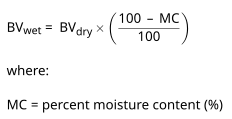
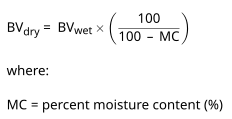
Soil to plant transfer factor-wet (Bvwet (mg/kg (fresh plant) / mg/kg (dry soil)). Bvwet for chemicals is determined by the following equation 7.7 x Kow-0.58, taken from McKone (1994). Values for metals come from BAES, IAEA, NCRP, and OTHER.
Soil to plant transfer factor-dry (Bvdry (mg/kg (dry plant) / mg/kg (dry soil)). Bvdry values were derived from Bvwet, assuming that dry mass is 20% of the fresh mass.
2.5 Maximum Contaminant Levels (MCLs)
The Safe Drinking Water Act (SDWA) was originally passed by Congress in 1974 to protect public health by regulating the nation's public drinking water supply. SDWA authorizes the United States Environmental Protection Agency (US EPA) to set national health based standards for drinking water to protect against both naturally-occurring and man-made contaminants that may be found in drinking water.
US EPA sets national standards for drinking water based on sound science to protect against health risks, considering available technology and costs. These National Primary Drinking Water Regulations set enforceable maximum contaminant levels (MCLs) for particular contaminants in drinking water or required ways to treat water to remove contaminants. The MCLs are published here.
US EPA sets primary drinking water standards through a three-step process: First, US EPA identifies contaminants that may adversely affect public health and occur in drinking water with a frequency and at levels that pose a threat to public health. Second, US EPA determines a maximum contaminant level goal (MCLG) for contaminants it decides to regulate. This goal is the level of a contaminant in drinking water below which there is no known or expected risk to health. Third, US EPA specifies a MCL, the maximum permissible level of a contaminant in drinking water that is delivered to any user of a public water system. These levels are enforceable standards, and are set as close to the goals as feasible.
MCLs are provided in the calculator output for ease of performing data screens.
2.6 EPA Office of Water (OW) Health Advisories (HAs)
The Health Advisories Program, sponsored by the EPA OW, publishes concentrations of drinking water contaminants at drinking water specific risk level concentrations for cancer (10-4 cancer Risk) and concentrations of drinking water contaminants at which noncancer adverse health effects are not anticipated to occur over specific exposure durations - one-day, ten-day, and Lifetime. The one-day and ten-day HAs are for a 10 kg child, and the Lifetime HA is for a 70 kg adult. The daily drinking water consumption for the 10 kg child and 70 kg adult are assumed to be 1 L/day and 2 L/day, respectively. The Lifetime HA for the drinking water contaminant is calculated from its associated drinking water equivalent level (DWEL), obtained from its RfD, and incorporates a drinking water Relative Source Contribution (RSC) factor of contaminant-specific data or a default of 20% of total exposure from all sources. MCLs and MCLGs for some regulated drinking water contaminants are also published.
HAs serve as the informal technical guidance for unregulated drinking water contaminants to assist Federal, State, and local officials, and managers of public or community water systems in protecting public health as needed. They are not to be construed as legally enforceable Federal standards. EPA's OW has provided MCLs, MCLGs, RfDs, One-Day HAs, Ten-day HAs, DWELs, and Lifetime HAs. Drinking Water Specific Risk Level Concentration for cancer (10-4 Cancer Risk), and Cancer Descriptors in the DWSHA tables. HAs are intended to protect against noncancer effects. The 10-4 Cancer Risk level provides information concerning cancer effects. The MCL values for specific drinking water contaminants must be used for regulated contaminants in public drinking water systems.
HAs for ten-day and 10-4 cancer risk are provided in the calculator output for ease of performing data screens. The HAs are not calculated with the same water intake rate, body weight, target cancer risk, use of prorating exposure, at times toxicity values, or use of relative source contribution as are used.
3. Understanding Your Site
The risk calculator provides generic excess lifetime cancer risk estimates and hazard indexies in the absence of site-specific exposure assessments. These results can be used for:
Prioritizing multiple sites or operable units or areas of concern within a facility or exposure units Focusing future site investigation and risk assessment efforts Identifying contamination which may warrant cleanup Identifying sites, or portions of sites, which warrant no further action or investigation
risks are provided for multiple exposure pathways, media, and chemicals with both carcinogenic and non-carcinogenic effects.
3.1 Developing a Conceptual Site Model
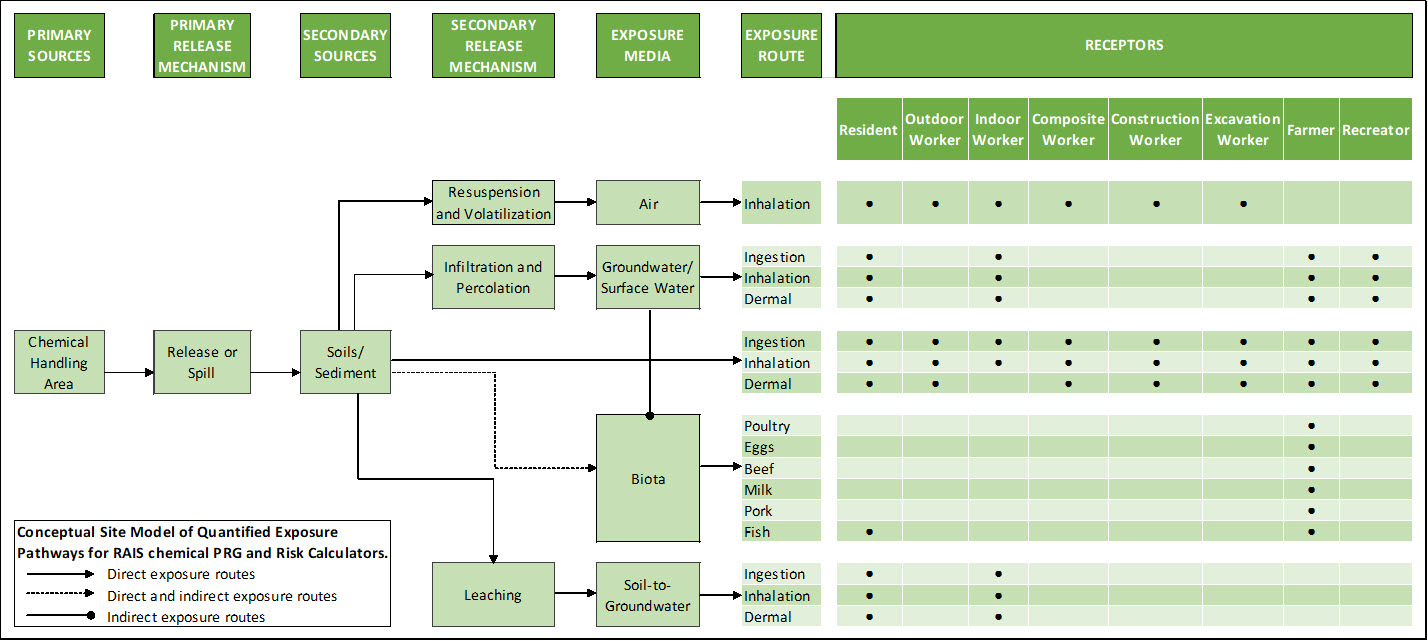
When determining risks, the exposure pathways of concern and site conditions should match those taken into account by the calculator. (Note, however, that future uses may not match current uses. Future uses of a site should be logical as conditions which might occur at the site in the future.) Thus, it is necessary to develop a conceptual site model (CSM) to identify likely contaminant source areas, exposure pathways, and potential receptors. This information can be used to determine the applicability of risks at the site and the need for additional information. The final CSM diagram represents linkages among contaminant sources, release mechanisms, exposure pathways, and routes and receptors based on historical information. It summarizes the understanding of the contamination problem. A separate CSM for ecological receptors can be useful. Part 2 and Attachment A of the Soil Screening Guidance for Superfund: Users Guide (EPA 1996) contains the steps for developing a CSM.
A conceptual site model for the land uses presented in this calculator is presented below.
As a final check, the CSM should address the following questions:
Are there potential ecological concerns? Is there potential for land use other than those used in the risk calculations (i.e., residential and commercial/industrial)? Are there other likely human exposure pathways that were not considered in development of the risks? Are there unusual site conditions (e.g. large areas of contamination, high fugitive dust levels, potential for indoor air contamination)? The risks may need to be adjusted to reflect the answers to these questions.
3.2 Background
Natural background concentrations should be considered prior to applying risks. Background levels will be addressed as they are for other contaminants at CERCLA sites. For further information, see EPA's guidance "Role of Background in the CERCLA Cleanup Program", April 2002, (OSWER 9285.6-07P) and Guidance for Comparing Background and Chemical Concentration in Soil for CERCLA Sites, September 2002, (OSWER 9285.7-41).
3.3 Potential Problems
As with any risk based screening tool, the potential exists for misapplication. In most cases, this results from not understanding the intended use of the risks. In order to prevent misuse of the results, the following should be avoided:
Applying risks to a site without adequately developing a conceptual site model that identifies relevant exposure pathways and exposure scenarios. Not considering the effects from the presence of multiple contaminants, where appropriate. Use of the risks or cleanup levels without adequate consideration of the other NCP remedy selection criteria on CERCLA sites. Use of outdated results (as more recent toxicity values may exist). Not considering the effects of additivity when screening multiple chemicals. Not performing additional screening for pathways not included in these results (e.g. vapor intrusion).
4. Land Use Descriptions, Equations, and Technical Documentation
The chronic daily intake (CDI) equations consider human exposure to individual contaminants in air, water, soil, sediment and biota. The technical discussion is aimed at producing risk results. The following text presents the land use equations and their exposure routes. Tables 1 through 27 in Section 6 present the definitions of the variables and their default values. Any alternative values or assumptions used in developing risks on a site should be presented with supporting rationale in the decision documents.
The CDI equations have evolved over time and are a combination of the following guidance documents:
- U.S. EPA 1989. U.S. Environmental Protection Agency (U.S. EPA). Risk assessment guidance for Superfund. Volume I: Human health evaluation manual (Part A). Interim Final. Office of Emergency and Remedial Response. EPA/540/1-89/002.
- U.S. EPA 1991a. U.S. Environmental Protection Agency (U.S. EPA). Human health evaluation manual, supplemental guidance: "Standard default exposure factors". OSWER Directive 9285.6-03.
- U.S. EPA 1991b. Risk Assessment Guidance for Superfund, Volume I: Human Health Evaluation Manual (Part B, Development of Risk-Based Preliminary Remediation Goals). Office of Emergency and Remedial Response. EPA/540/R-92/003. December 1991
- U.S. EPA. 1996. Soil Screening Guidance: User's Guide. Office of Emergency and Remedial Response. Washington, DC. OSWER No. 9355.4-23.
- U.S. EPA. 1996. Soil Screening Guidance: Technical Background Document. Office of Emergency and Remedial Response. Washington, DC. OSWER No. 9355.4-17A.
- U.S. EPA. 1997. Exposure Factors Handbook. Office of Research and Development, Washington, DC. EPA/600/P-95/002Fa.
- U.S. EPA. 1997. Parameter Guidance Document. National Center for Environmental Assessment, NCEA-0238.
- U.S. EPA. 1999a. Data Collection for the Hazardous Waste Identification Rule. Office of Solid Waste, Washington, DC. The section on cattle fodder, soil and water intakes is here.
- U.S. EPA, 2001. WATER9. Version 1.0.0. Office of Air Quality Planning and Standards, Research Triangle Park, NC. Web site at https://www.epa.gov/chief/water9-version-30 or pdf here Appendix B
- U.S. EPA 2002. Supplemental Guidance for Developing Soil Screening Levels for Superfund Sites. OSWER 9355.4-24. December 2002.
- U.S. EPA 2004. Risk Assessment Guidance for Superfund Volume I: Human Health Evaluation Manual (Part E, Supplemental Guidance for Dermal Risk Assessment) Final. OSWER 9285.7-02EP.July 2004.
- U.S. EPA. 2005. Human Health Risk Assessment Protocol for Hazardous Waste Combustion Facilities. Office of Solid Waste, Washington, DC. The pdf is available here Final EPA530-D-98-001A.
- U.S. EPA 2009 Risk Assessment Guidance for Superfund: Volume I - Human Health Evaluation Manual (Part F, Supplemental Guidance for Inhalation Risk Assessment (Final) . Office of Superfund Remediation and Technology Innovation, EPA-540-R-070-002 OSWER 9285.7-82 January 2009. Cover memo.
- U.S. EPA. 2011. Exposure Factors Handbook. Office of Research and Development, Washington, DC. EPA/600/R-090/052F
- U.S. EPA. 2014. OSWER Directive 9200.1-120 and FAQ. Office of Solid Waste and Emergency Response, Washington, DC.
- U.S. EPA. 1994c. Revised Draft Guidance for Performing Screening Level Risk Analyses at Combustion Facilities Burning Hazardous Wastes. Attachment C. Office of Emergency and Remedial Response. Office of Solid Waste. December 14.
4.1 Resident
4.1.1 Resident Soil
This receptor spends most, if not all, of the day at home. The activities for this receptor involve typical home making chores (cooking, cleaning and laundering) as well as outdoor activities. The resident is assumed to be exposed to contaminants via the following pathways: incidental ingestion of soil, dermal contact with soil, inhalation of volatiles and fugitive dust. Adults and children exhibit different ingestion rates for soil. For example, the child resident is assumed to ingest 200 mg per day while the adult ingests 100 mg per day. To account for changes in intake as the receptor ages, age adjusted intake equations were developed.
4.1.1.1 Noncarcinogenic for Child
The residential soil CDI equations, presented here for child exposures, contain the following exposure routes:
incidental ingestion of soil,

inhalation of particulates emitted from soil, and

dermal contact with soil.

4.1.1.2 Noncarcinogenic for Adult
The residential soil CDI equations, presented here for adult exposures, contain the following exposure routes:
incidental ingestion of soil,

inhalation of particulates emitted from soil, and

dermal contact with soil.

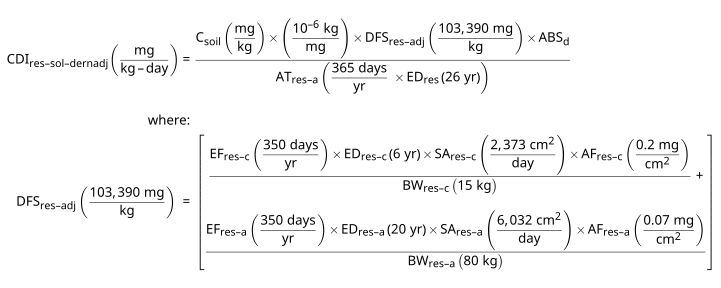
4.1.1.3 Noncarcinogenic Age-adjusted
The residential soil CDI equations, presented here for age-adjusted exposures, contain the following exposure routes:
incidental ingestion of soil,
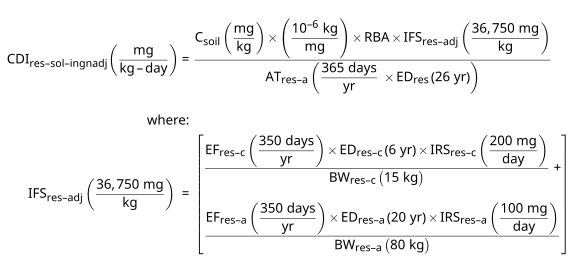
inhalation of particulates emitted from soil, and

dermal contact with soil.
4.1.1.4 Carcinogenic
The residential soil CDI equations, presented here, contain the following exposure routes:
incidental ingestion of soil,
inhalation of particulates emitted from soil, and
dermal contact with soil.
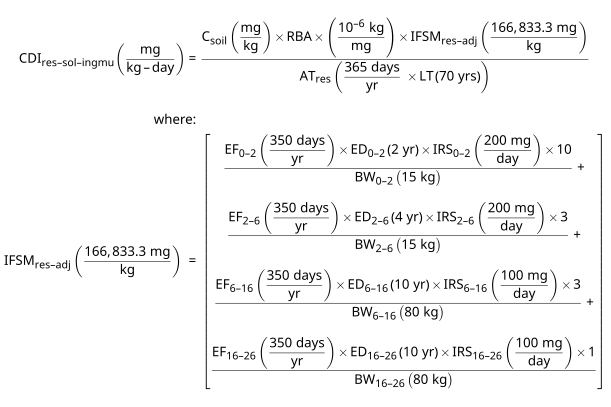
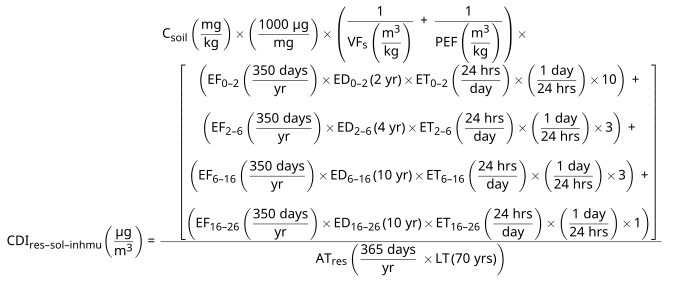
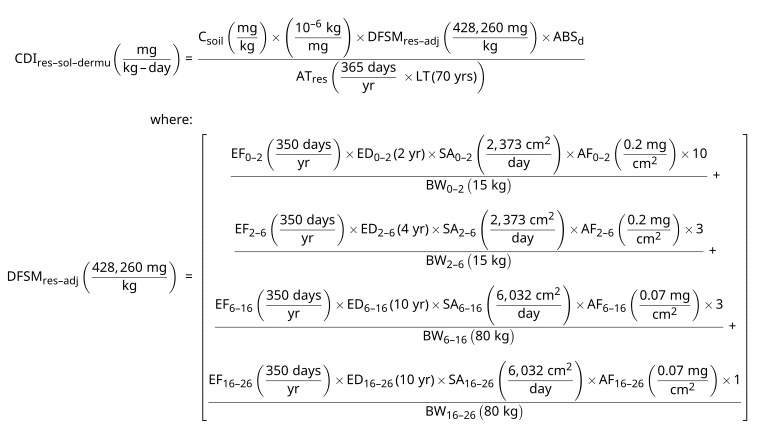
4.1.1.5 Mutagenic
The residential soil CDI equations, presented here, contain the following exposure routes:
incidental ingestion of soil,
inhalation of particulates emitted from soil, and
dermal contact with soil.
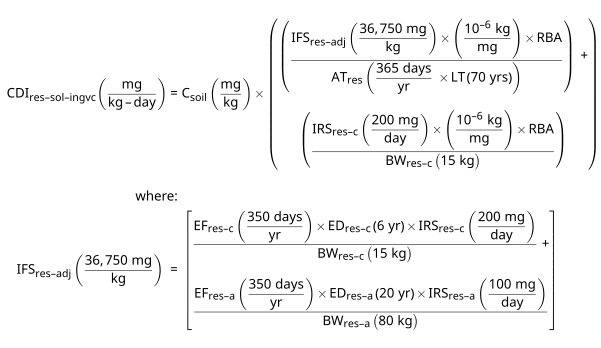
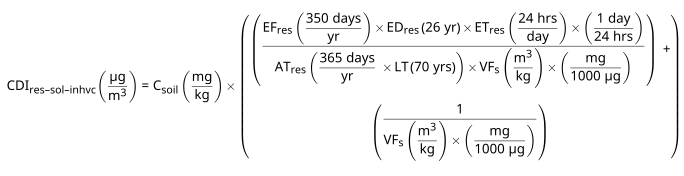
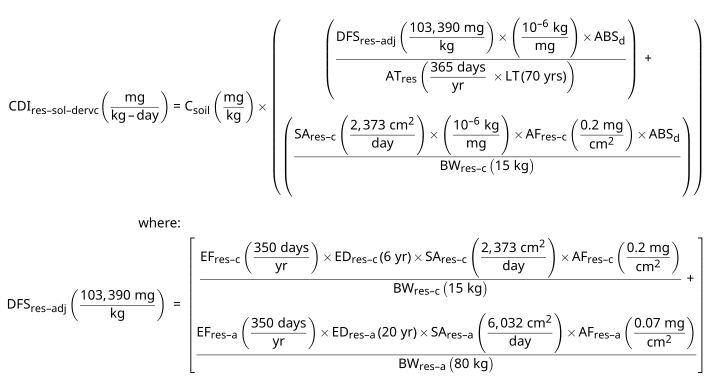
4.1.1.6 Vinyl Chloride - Carcinogenic
The residential soil CDI equations, presented here, contain the following exposure routes:
incidental ingestion of soil,
inhalation of particulates emitted from soil, and
dermal contact with soil.
4.1.1.7 Trichloroethylene - Carcinogenic and Mutagenic
The residential soil CDI equations, presented here, contain the following exposure routes:
incidental ingestion of soil,
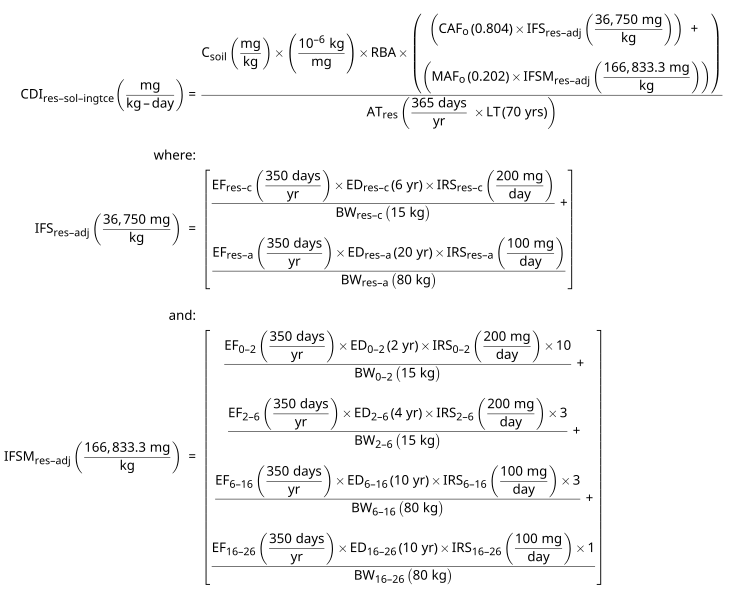
inhalation of particulates emitted from soil, and
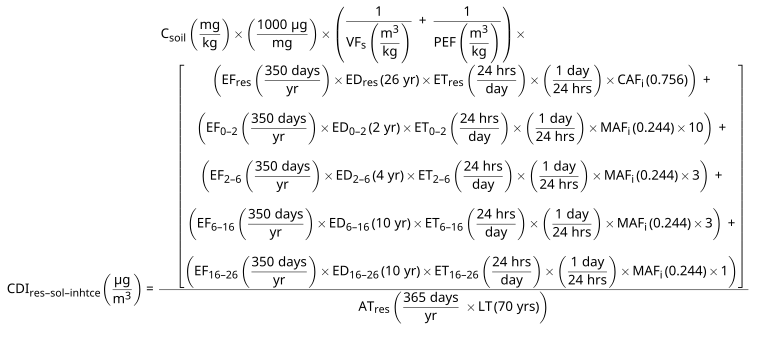
dermal contact with soil.
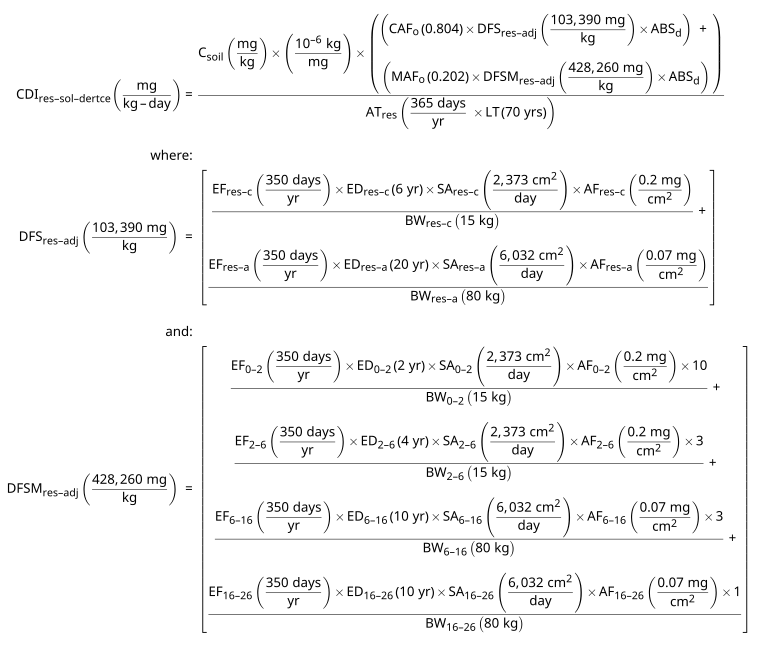
4.1.1.8 Supporting Equations for Resident Soil
Child Supporting Equations.
Adult Supporting Equations.
Age-adjusted Supporting Equations.
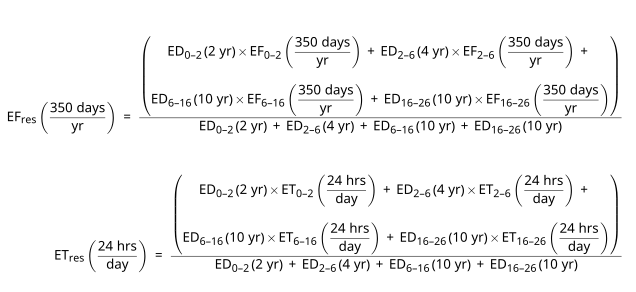
4.1.2 Resident Tap Water
This receptor is exposed to chemicals in water that are delivered into a residence from sources such as groundwater or surface water. Ingestion of drinking water is an appropriate pathway for all chemicals. The inhalation exposure route is only calculated for volatile compounds. Activities such as showering, laundering, and dish washing contribute to contaminants in the air for inhalation. Dermal contact with tap water is also considered for analytes determined to be within the effective predictive domain as described in Section 4.10.8.
4.1.2.1 Noncarcinogenic for Child
The tap water CDI equations, presented here for child exposures, contain the following exposure routes:
ingestion of water,

dermal contact with water, and
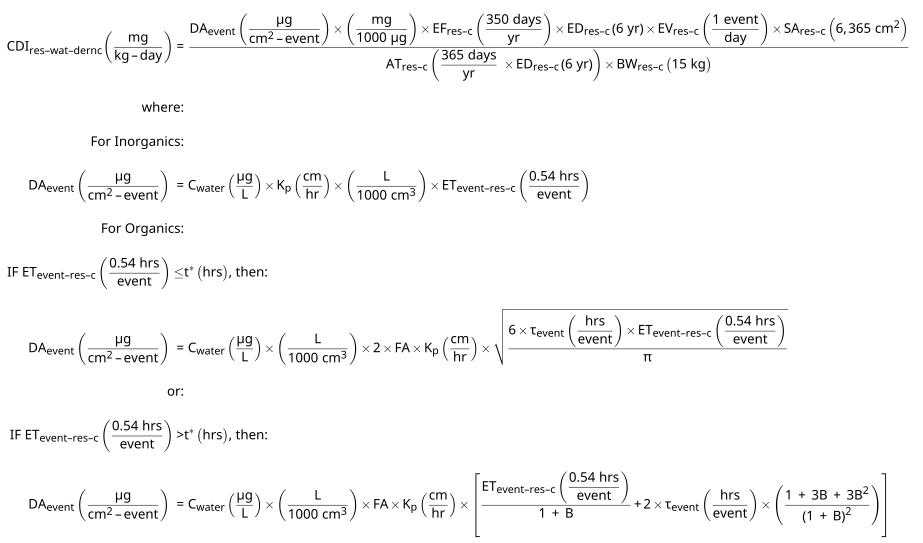
inhalation of volatiles.

4.1.2.2 Noncarcinogenic for Adult
The tap water CDI equations, presented here for adult exposures, contain the following exposure routes:
ingestion of water,

dermal contact with water, and
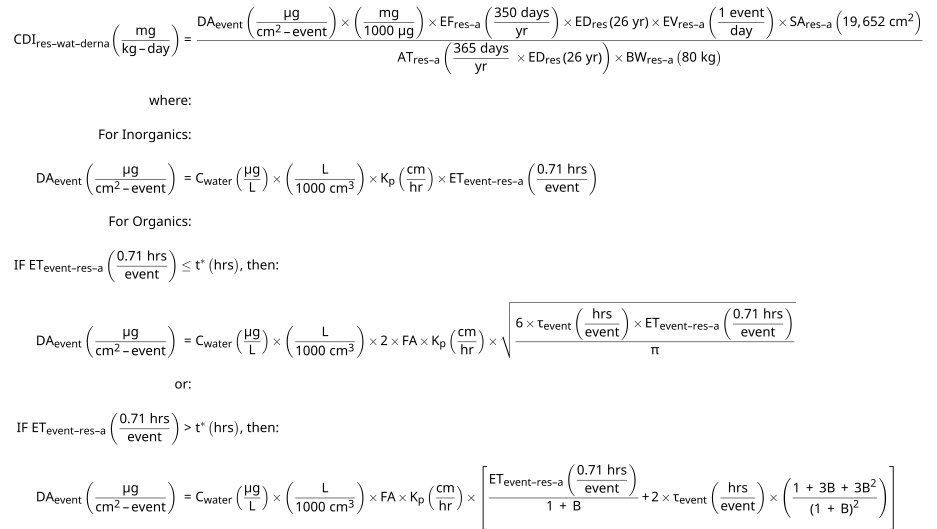
inhalation of volatiles.

4.1.2.3 Noncarcinogenic for Age-adjusted
The tap water CDI equations, presented here for age-adjusted exposures, contain the following exposure routes:
ingestion of water,
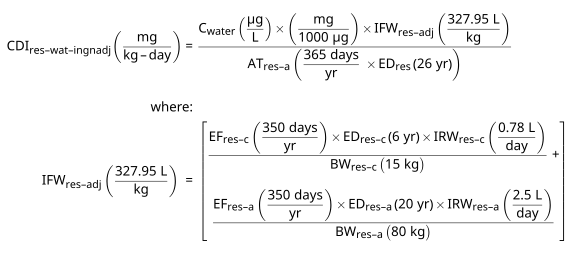
dermal contact with water, and
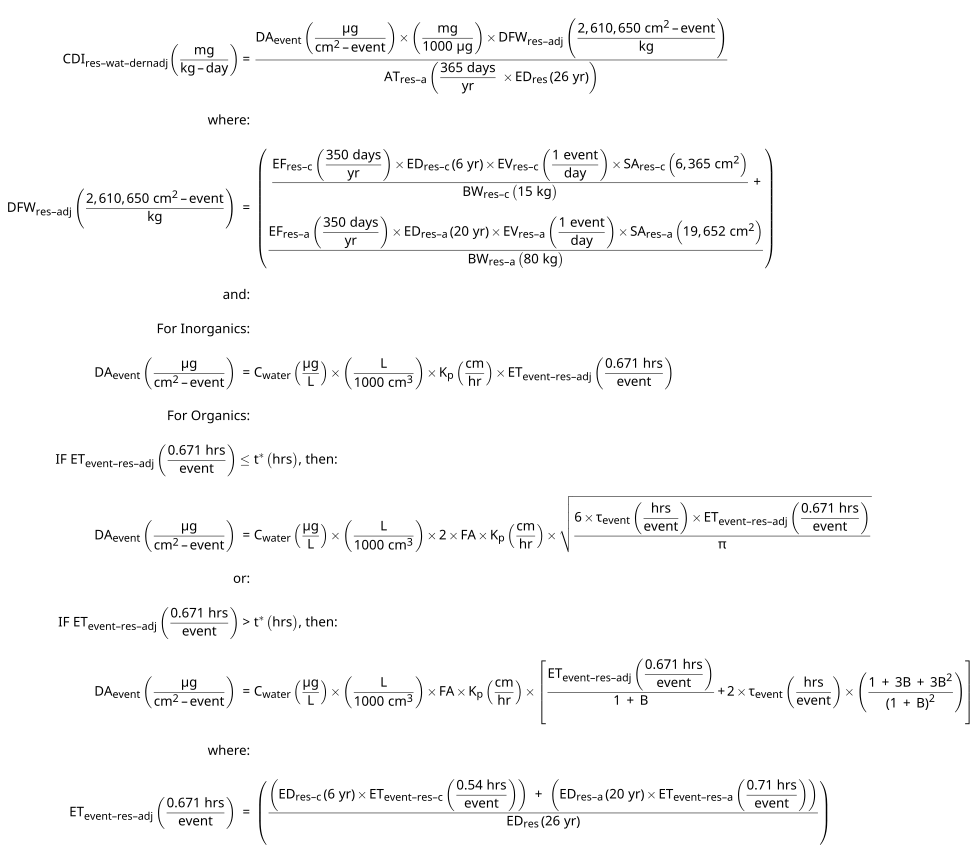
inhalation of volatiles.

4.1.2.4 Carcinogenic
The tap water CDI equations, presented here, contain the following exposure routes:
ingestion of water,
dermal contact with water, and
inhalation of volatiles.
4.1.2.5 Mutagenic
The tap water CDI equations, presented here, contain the following exposure routes:
ingestion of water,
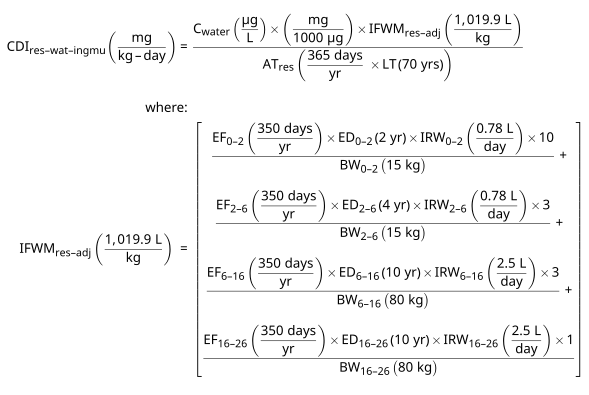
dermal contact with water, and
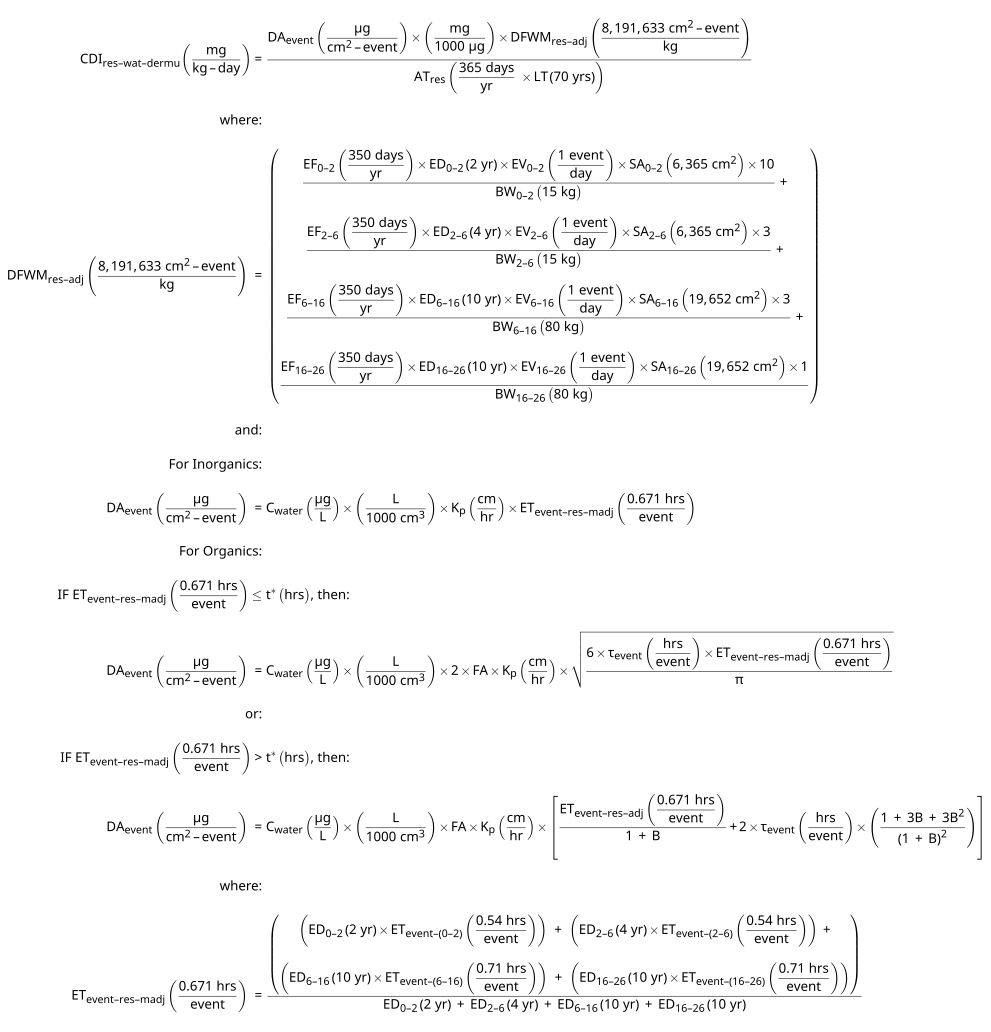
inhalation of volatiles.
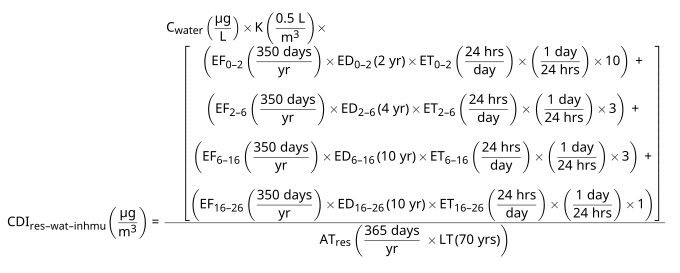
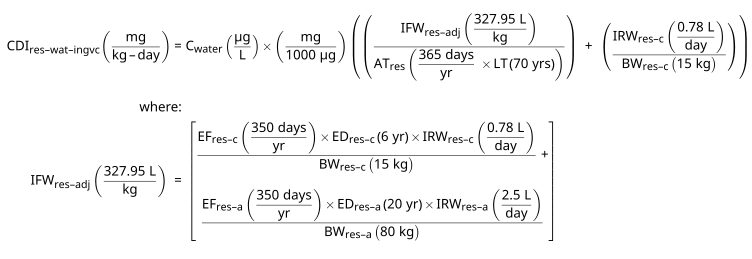
4.1.2.6 Vinyl Chloride - Carcinogenic
The tap water CDI equations, presented here, contain the following exposure routes:
ingestion of water,
dermal contact with water, and
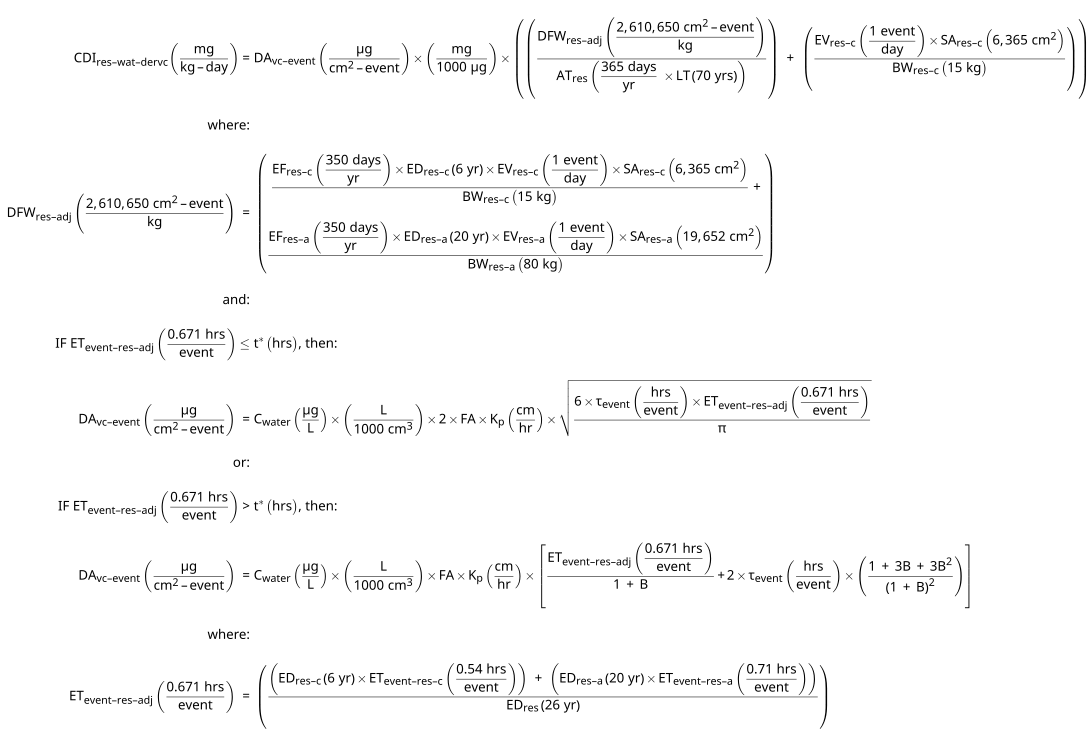
inhalation of volatiles.

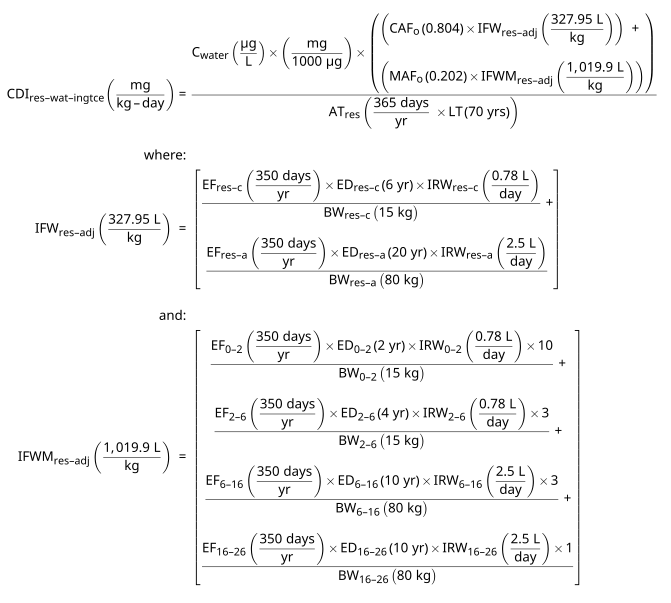
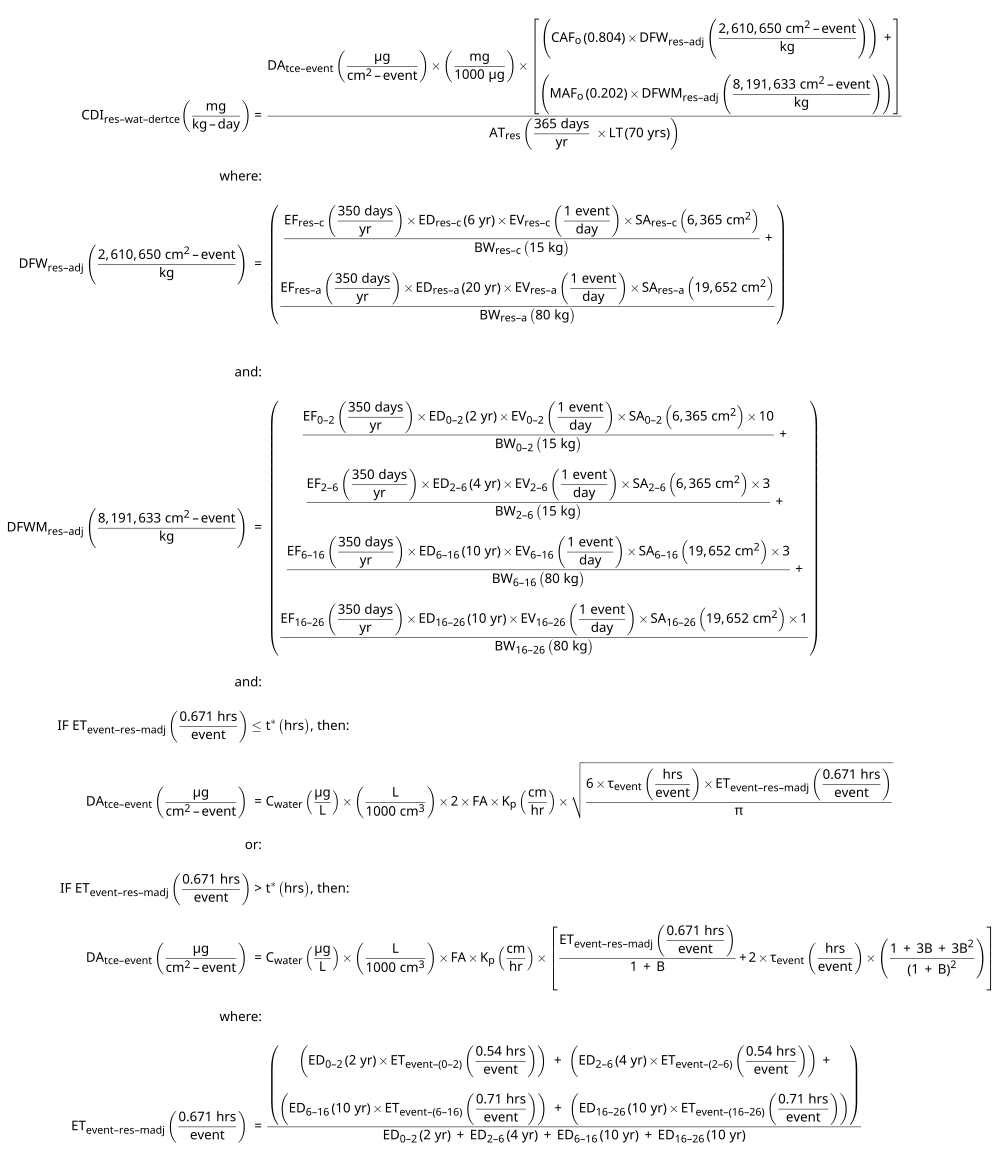
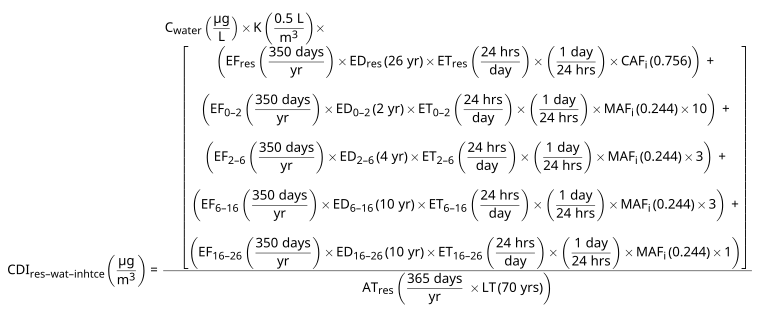
4.1.2.7 Trichloroethylene - Carcinogenic and Mutagenic
The tap water CDI equations, presented here, contain the following exposure routes:
ingestion of water,
dermal contact with water, and
inhalation of volatiles.
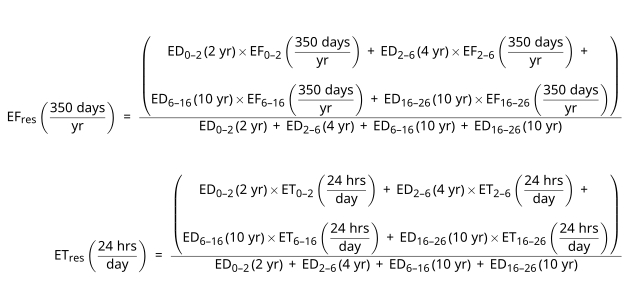
4.1.2.8 Supporting Equations for Tap Water
Child Supporting Equations.
Adult Supporting Equations.
Age-adjusted Supporting Equations.
4.1.3 Resident Air
This receptor spends most, if not all, of the day at home. The activities for this receptor involve typical home making chores (cooking, cleaning and laundering) as well as outdoor activities. The resident is assumed to be exposed to contaminants via the following pathway: inhalation of ambient air. This land use has no assumptions of how contaminants get into the air.
4.1.3.1 Noncarcinogenic
The Ambient air CDI equation, presented here, contains the following exposure route:
inhalation of volatiles.
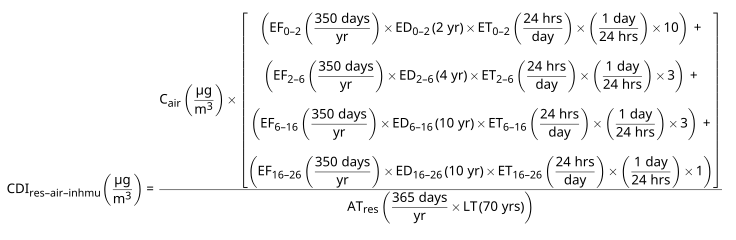
4.1.3.2 Carcinogenic
The Ambient air CDI equation, presented here, contains the following exposure route:
inhalation of volatiles.
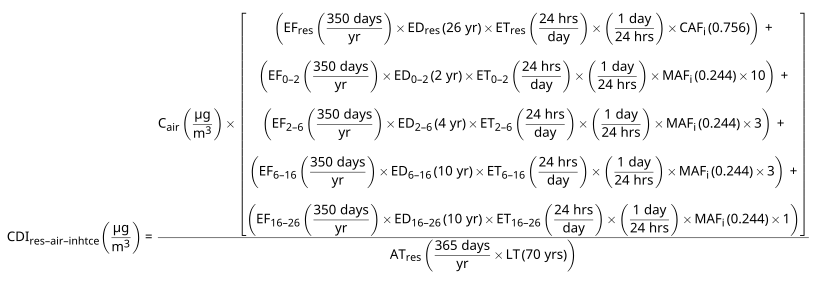
4.1.3.3 Mutagenic
The Ambient air CDI equation, presented here, contains the following exposure route:
inhalation of volatiles
4.1.3.4 Vinyl Chloride - Carcinogenic
The Ambient air CDI equation, presented here, contains the following exposure route:
inhalation of volatiles.

4.1.3.5 Trichloroethylene - Carcinogenic and Mutagenic
The Ambient air CDI equation, presented here, contains the following exposure route:
inhalation of volatiles.
4.1.3.6 Noncarcinogenic - Refractory Ceramic Fibers
The Ambient air CDI equation, presented here, contains the following exposure route:
inhalation of volatiles.

4.1.3.7 Carcinogenic - Asbestos
The Ambient air CDI equation, presented here, contains the following exposure route:
inhalation of volatiles.

4.1.4 Consumption of Fish
This receptor is exposed to chemicals in fish tissue or surface water. Consumption of fish is an appropriate pathway for all chemicals. For more information regarding the exposure assumptions for the consumption of fish, see Section 2.2.1.
4.1.4.1 Concentration in Fish
These fish CDIs represent the fish intake rates based on fish tissue concentrations.
4.1.4.1.1 Noncarcinogenic for Child
The ingestion of fish equation, presented here, contains the following exposure route:
consumption of fish
4.1.4.1.2 Noncarcinogenic for Adult
The ingestion of fish equation, presented here, contains the following exposure route:
consumption of fish
4.1.4.1.3 Noncarcinogenic for Age-adjusted
The ingestion of fish equation, presented here, contains the following exposure route:
consumption of fish
4.1.4.1.4 Carcinogenic
The ingestion of fish equation, presented here, contains the following exposure route:
consumption of fish

4.1.4.1.5 Mutagenic
The ingestion of fish equation, presented here, contains the following exposure route:
consumption of fish
4.1.4.1.6 Vinyl Chloride - Carcinogenic
The ingestion of fish equation, presented here, contains the following exposure route:
consumption of fish
4.1.4.1.7 Trichloroethylene - Carcinogenic and Mutagenic
The ingestion of fish equation, presented here, contains the following exposure route:
consumption of fish
4.1.4.1.8 Supporting Equations for Fish Consumption
Child Supporting Equations
Adult Supporting Equations
Age-adjusted Supporting Equations
4.1.4.2 Concentration in Surface Water
These fish CDIs represent the fish intake rates based on surface water concentrations.
4.1.4.2.1 Noncarcinogenic for Child
The ingestion of fish equation, presented here, contains the following exposure route:
consumption of fish
4.1.4.2.2 Noncarcinogenic for Adult
The ingestion of fish equation, presented here, contains the following exposure route:
consumption of fish
4.1.4.2.3 Noncarcinogenic for Age-adjusted
The ingestion of fish equation, presented here, contains the following exposure route:
consumption of fish
4.1.4.2.4 Carcinogenic
The ingestion of fish equation, presented here, contains the following exposure route:
consumption of fish

4.1.4.2.5 Mutagenic
The ingestion of fish equation, presented here, contains the following exposure route:
consumption of fish
4.1.4.2.6 Vinyl Chloride - Carcinogenic
The ingestion of fish equation, presented here, contains the following exposure route:
consumption of fish
4.1.4.2.7 Trichloroethylene - Carcinogenic and Mutagenic
The ingestion of fish equation, presented here, contains the following exposure route:
consumption of fish
4.1.4.2.8 Supporting Equations for Fish Consumption
Child Supporting Equations
Adult Supporting Equations
Age-adjusted Supporting Equations
4.1.5 Soil to Groundwater
The soil to groundwater media uses the same water concentration determination equations for resident and indoor worker based on the respective soil concentration entered by the user for each land use. The graphical representation below illustrates the transport of contaminants from soil to groundwater for the resident land use. For more information about soil to groundwater, including equation images, please see section 4.9 of this user guide.
4.2 Composite Worker
4.2.1 Composite Worker Soil
This is a long-term receptor exposed during the work day who is a full-time employee working on-site and spends most of the workday conducting maintenance activities outdoors. The activities for this receptor (e.g., moderate digging, landscaping) typically involve on-site exposure to surface soils. The composite worker is expected to have an elevated soil ingestion rate (100 mg per day) and is assumed to be exposed to contaminants via the following pathways: incidental ingestion of soil, dermal contact with soil, inhalation of volatiles and fugitive dust. The composite worker combines the most protective exposure assumptions of the outdoor and indoor workers. The only difference between the outdoor worker and the composite worker is that the composite worker uses the more protective exposure frequency of 250 days/year from the indoor worker scenario.
4.2.1.1 Noncarcinogenic
The composite worker soil CDI equations, presented here, combine the most protective exposure parameters from the outdoor and indoor worker. The composite worker contains the following exposure routes:
incidental ingestion of soil,
inhalation of particulates emitted from soil, and
dermal exposure.
4.2.1.2 Carcinogenic
The composite worker soil CDI equations, presented here, contain the following exposure routes:
incidental ingestion of soil,
inhalation of particulates emitted from soil, and
dermal exposure.
4.2.2 Composite Worker Air
This is a long-term receptor exposed during the work day who is a full-time employee working on-site and spends most of the workday conducting maintenance activities indoors. The composite worker is assumed to be exposed to contaminants via the following pathway: inhalation of ambient air. The composite worker combines the most protective exposure assumptions of the outdoor and indoor workers. The only difference between the outdoor worker and the composite worker is that the composite worker uses the more protective exposure frequency of 250 days/year from the indoor worker scenario. This land use has no assumptions of how contaminants get into the air.
4.2.2.1 Noncarcinogenic
The composite worker ambient air CDI equation, presented here, combines the most protective parameters from the outdoor and indoor workers. The composite worker contains the following exposure route:
inhalation of volatiles.
4.2.2.2 Carcinogenic
The Ambient air CDI equation, presented here, contains the following exposure routes:
inhalation of volatiles.
4.2.2.3 Noncarcinogenic - Refractory Ceramic Fibers
The The Ambient air CDI equation, presented here, contains the following exposure routes:
inhalation of volatiles.

4.2.2.4 Carcinogenic - Asbestos
The Ambient air CDI equation, presented here, contains the following exposure routes:
inhalation of volatiles.

4.3 Outdoor Worker
4.3.1 Outdoor Worker Soil
This is a long-term receptor exposed during the work day who is a full-time employee working on-site and spends most of the workday conducting maintenance activities outdoors. The activities for this receptor (e.g., moderate digging, landscaping) typically involve on-site exposure to surface soils. The outdoor worker is expected to have an elevated soil ingestion rate (100 mg per day) and is assumed to be exposed to contaminants via the following pathways: incidental ingestion of soil, dermal contact with soil, inhalation of volatiles and fugitive dust. The outdoor worker receives more exposure than the indoor worker under commercial/industrial conditions.
4.3.1.1 Noncarcinogenic
The outdoor worker soil CDI equations, presented here, contain the following exposure routes:
incidental ingestion of soil,
inhalation of particulates emitted from soil, and
dermal exposure.
4.3.1.2 Carcinogenic
The outdoor worker soil CDI equations, presented here, contain the following exposure routes:
incidental ingestion of soil,
inhalation of particulates emitted from soil, and
dermal exposure.
4.3.2 Outdoor Worker Air
This is a long-term receptor exposed during the work day who is a full-time employee working on-site and spends most of the workday conducting maintenance activities outdoors. The outdoor worker is assumed to be exposed to contaminants via the following pathway: inhalation of ambient air. This land use has no assumptions of how contaminants get into the air.
4.3.2.1 Noncarcinogenic
The Ambient air CDI equation, presented here, contains the following exposure route:
inhalation of volatiles.
4.3.2.2 Carcinogenic
The Ambient air CDI equation, presented here, contains the following exposure route:
inhalation of volatiles.
4.3.2.3 Noncarcinogenic - Refractory Ceramic Fibers
The The Ambient air CDI equation, presented here, contains the following exposure routes:
inhalation of volatiles.

4.3.2.4 Carcinogenic - Asbestos
The Ambient air CDI equation, presented here, contains the following exposure routes:
inhalation of volatiles.

4.4 Indoor Worker
4.4.1 Indoor Worker Soil
This receptor spends most, if not all, of the workday indoors. Thus, an indoor worker has no direct dermal contact with outdoor soils. This worker may, however, be exposed to contaminants through ingestion of contaminated soils that have been incorporated into indoor dust and inhalation of volatiles and particulates from outside soils. CDIs calculated for this receptor are expected to be protective of both workers engaged in low intensity activities such as office work and those engaged in more strenuous activity (e.g., factory or warehouse workers).
4.4.1.1 Noncarcinogenic
The indoor worker soil CDI equations, presented here, contain the following exposure routes:
incidental ingestion of soil and
inhalation of particulates emitted from soil.
4.4.1.2 Carcinogenic
The indoor worker soil CDI equations, presented here, contain the following exposure routes:
incidental ingestion of soil and
inhalation of particulates emitted from soil.
4.4.2 Indoor Worker Air
This is a long-term receptor exposed during the work day who is a full-time employee working on-site and spends most of the workday conducting maintenance activities indoors. The indoor worker is assumed to be exposed to contaminants via the following pathway: inhalation of ambient air. This land use has no assumptions of how contaminants get into the air.
4.4.2.1 Noncarcinogenic
The Ambient air CDI equation, presented here, contains the following exposure route:
inhalation of volatiles.
4.4.2.2 Carcinogenic
The Ambient air CDI equation, presented here, contains the following exposure routes:
inhalation of volatiles.
4.4.2.3 Noncarcinogenic - Refractory Ceramic Fibers
The The Ambient air CDI equation, presented here, contains the following exposure routes:
inhalation of volatiles.

4.4.2.4 Carcinogenic - Asbestos
The Ambient air CDI equation, presented here, contains the following exposure routes:
inhalation of volatiles.

4.4.3 Indoor Worker Tap Water
This receptor is exposed to chemicals in water that are delivered into a commercial/industrial facility from sources such as groundwater or surface water. Ingestion of drinking water is an appropriate pathway for all chemicals. The inhalation exposure route is only calculated for volatile compounds. Activities such as showering, laundering, and dish washing contribute to contaminants in the air for inhalation. Dermal contact with tap water is also considered for analytes determined to be within the effective predictive domain as described in Section 4.10.8.
4.4.3.1 Noncarcinogenic
The tap water CDI equations, presented here, contain the following exposure routes:
ingestion of water,
dermal contact with water, and
inhalation of volatiles.
4.4.3.2 Carcinogenic
The tap water CDI equations, presented here, contain the following exposure routes:
ingestion of water,
dermal contact with water, and
inhalation of volatiles.
4.4.4 Soil to Groundwater
The soil to groundwater media uses the same water concentration determination equations for resident and indoor worker based on the respective soil concentration entered by the user for each land use. The graphical representation below illustrates the transport of contaminants from soil to groundwater for the indoor worker land use. For more information about soil to groundwater, including equation images, please see section 4.9 of this user guide.
4.5 Construction Worker
4.5.1 Construction Worker Soil Exposure to Unpaved Road Traffic
The construction land use is described in the supplemental soil screening guidance. This land use is limited to an exposure duration of 1 year and is thus, subchronic. Other unique aspects of this scenario are that the particulate emission factor (PEF) is based on mechanical disturbance of the soil and a special volatilization factor (VF) equation is used. See Section 4.1.3 for further information on subchronic VFs and PEFs. The PEFs calculated in these scenarios may predict much higher air concentrations than the standard wind-driven PEFs; however, the inhalation screening level will likely be dominated by the VF in the case of a volatile contaminant. VFs are commonly 5 orders of magnitude more protective than PEFs. Additionally, the ingestion route typically is the driving factor in most risk calculations. Two types of mechanical soil disturbance are addressed: standard vehicle traffic and other than standard vehicle traffic (e.g. wind, grading, dozing, tilling and excavating). In general, the intake and contact rates are all greater than the outdoor worker. Exhibit 5-1 in the supplemental soil screening guidance presents the exposure parameters.
4.5.1.1 Noncarcinogenic
The construction worker soil CDI equations, presented here, contain the following exposure routes:
incidental ingestion of soil,
inhalation of particulates emitted from soil, and
dermal exposure.
4.5.1.2 Carcinogenic
The construction worker soil CDI equations, presented here, contain the following exposure routes:
incidental ingestion of soil,
inhalation of particulates emitted from soil, and
dermal exposure.
4.5.2 Construction Worker Soil Exposure to Other Construction Activities
This is a short-term receptor exposed during the work day working around vehicles suspending dust in the air. The activities for this receptor (e.g., trenching, excavating) typically involve on-site exposure to surface soils. The construction worker is expected to have an elevated soil ingestion rate (330 mg per day) and is assumed to be exposed to contaminants via the following pathways: incidental ingestion of soil, dermal contact with contaminants in soil, inhalation of volatiles and fugitive dust. The only difference between this construction worker and the one described in section 4.5.1 is that this construction worker uses a different PEF. The construction land use is described in the supplemental soil screening guidance. This land use is limited to an exposure duration of 1 year and is thus, subchronic. Other unique aspects of this scenario are that the PEF is based on mechanical disturbance of the soil. Two types of mechanical soil disturbance are addressed: standard vehicle traffic and other than standard vehicle traffic (e.g. wind, grading, dozing, tilling and excavating). In general, the intakes and contact rates are all greater than the outdoor worker. Exhibit 5-1 in the supplemental soil screening guidance presents the exposure parameters.
4.5.2.1 Noncarcinogenic
The construction worker soil CDI equations, presented here, contain the following exposure routes:
incidental ingestion of soil,
inhalation of particulates emitted from soil, and

dermal exposure.
4.5.2.2 Carcinogenic
The construction worker soil CDI equations, presented here, contain the following exposure routes:
incidental ingestion of soil,
inhalation of particulates emitted from soil, and

dermal exposure.
4.5.3 Construction Worker Air
This is a short-term receptor exposed during the work day during heavy construction activities outdoors. The activities for this receptor (e.g., trenching, excavating) typically involve on-site exposures to surface soils. The construction worker is assumed to be exposed to contaminants via the following pathways: inhalation of ambient air and external radiation from contaminants in ambient air. This land use has no assumptions of how contaminants get into the air.
4.5.3.1 Noncarcinogenic
The Ambient air CDI equation, presented here, contains the following exposure route:
inhalation of volatiles.
4.5.3.2 Carcinogenic
The Ambient air CDI equation, presented here, contains the following exposure route:
inhalation of volatiles.
4.5.2.3 Noncarcinogenic - Refractory Ceramic Fibers
The The Ambient air CDI equation, presented here, contains the following exposure routes:
inhalation of volatiles.

4.5.2.4 Carcinogenic - Asbestos
The Ambient air CDI equation, presented here, contains the following exposure routes:
inhalation of volatiles.

4.6 Excavation Worker
4.6.1 Excavation Worker Soil
The excavation worker land use was developed for use at DOE ORO facilities to address short term exposures. Example situations for exposure would be utility line maintenance or installation. This land use is limited to an exposure duration of 1 year and is thus, subchronic. The PEF and VF used in this land use are the same ones used in the resident and composite worker land use scenarios. In general, the intake and contact rates are all greater than the outdoor worker.
4.6.1.1 Noncarcinogenic
The excavation worker soil CDI equations, presented here, contain the following exposure routes:
incidental ingestion of soil,
inhalation of particulates emitted from soil, and
dermal exposure.
4.6.1.2 Carcinogenic
The excavation worker soil CDI equations, presented here, contain the following exposure routes:
incidental ingestion of soil,
inhalation of particulates emitted from soil, and
dermal exposure.
4.6.2 Excavation Worker Air
The excavation worker land use was developed for use at DOE ORO facilities to address short term exposures. This land use is limited to an exposure duration of 1 year and is thus, subchronic. In general, the intake and contact rates are all greater than the outdoor worker.
4.6.2.1 Noncarcinogenic
The Ambient air CDI equation, presented here, contains the following exposure route:
inhalation of volatiles.
4.6.2.2 Carcinogenic
The Ambient air CDI equation, presented here, contains the following exposure route:
inhalation of volatiles.
4.6.2.3 Noncarcinogenic - Refractory Ceramic Fibers
The The Ambient air CDI equation, presented here, contains the following exposure routes:
inhalation of volatiles.

4.6.2.4 Carcinogenic - Asbestos
The Ambient air CDI equation, presented here, contains the following exposure routes:
inhalation of volatiles.

4.7 Recreator
4.7.1 Recreator Soil/Sediment
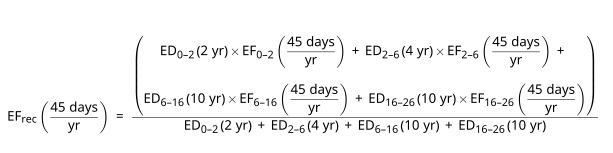
This receptor spends time outside involved in recreational activities. The recreator is assumed to be exposed to contaminants via the following pathways: incidental ingestion of soil, dermal contact with contaminants in soil, and inhalation of volatiles and fugitive dust. The exposure time and frequency are reasonable estimates based on weekend activities during the warmest 9 months of the year equating to about 75 days per year.
4.7.1.1 Noncarcinogenic for Child
The recreational soil/sediment CDI equations, presented here for child exposures, contain the following exposure routes:
incidental ingestion of soil/sediment,

inhalation of particulates emitted from soil/sediment, and

dermal contact with soil/sediment.

4.7.1.2 Noncarcinogenic for Adult
The recreational soil/sediment CDI equations, presented here for adult exposures, contain the following exposure routes:
incidental ingestion of soil/sediment,

inhalation of particulates emitted from soil/sediment, and

dermal contact with soil/sediment.

4.7.1.3 Noncarcinogenic for Age-adjusted
The recreational soil/sediment CDI equations, presented here for age-adjusted exposures, contain the following exposure routes:
incidental ingestion of soil/sediment,
inhalation of particulates emitted from soil/sediment, and

dermal contact with soil/sediment.
4.7.1.4 Carcinogenic
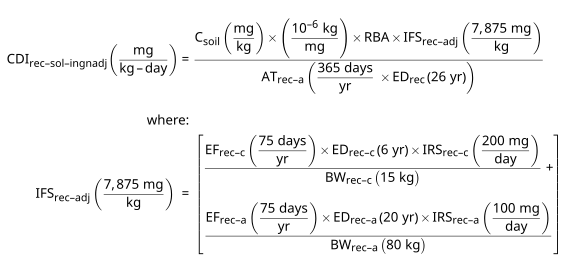
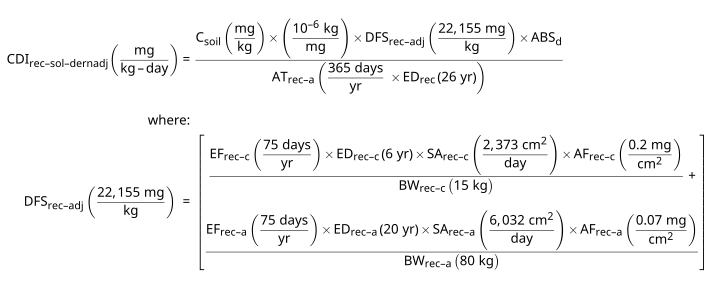
The recreational soil/sediment CDI equations, presented here, contain the following exposure routes:
incidental ingestion of soil/sediment,
inhalation of particulates emitted from soil/sediment, and
dermal contact with soil/sediment.
4.7.1.5 Mutagenic
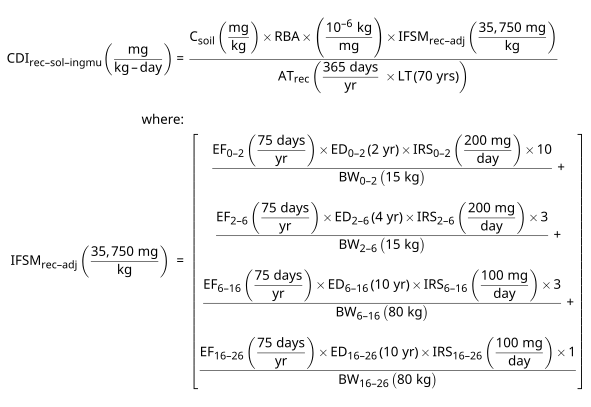
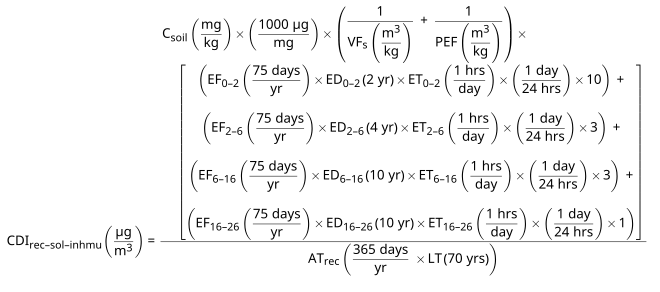
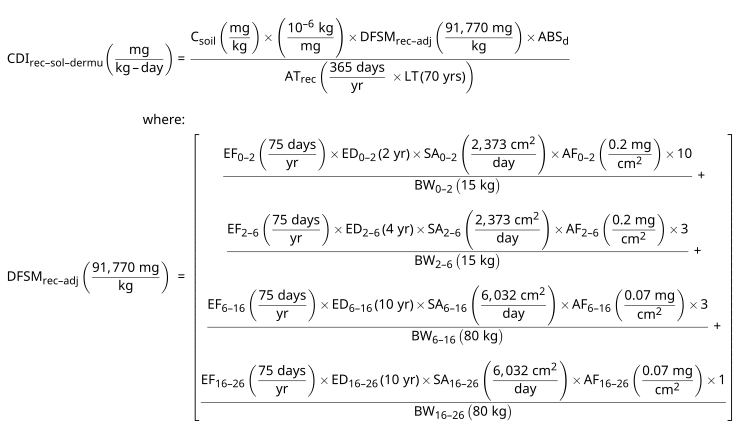
The recreational soil/sediment CDI equations, presented here, contain the following exposure routes:
incidental ingestion of soil/sediment,
inhalation of particulates emitted from soil/sediment, and
dermal contact with soil/sediment.
4.7.1.6 Vinyl Chloride - Carcinogenic
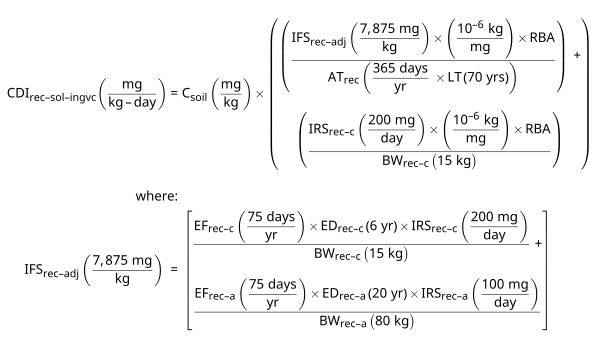
The recreational soil/sediment CDI equations, presented here, contain the following exposure routes:
incidental ingestion of soil/sediment,
inhalation of particulates emitted from soil/sediment, and
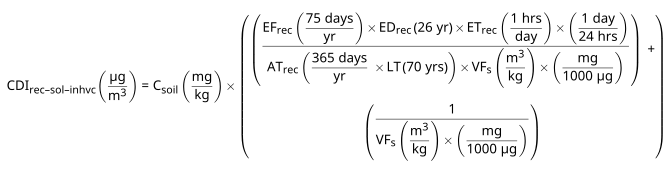
dermal contact with soil/sediment.
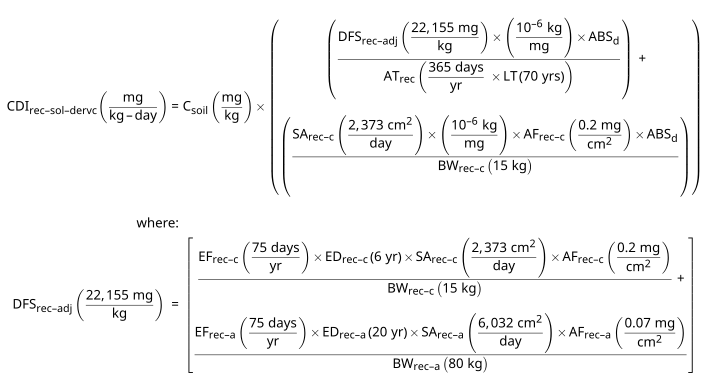
4.7.1.7 Trichloroethylene - Carcinogenic and Mutagenic
The recreational soil/sediment CDI equations, presented here, contain the following exposure routes:
incidental ingestion of soil/sediment,
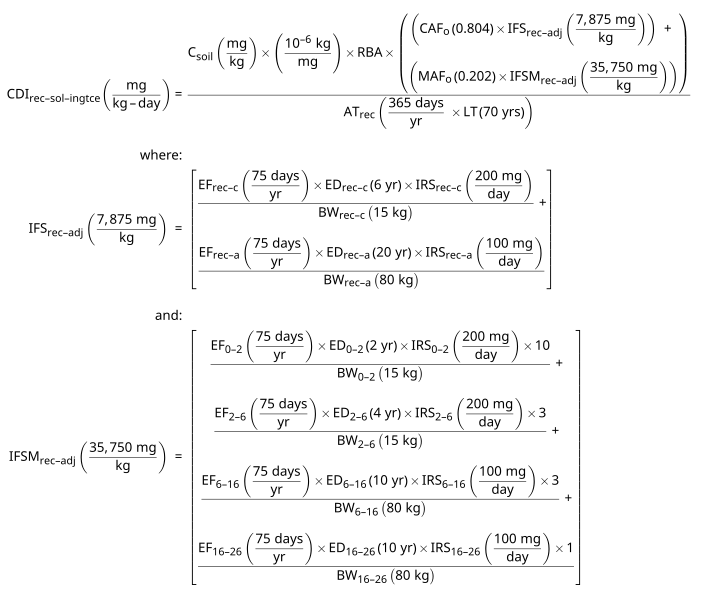
inhalation of particulates emitted from soil/sediment, and
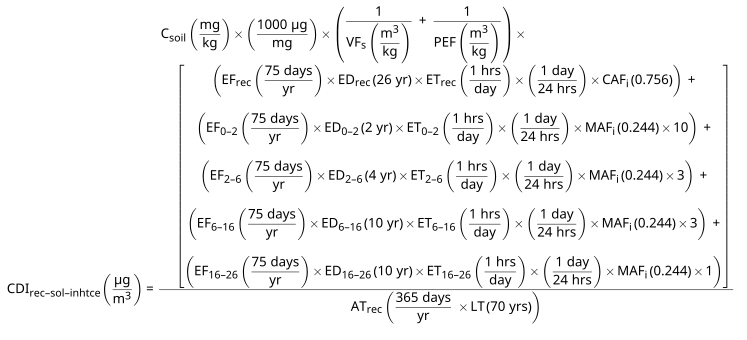
dermal contact with soil/sediment.
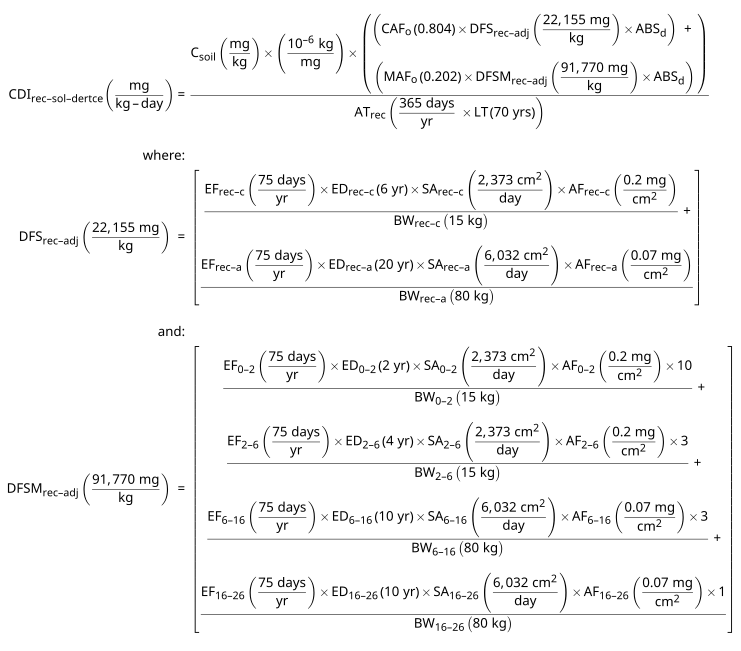
4.7.1.8 Supporting Equations for Recreational Soil/Sediment
Child Supporting Equations.
Adult Supporting Equations.
Age-adjusted Supporting Equations.
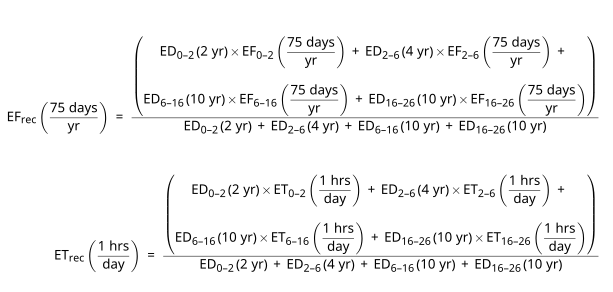
4.7.2 Recreator Surface Water
This receptor is exposed to chemicals that are present in surface water. Ingestion of water and dermal contact with water are appropriate pathways. Dermal contact with surface water is also considered for analytes determined to be within the effective predictive domain as described in Section 4.10.8. Inhalation is not considered due to mixing with outdoor air. The exposure time and events per day are reasonable estimates.
4.7.2.1 Noncarcinogenic Child
The surface water CDI equations, presented here for child exposures, contain the following exposure routes:
ingestion of water and

dermal contact with water.
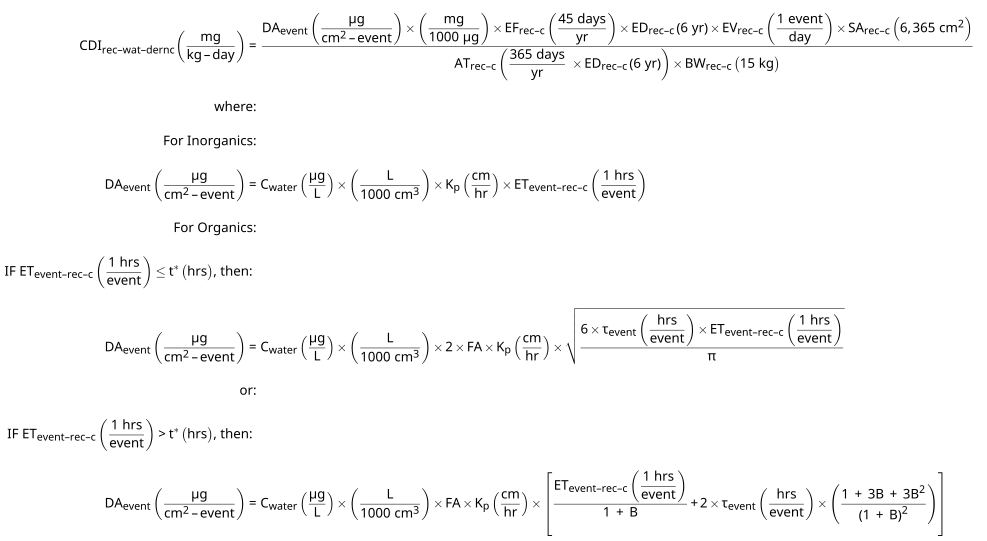
4.7.2.2 Noncarcinogenic Adult
The surface water CDI equations, presented here for adult exposures, contain the following exposure routes:
ingestion of water and

dermal contact with water.
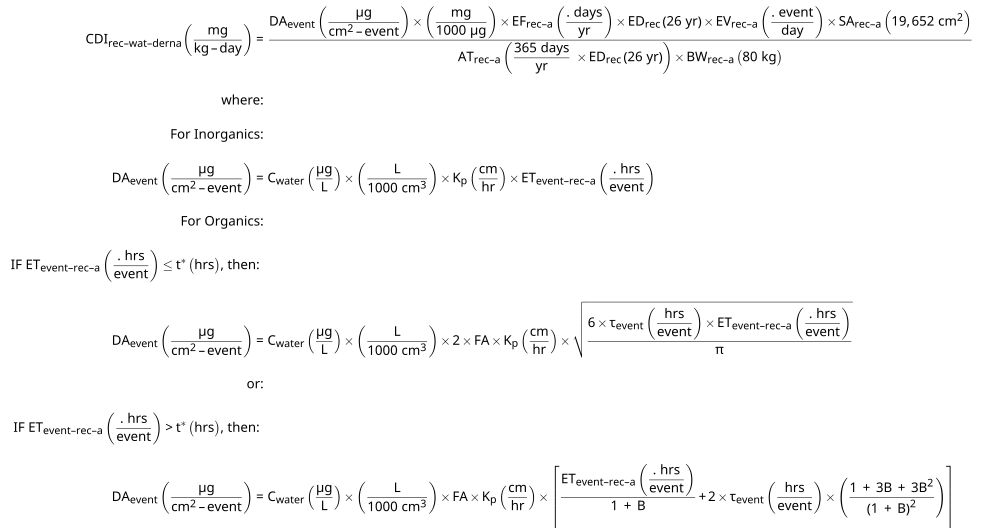
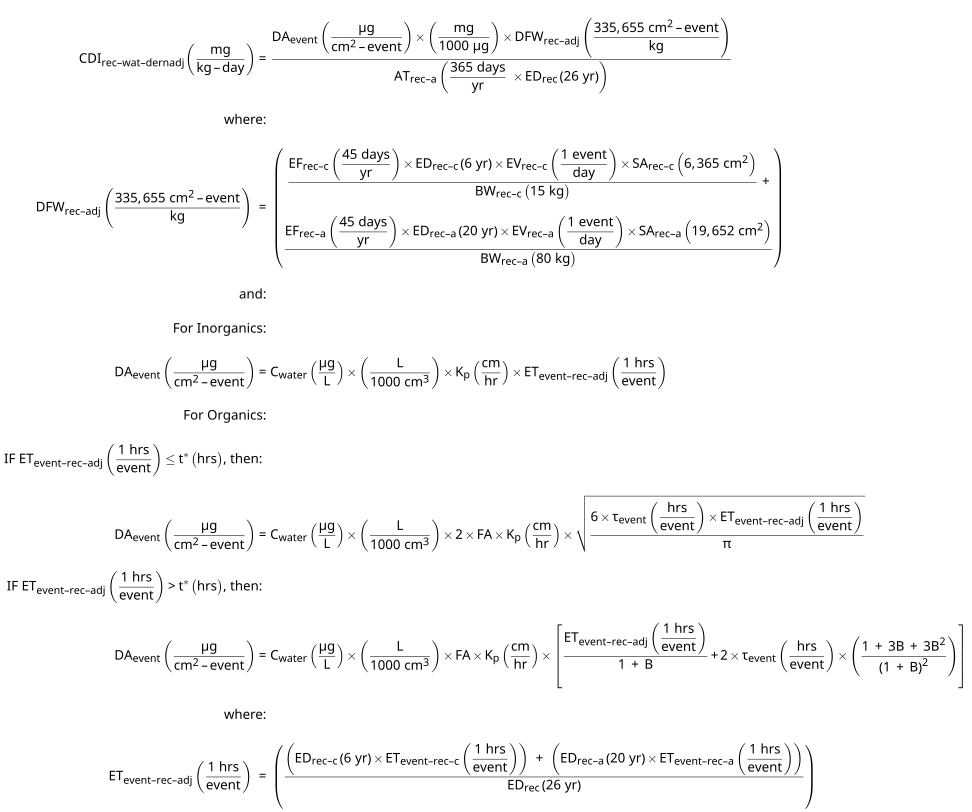
4.7.2.3 Noncarcinogenic Age-adjusted
The surface water CDI equations, presented here for age-adjusted exposures, contain the following exposure routes:
ingestion of water and
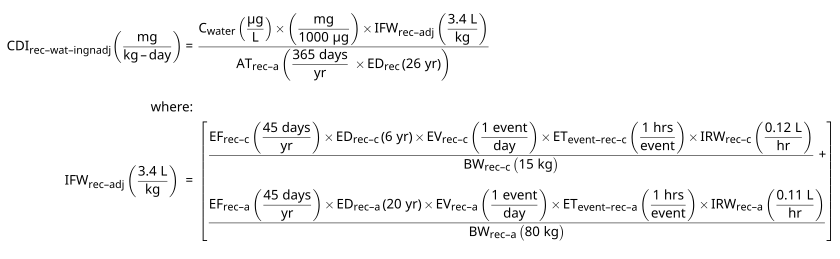
dermal contact with water.
4.7.2.4 Carcinogenic
The surface water CDI equations, presented here, contain the following exposure routes:
ingestion of water and
dermal contact with water.
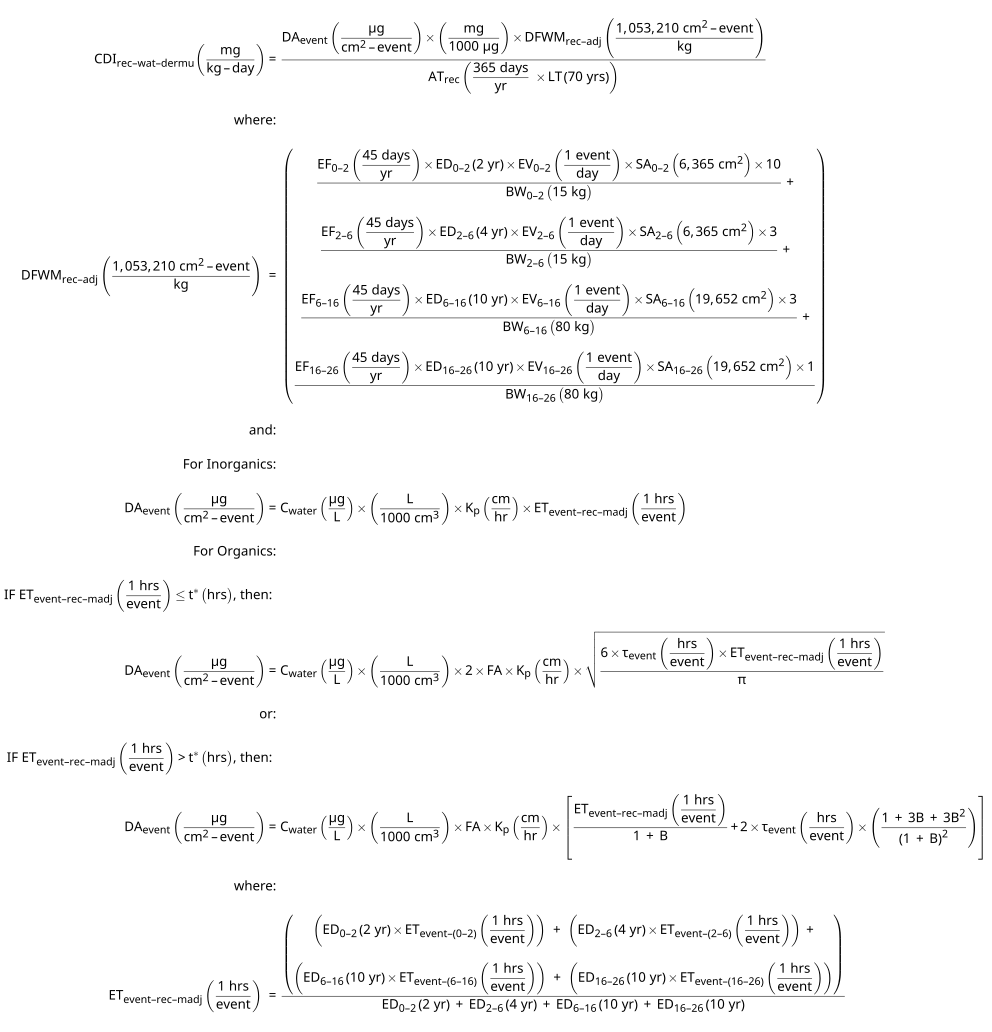
4.7.2.5 Mutagenic
The surface water CDI equations, presented here, contain the following exposure routes:
ingestion of water and
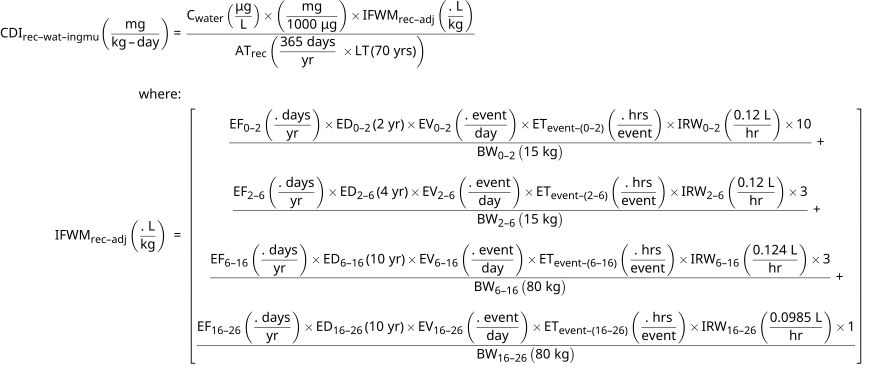
dermal contact with water.
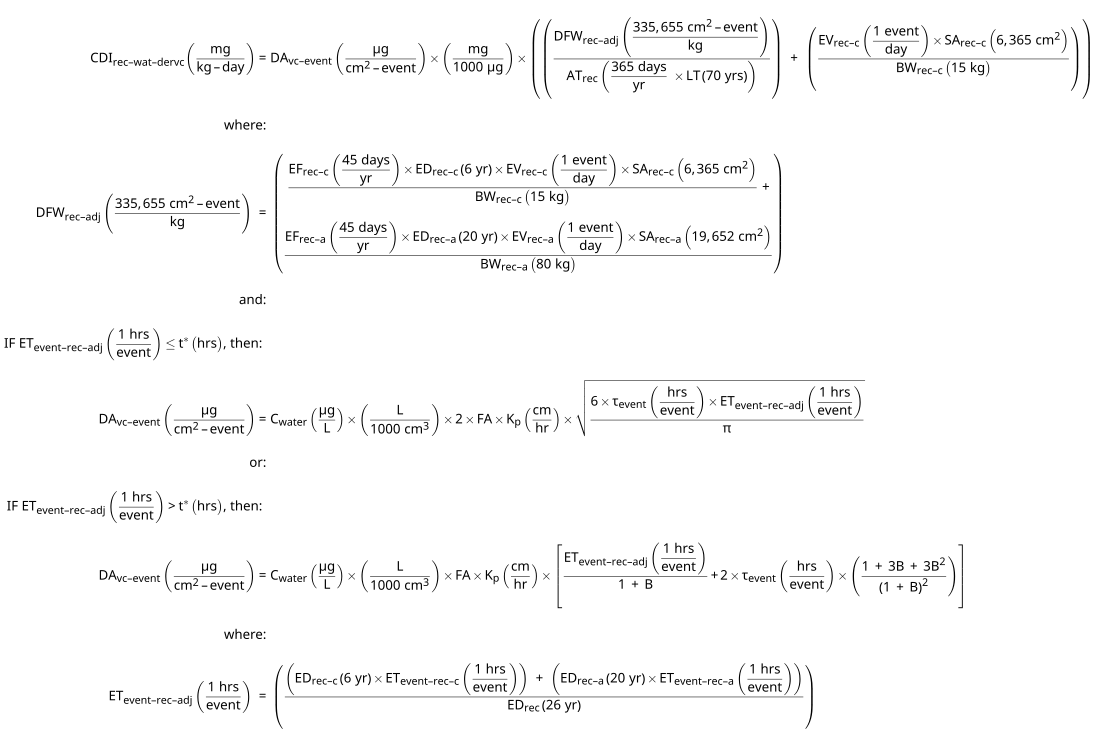
4.7.2.6 Vinyl Chloride - Carcinogenic
The surface water CDI equations, presented here, contain the following exposure routes:
ingestion of water and
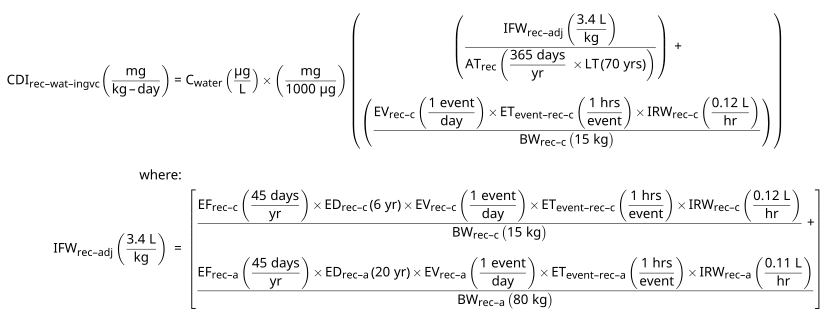
dermal contact with water.
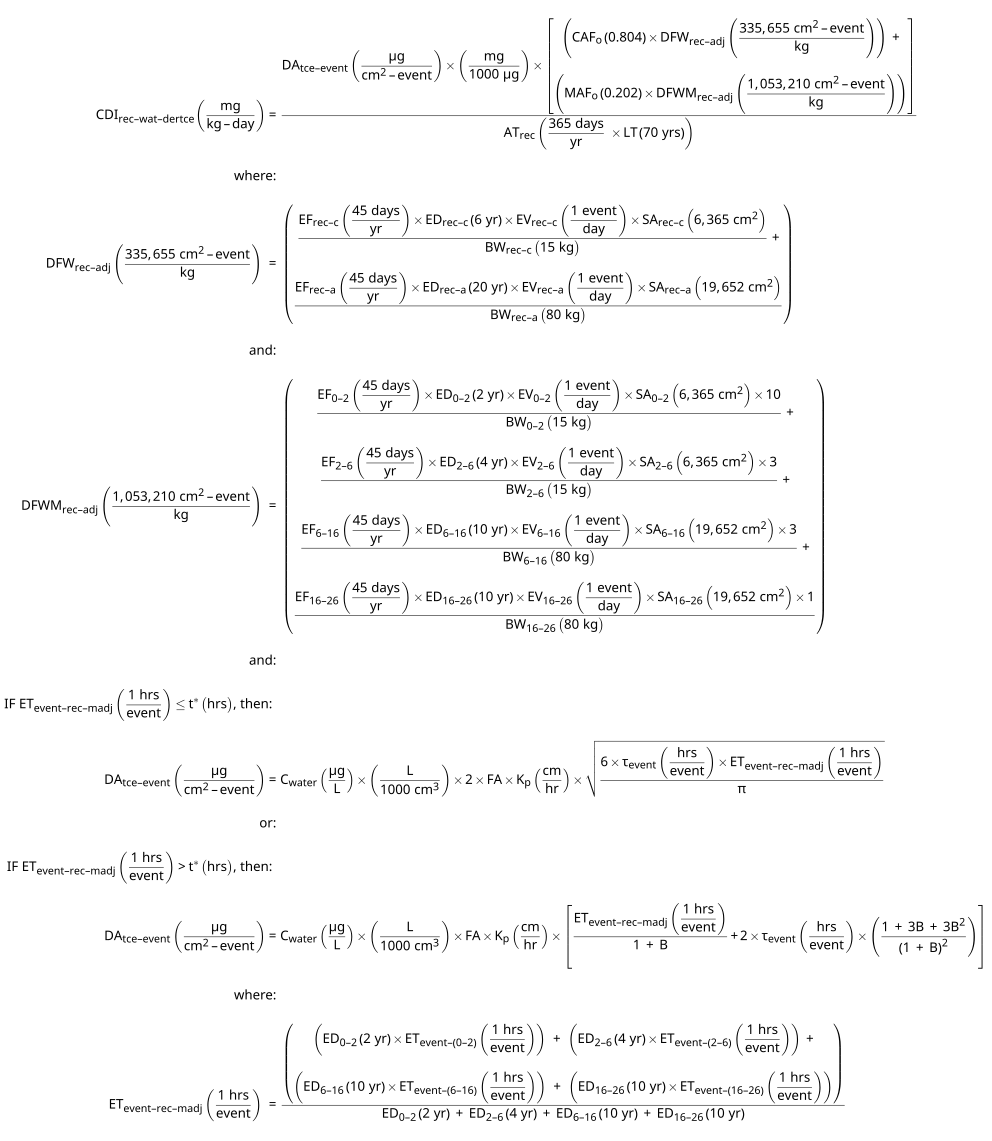
4.7.2.7 Trichloroethylene - Carcinogenic and Mutagenic
The surface water CDI equations, presented here, contain the following exposure routes:
ingestion of water and
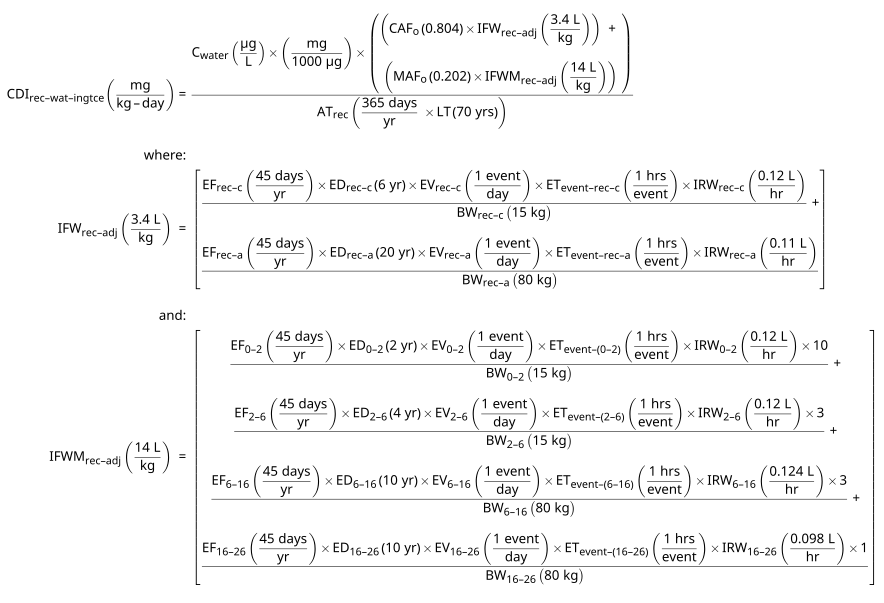
dermal contact with water.
4.7.2.8 Supporting Equations for Recreation Surface Water
Child Supporting Equations.
Adult Supporting Equations.
Age-adjusted Supporting Equations.
4.8 Farmer
4.8.1 Farmer Direct Consumption of Agricultural Products
The farmer scenario should be considered an extension of the resident scenario and evaluate consumption of farm products for a subsistence farmer. Like the resident, the farmer assumes the receptor will be exposed via the consumption of home grown produce (100% of fruit and vegetables are from the farm). In addition to produce, 100% of consumption of the following are also considered to be from the farm: beef and milk. All feed (100%) for farm products is considered to have been grown on contaminated portions of the site. For these farm products, risk-based CDIs are provided for the farm product itself (vegetables, beef, and milk). Also like the resident, age-adjusted intake equations were developed for all of the consumption equations to account for changes in intake as the receptor ages.
4.8.1.1 Noncarcinogenic Child
The ingestion of produce equation, presented here, contains the following exposure route:
consumption of produce.

consumption of dairy.

consumption of beef.

4.8.1.2 Noncarcinogenic Adult
The ingestion of dairy equation, presented here, contains the following exposure route:
consumption of produce.

consumption of dairy.

consumption of beef.

4.8.1.3 Noncarcinogenic Age-ajusted
The ingestion of beef equation, presented here, contains the following exposure route:
consumption of produce.

consumption of dairy.

consumption of beef.

4.8.1.4 Carcinogenic
The ingestion of beef equation, presented here, contains the following exposure route:
consumption of produce.
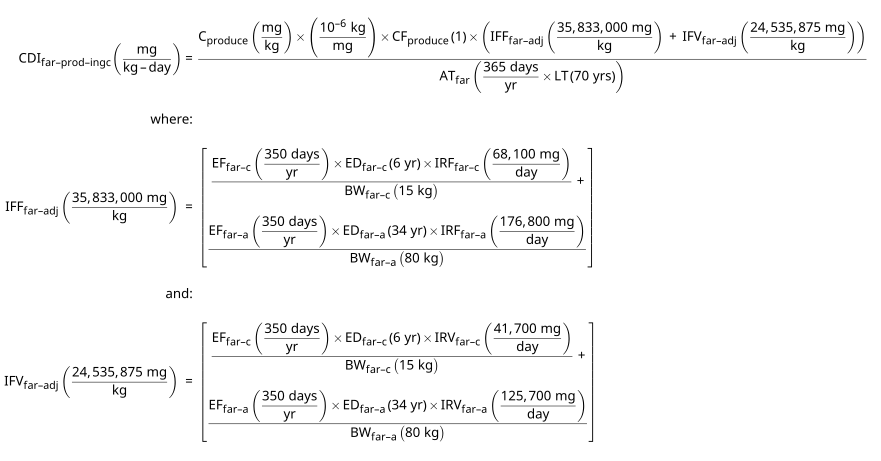
consumption of dairy.
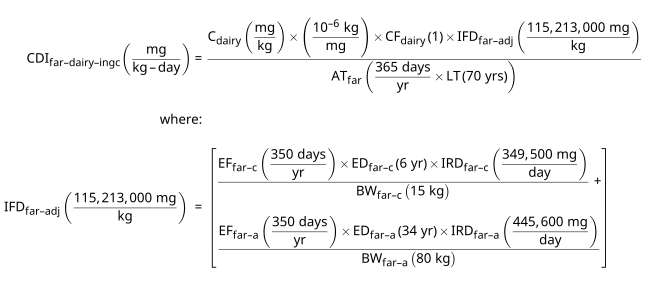
consumption of beef.
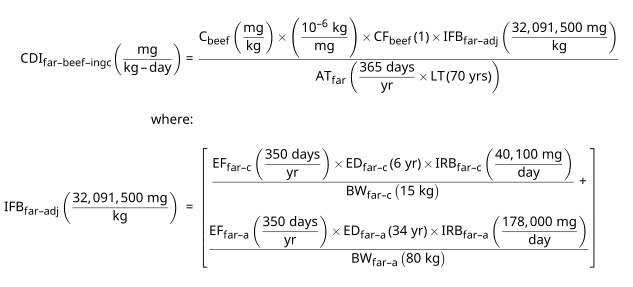
4.8.1.5 Mutagenic
The ingestion of beef equation, presented here, contains the following exposure route:
consumption of produce.

consumption of dairy.

consumption of beef.

4.8.1.6 Trichloroethylene
The ingestion of beef equation, presented here, contains the following exposure route:
consumption of produce.

consumption of dairy.

consumption of beef.

4.8.1.7 Vinyl Chloride
The ingestion of beef equation, presented here, contains the following exposure route:
consumption of produce.

consumption of dairy.

consumption of beef.

4.8.2 Farmer Direct Exposure to Tap Water and Consumption of Agricultural Products - Combined Water and Biota
4.8.2.1 Noncarcinogenic Child
The tap water land use equation, presented here for child exposures, contains the following exposure routes:
ingestion of water,

dermal contact with water,

inhalation of volatiles,

consumption of produce,

consumption of milk,

and consumption of beef.

4.8.2.2 Noncarcinogenic Adult
The tap water land use equation, presented here for adult exposures, contains the following exposure routes:
ingestion of water,

dermal contact with water,

inhalation of volatiles,

consumption of produce,

consumption of milk,

and consumption of beef.

4.8.2.3 Noncarcinogenic Age-adjusted
The tap water land use equation, presented here for age-adjusted exposures, contains the following exposure routes:
ingestion of water,

dermal contact with water,

inhalation of volatiles,

consumption of produce,

consumption of milk,

and consumption of beef.

4.8.2.4 Carcinogenic
The tap water land use equation, presented here for carcinogenic exposures, contains the following exposure routes:
ingestion of water,

dermal contact with water,

inhalation of volatiles,

consumption of produce,
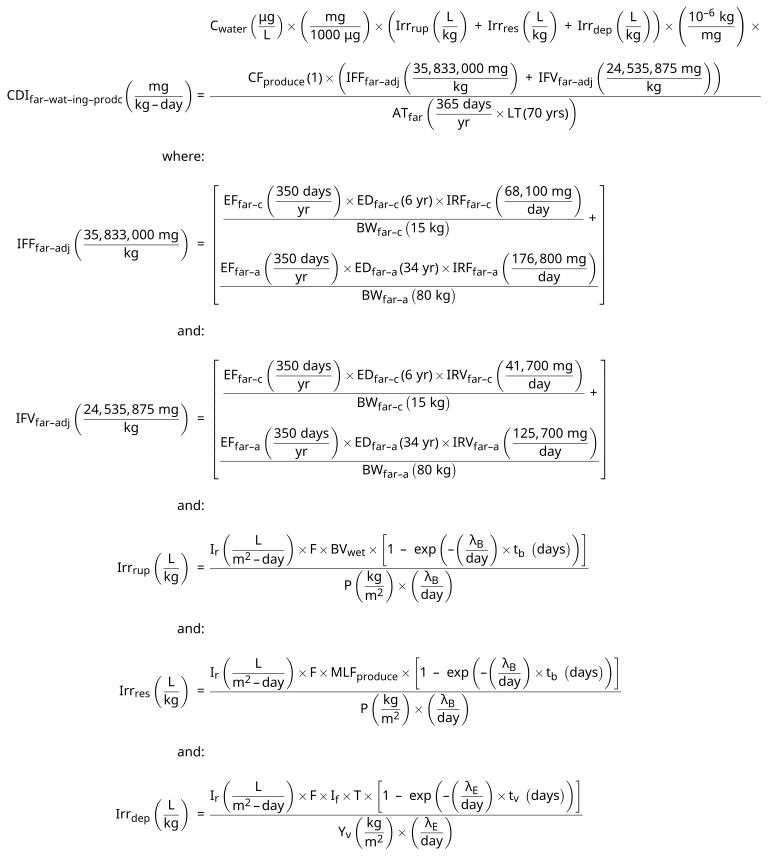
consumption of milk,
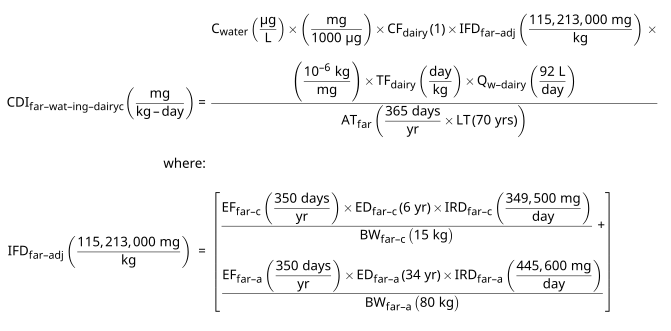
and consumption of beef.
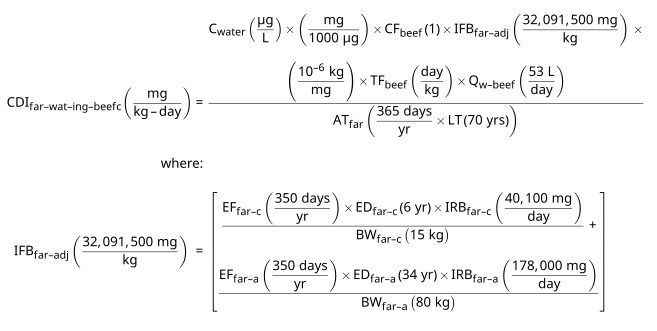
4.8.2.5 Mutagenic
The tap water land use equation, presented here for mutagenic exposures, contains the following exposure routes:
ingestion of water,

dermal contact with water,

inhalation of volatiles,

consumption of produce,

consumption of milk,

and consumption of beef.

4.8.2.6 Trichloroethylene
The tap water land use equation, presented here for trichloroethylene exposures, contains the following exposure routes:
ingestion of water,

dermal contact with water,

inhalation of volatiles,

consumption of produce,

consumption of milk,

and consumption of beef.

4.8.2.7 Vinyl Chloride
The tap water land use equation, presented here for vinyl chloride exposures, contains the following exposure routes:
ingestion of water,

dermal contact with water,

inhalation of volatiles,

consumption of produce,

consumption of milk,

and consumption of beef.

4.8.3 Farmer Direct Exposure to Soil and Consumption of Agricultural Products - Combined Soil and Biota
4.8.3.1 Noncarcinogenic Child
The farmer soil land use equations, presented here for child exposures, contain the following exposure routes:
ingestion of soil,

dermal contact with soil,

inhalation of particulates emitted from soil,

consumption of produce,

consumption of milk,

and consumption of beef.

4.8.3.2 Noncarcinogenic Adult
The farmer soil land use equations, presented here for adult exposures, contain the following exposure routes:
ingestion of soil,

dermal contact with soil,

inhalation of particulates emitted from soil,

consumption of produce,

consumption of milk,

and consumption of beef.

4.8.3.3 Noncarcinogenic Age-adjusted
The farmer soil land use equations, presented here for age-adjusted exposures, contain the following exposure routes:
ingestion of soil,

dermal contact with soil,

inhalation of particulates emitted from soil,

consumption of produce,

consumption of milk,

and consumption of beef.

4.8.3.4 Carcinogenic
The farmer soil land use equations, presented here for carcinogenic exposures, contain the following exposure routes:
ingestion of soil,

dermal contact with soil,

inhalation of particulates emitted from soil,

consumption of produce,
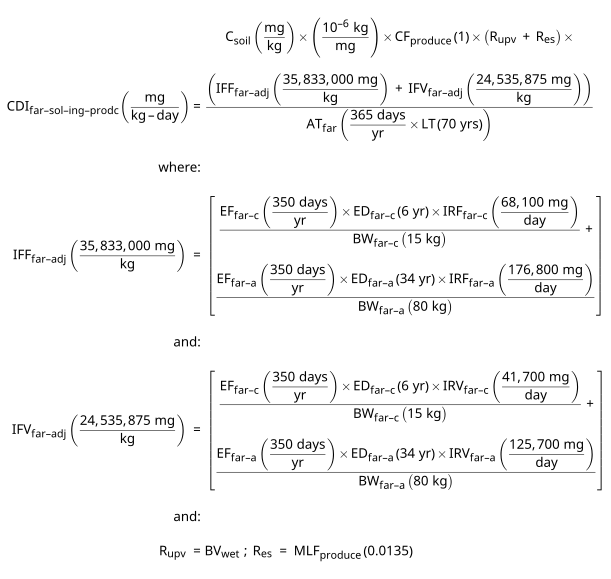
consumption of milk,
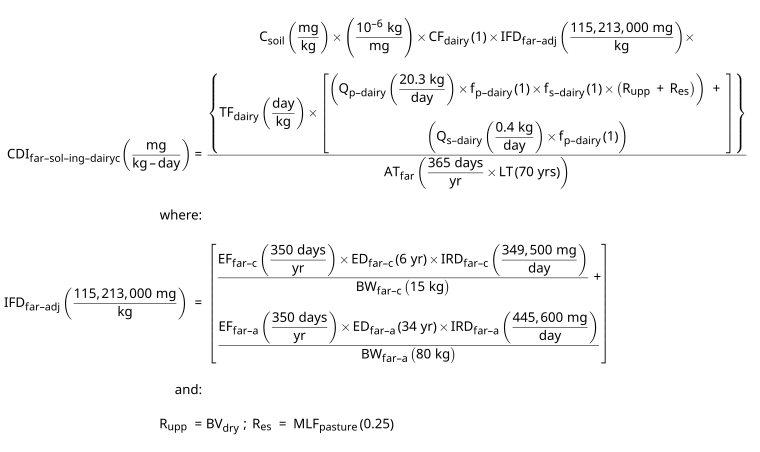
and consumption of beef.
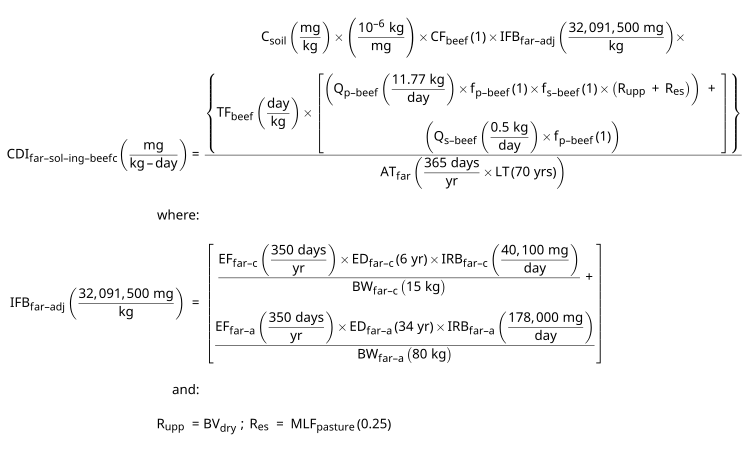
4.8.3.5 Mutagenic
The farmer soil land use equations, presented here for mutagenic exposures, contain the following exposure routes:
ingestion of soil,

dermal contact with soil,

inhalation of particulates emitted from soil,

consumption of produce,

consumption of milk,

and consumption of beef.

4.8.3.6 Trichloroethylene
The farmer soil land use equations, presented here for trichloroethylene exposures, contain the following exposure routes:
ingestion of soil,

dermal contact with soil,

inhalation of particulates emitted from soil,

consumption of produce,

consumption of milk,

and consumption of beef.

4.8.3.7 Vinyl Chloride
The farmer soil land use equations, presented here for vinyl chloride exposures, contain the following exposure routes:
ingestion of soil,

dermal contact with soil,

inhalation of particulates emitted from soil,

consumption of produce,

consumption of milk,

and consumption of beef.

4.9 Soil to Groundwater
The soil migration to groundwater risk scenario is used to determine risk from groundwater exposure based on concentration in soil. Migration of contaminants from soil to groundwater can be envisioned as a two-stage process: (1) release of contaminant from soil to soil leachate and (2) transport of the contaminant through the underlying soil and aquifer to a receptor well. The soil to groundwater scenario considers both of these fate and transport mechanisms. The groundwater concentration is determined using a known concentration in soil, chemical specific Kd, and a dilution attenuation factor to obtain a risk or hazard. The soil to groundwater media option is included in both resident and indoor worker land use scenarios as they both model tap water risks.
The risks and hazards determined in the soil migration to groundwater scenario are all based on three phases (vapor, soil and water).
Kds are from the Soil Screening Guidance Exhibit C-4. According to Appendix C,
"Exhibit C-4 provides pH-specific soil-water partition coefficients (Kd) for metals. Site-specific soil pH measurements can be used to select appropriate Kd values for these metals. Where site-specific soil pH values are not available, values corresponding to a pH of 6.8 should be used."If a metal is not listed in Exhibit C-4, Kds were taken from Baes, C. F. 1984. Kds for organic componds are calculated from Koc and the fraction of organic carbon in the soil (foc). Kds for metals are listed below.
Chemical CAS Reference Aluminum 7429-90-5 Baes, C.F. 1984 Antimony (metallic) 7440-36-0 SSG 9355.4-23 July 1996 Arsenic, Inorganic 7440-38-2 SSG 9355.4-23 July 1996 Barium 7440-39-3 SSG 9355.4-23 July 1996 Beryllium and compounds 7440-41-7 SSG 9355.4-23 July 1996 Boron and Borates Only 7440-42-8 Baes, C.F. 1984 Bromate 15541-45-4 Baes, C.F. 1984 Cadmium (Diet) 7440-43-9 SSG 9355.4-23 July 1996 Cadmium (Water) 7440-43-9 SSG 9355.4-23 July 1996 Chlorine 7782-50-5 Baes, C.F. 1984 Chromium (III) (Insoluble Salts) 16065-83-1 SSG 9355.4-23 July 1996 Chromium Salts 0-00-3 Baes, C.F. 1984 Chromium VI (chromic acid mists) 18540-29-9 SSG 9355.4-23 July 1996 Chromium VI (particulates) 18540-29-9 SSG 9355.4-23 July 1996 Chromium, Total (1:6 ratio Cr VI: Cr III) 7440-47-3 SSG 9355.4-23 July 1996 Cobalt 7440-48-4 Baes, C.F. 1984 Copper 7440-50-8 Baes, C.F. 1984 Cyanide (CN-) 57-12-5 SSG 9355.4-23 July 1996 Fluoride 16984-48-8 Surrogate Value from Fluorine (Soluble Fluoride) Fluorine (Soluble Fluoride) 7782-41-4 Baes, C.F. 1984 Hydrogen Cyanide (HCN) 74-90-8 Surrogate value from Cyanide Iron 7439-89-6 Baes, C.F. 1984 Lead and Compounds 7439-92-1 Baes, C.F. 1984 Lithium 7439-93-2 Baes, C.F. 1984 Magnesium 7439-95-4 Baes, C.F. 1984 Manganese (Diet) 7439-96-5 Baes, C.F. 1984 Manganese (Water) 7439-96-5 Baes, C.F. 1984 Mercury (elemental) 7439-97-6 SSG 9355.4-23 July 1996 Mercury, Inorganic Salts 0-01-7 SSG 9355.4-23 July 1996 Molybdenum 7439-98-7 Baes, C.F. 1984 Nickel Soluble Salts 7440-02-0 SSG 9355.4-23 July 1996 Phosphorus, White 7723-14-0 Baes, C.F. 1984 Selenium 7782-49-2 SSG 9355.4-23 July 1996 Silver 7440-22-4 SSG 9355.4-23 July 1996 Sodium 7440-23-5 Baes, C.F. 1984 Sodium Fluoride 7681-49-4 Surrogate Value from Fluorine (Soluble Fluoride) Strontium, Stable 7440-24-6 Baes, C.F. 1984 Thallium (Soluble Salts) 7440-28-0 SSG 9355.4-23 July 1996 Thorium 0-23-2 Baes, C.F. 1984 Tin 7440-31-5 Baes, C.F. 1984 Titanium 7440-32-6 Baes, C.F. 1984 Uranium (Soluble Salts) 0-23-8 Baes, C.F. 1984 Vanadium and Compounds 0-06-6 SSG 9355.4-23 July 1996 Vanadium, Metallic 7440-62-2 SSG 9355.4-23 July 1996 Zinc (Metallic) 7440-66-6 SSG 9355.4-23 July 1996 Zirconium 7440-67-7 Baes, C.F. 1984 Because Kds vary greatly by soil type, it is highly recommended that site-specific Kds be determined and used to calculate grounwater concentration.
The more protective of the carcinogenic and noncarcinogenic groundwater concentration is selected to calculate the risk/hazard.
4.9.1 Noncarcinogenic Tap Water Equations for SSLs
The groundwater concentration calculated using method 1 are used to calculate the tap water chronic daily intake equations, presented in Section 4.1.3 for volatiles and non-volatiles. If the contaminant is a volatile, ingestion, dermal and inhalation exposure routes are considered. If the contaminant is not a volatile, only ingestion and dermal are considered.
4.9.2 Carcinogenic Tap Water Equations for SSLs
The groundwater concentration calculated using method 2 are used to calculate the tap water chronic daily intake equations, presented in Section 4.1.3 for volatiles and non-volatiles. Sections 4.1.3.5, 4.1.3.6, and 4.1.3.7 present the mutagenic, vinyl chloride, and trichloroethylene equations, respectively. If the contaminant is a volatile, then ingestion, dermal, and inhalation exposure routes are considered. If the contaminant is not a volatile, only ingestion and dermal are considered.
4.9.3 Indoor Worker Noncarcinogenic Tap Water Equations for SSLs
The tap water equations, presented in Section 4.4.3, are used to calculate the noncarcinogenic risk for volatiles and non-volatiles. If the contaminant is a volatile, ingestion, dermal and inhalation exposure routes are considered. If the contaminant is not a volatile, only ingestion and dermal are considered.
4.9.4 Indoor Worker Carcinogenic Tap Water Equations for SSLs
The tap water equations, presented in Section 4.4.3, are used to calculate the carcinogenic risk for volatiles and non-volatiles. If the contaminant is a volatile, then ingestion, dermal, and inhalation exposure routes are considered. If the contaminant is not a volatile, only ingestion and dermal are considered.
4.9.5 Method 1: Concentration in Groundwater from Concentration in Soil
Method 1 employs a partitioning equation for migration to groundwater and defaults are provided. This method is used for the default soil to groundwater output in the calculator.
method 1 - partitioning.
4.9.6 Method 2: Concentration in Groundwater from Concentration in Soil
Method 2 employs a mass-limit equation for migration to groundwater and site-specific information is required. This method can be used in the site-specific calculator portion of this website.
method 2 - mass loading.
4.9.7 Determination of the Dilution Attenuation Factor
The default risk/hazard values are based on a dilution attenuation factor of 1. If one wishes to use the calculator to calculate risks or hazards using the SSL guidance for a source up to 0.5 acres, then a dilution attenuation factor of 20 can be used. If all of the parameters needed to calculate a site-specific dilution attenuation factor are known, they may be entered.
dilution attenuation factor.
4.10 Supporting Equations and Parameter Discussion
There are two inhalation variables in the above CDI equations that require further explanation: the particulate emission factor (PEF) and the volatilization factor (VF). Also there are supporting equations and practices presented for the dermal exposure to water route.
4.10.1 Particulate Emission Factor (PEF)
Inhalation of contaminants adsorbed to respirable particles (PM10) was assessed using a default PEF equal to 1.36 x 10⁹m3/kg. This equation relates the contaminant concentration in soil with the concentration of respirable particles in the air due to fugitive dust emissions from contaminated soils. The generic PEF was derived using default values that correspond to a receptor point concentration of approximately 0.76 ug/m3. The relationship is derived by Cowherd (1985) for a rapid assessment procedure applicable to a typical hazardous waste site, where the surface contamination provides a relatively continuous and constant potential for emission over an extended period of time (e.g. years). This represents an annual average emission rate based on wind erosion that should be compared with chronic health criteria; it is not appropriate for evaluating the potential for more acute exposures. Definitions of the input variables are in Section 6.
With the exception of specific heavy metals, the PEF does not appear to significantly affect most soil screening levels. The equation forms the basis for deriving a generic PEF for the inhalation pathway. For more details regarding specific parameters used in the PEF model, refer to Soil Screening Guidance: Technical Background Document. The use of alternate values on a specific site should be justified and presented in an Administrative Record if considered in CERCLA remedy selection.
Note: the generic PEF evaluates wind-borne emissions and does not consider dust emissions from traffic or other forms of mechanical disturbance that could lead to greater emissions than assumed here.
4.10.2 Vehicle traffic-driven Particulate Emission Factor (PEFsc)
The equation to calculate the subchronic particulate emission factor (PEFsc) is significantly different from the residential and non-residential PEF equations. The PEFsc focuses exclusively on emissions from truck traffic on unpaved roads, which typically contribute the majority of dust emissions during construction. This equation requires estimates of parameters such as the number of days with at least 0.01 inches of rainfall, the mean vehicle weight, and the sum of fleet vehicle distance traveled during construction.
The number of days with at least 0.01 inches of rainfall can be estimated using Exhibit 5-2 in the supplemental soil screening guidance. Mean vehicle weight (W) can be estimated by assuming the numbers and weights of different types of vehicles. For example, assuming that the daily unpaved road traffic consists of 20 two-ton cars and 10 twenty-ton trucks, the mean vehicle weight would be:
W = [(20 cars x 2 tons/car) + (10 trucks x 20 tons/truck)]/30 vehicles = 8 tons
The sum of the fleet vehicle kilometers traveled during construction (∑ VKT) can be estimated based on the size of the area of surface soil contamination, assuming the configuration of the unpaved road, and the amount of vehicle traffic on the road. For example, if the area of surface soil contamination is 0.5 acres (or 2,024 m2), and one assumes that this area is configured as a square with the unpaved road segment dividing the square evenly, the road length would be equal to the square root of 2,024 m2, 45 m (or 0.045 km). Assuming that each vehicle travels the length of the road once per day, 5 days per week for a total of 6 months, the total fleet vehicle kilometers traveled would be:
∑ VKT = 30 vehicles x 0.045 km/day x (52 weeks/year ÷ 2) x 5 days/wk = 175.5 km
4.10.3 Other than vehicle traffic-driven Particulate Emission Factor (PEF'sc)
Other than emissions from unpaved road traffic, the construction worker may also be exposed to particulate matter emissions from wind erosion, excavation soil dumping, dozing, grading, and tilling or similar operations PEF'sc. These operations may occur separately or concurrently and the duration of each operation may be different. For these reasons, the total unit mass emitted from each operation is calculated separately and the sum is normalized over the entire area of contamination and over the entire time during which construction activities take place. Equation E-26 in the supplemental soil screening guidance was used.
4.10.4 Infinite Source Chronic Volatilization Factor (VFulim)
The soil-to-air VF is used to define the relationship between the concentration of the contaminant in soil and the flux of the volatilized contaminant to air. VF is calculated from the equation below using chemical-specific properties and either site-measured or default values for soil moisture, dry bulk density, and fraction of organic carbon in soil. The Soil Screening Guidance: User's Guide describes how to develop site measured values for these parameters.
VF is only calculated for volatile organic compounds (VOCs). VOCs, for the purpose of this guidance, are chemicals with a Henry's Law constant of 1 x 10⁻⁵ atm-m3/mole or greater and with a molecular weight of less than 200 g/mole.
Diffusivity in Water (cm2/s)
Diffusivity in water can be calculated from the chemical's molecular weight and density, using the following correlation equation based on WATER9 (U.S. EPA, 2001):
If density is not available, diffusivity in water can be calculated using the correlation equation based on U.S. EPA (1987). The value for diffusivity in water must be greater than zero. No maximum limit is enforced.
Diffusivity in Air (cm2/s).
Diffusivity in air can be calculated from the chemical's molecular weight and density, using the following correlation equation based on WATER9 (U.S. EPA, 2001). If density is not available, an alternate equation is provided.:
For dioxins, furans, and dioxin-like PCBs, diffusivity in air should always be calculated from the molecular weight using the Graham's Law correlation equation based on December 2003 NAS Review Draft Part I: Volume 3 (pg 4-38). In this equation, the unknown diffusivity is solved by correlation to the known diphenyl diffusivity of 0.068 cm2/s and MW of 154 g/mol.
4.10.5 Mass-limit Chronic Volatilization Factor (VFmlim)
This Equation presents a model for calculating mass-limit SSLs for the outdoor inhalation of volatiles. This model can be used only if the depth and area of contamination are known or can be estimated with confidence. This equation is presented in the Soil Screening Guidance: User's Guide and the Supplemental Soil Screening Guidance.
Use of infinite source models to estimate volatilization can violate mass balance considerations, especially for small sources. To address this concern, the Soil Screening Guidance includes a model for calculating a mass-limit SSL that provides a lower limit to the SSL when the area and depth (i.e., volume) of the source are known or can be estimated reliably.
A mass-limit SSL represents the level of contaminant in the subsurface that is still protective when the entire volume of contamination volatilizes over the 30-year exposure duration and the level of contaminant at the receptor does not exceed the health-based limit.
To use mass-limit SSLs, determine the area and depth of the source, calculate both standard and mass-limit SSLs, compare them for each chemical of concern and select the higher of the two values.
Note that the equation requires a site-specific determination of the average depth of contamination in the source. Step 3, in the SSG, provides guidance for conducting subsurface sampling to determine source depth. Where the actual average depth of contamination is uncertain, a conservative estimate should be used (e.g., the maximum possible depth in the unsaturated zone). At many sites, the average water table depth may be used unless there is reason to believe that contamination extends below the water table. In this case SSLs do not apply and further investigation of the source in question is needed.
4.10.6 Unlimited Source Subchronic Volatilization Factor for Construction Worker (VFulim-sc)
Equation 5-14 of the supplemental soil screening guidance is appropriate for calculating the soil-to-air volatilization factor (VFsc) that relates the concentration of a contaminant in soil to the concentration in air resulting from volatilization. The equation for the subchronic dispersion factor for volatiles, Q/Csa, is presented in Equation 5-15 of the supplemental soil screening guidance. Q/Csa was derived using EPA's SCREEN3 dispersion model for a hypothetical site under a wide range of meteorological conditions. Unlike the Q/C values for the other scenarios, the Q/Csa for the construction scenario's simple site-specific approach can be modified only to reflect different site sizes between 0.5 and 500 acres; it cannot be modified for climatic zone. Site managers conducting a detailed site-specific analysis for the construction scenario can develop a site-specific Q/C value by running the SCREEN3 model. Further details on the derivation of Q/Csa can be found in Appendix E of the supplemental soil screening guidance.
4.10.7 Mass-limit Subchronic Volatilization Factor for Construction Worker (VFmlim-sc)
Since the equations developed to calculate SSLs for the inhalation of volatiles outdoors assume an infinite source, they can violate mass-balance considerations, especially for small sources. To address this concern, a mass-limit SSL equation for this pathway may be used (Equation 5-17 of the supplemental soils screening guidance). This equation can be used only when the volume (i.e., area and depth) of the contaminated soil source is known or can be estimated with confidence. As discussed above, the simple site-specific approach for calculating construction scenario SSLs uses the same emission model for volatiles as that used in the residential and non-residential scenarios. However, the conservative nature of this model (i.e., it assumes all contamination is at the surface) makes it sufficiently protective of construction worker exposures to volatiles.
4.10.8 Dermal Contact with Water Supporting Equations
RAGS Part E stresses the determination of whether a chemical is within the effective predictive domain (EPD) for the determination of dermal permeability constant (Kp) applicability. The RAIS risk output provides determination of whether or not a chemical is within the EPD. The RAIS risk output also displays our determination of the fraction of the chemical that is ultimately absorbed (FA). FA depends strongly on the chemical's lipophilic characteristic and molecular weight as expressed in the B parameter and the lag time. RAGS Part E has determined that dermal exposures contributing less than 10% of oral exposures are insignificant. However, the RAIS presents dermal risks regardless of contribution percent.
Effective Predictive Domain (EPD) is an area on a X/Y plot that symbolizes 95% statistical confidence levels of a regression equation to accurately estimate a dermal permeability constant (Kp). Only if a chemical is within the EPD, will the dermal route be calculated. The EPD is determined by investigating the predictive power of a regression equation using MW and log Kout values for a compound. If the intersection of the values falls within the designated plotted area, the chemical is determined to be in the EPD and the dermal route is calculated. The boundaries of MW and log Kout for the regression equation are presented below. The EPD is depicted in RAGS Part E in Appendix A; Exhibit A-1.
Dermal permeability constant (Kp cm/hr) values are either from EPI Suite or RAGS Part E in the chemical parameter hierarchy. Values from both sources are estimated. Each source has a different estimation model. The RAGS Part E model requires a log Kout and a MW, and if both log Kout and MW are available, a Kp is calculated. The RAGS Part E model is taken from the spreadsheet that accompanies RAGS Part E documentation and is reproduced below.
Fraction absorbed water (FA) is described in RAGS Part E in Appendix A. The FA term should be applied to account for the loss of chemical due to the desquamation of the outer skin layer and a corresponding reduction in the absorbed dermal dose. To determine FA values, the following regression analysis was performed. This analysis builds on the RAGS Part E data.
The dimensionless value (B) is the ratio of the permeability coefficient of a compound through the stratum corneum relative to its permeability coefficient across the viable epidermis (ve).
t* = Time to reach steady-state (hours) = 2.4 τevent
τevent = Lag time per event (hours/event)
4.10.10 Henry's Law Constant and Vapor Pressure Determination at Temperature Other Than 25°C
In site-specific mode for land uses that utilize soil or soil to groundwater media, users are given the option to the change groundwater temperature from the default of 25°C to a site-specific value. Since the unitless Henry's Law Constant (H') is derived based on the partial pressure of a gas in equilibrium with a liquid and the equilibrium changes when temperature changes, H' is changed to reflect the equilibrium at the given temperature. The equation below illustrates how H' is derived when groundwater temperature is changed. An EPA Fact Sheet describing the process can be found at Henrys Law Constant Fact Sheet.
Use the map below to find the average groundwater temperature in your region.
The equation below illustrates how vapor pressure is derived when groundwater-soil system temperature is changed.
When changing the groundwater-soil system temperature, the criteria that determines whether a chemical is volatile or not may also change. The Henry's Law constants and vapor pressures that are used in RAIS calculations are based on standard laboratory conditions of 25°C. When the groundwater-soil system temperature is changed, the Henry's Law constants and vapor pressures will change accordingly. A volatile chemical at 25°C may not be volatile at a lower temperature. Conversely, a nonvolatile may become volatile at temperatures above 25°C. When the groundwater-soil system temperature is changed the RAIS calculator will provide the user with recalculated Henry's Law constants and vapor pressures. These values can be compared to the volatility status requirements presented in section 4.10.4. The RAIS calculator does not automatically change the volatility status of a chemical to reflect the user's change of the groundwater-soil system temperature. In site-specific user-provided mode of the calculator, the user may change the volatility status of a chemical if deemed appropriate by the user's regional risk assessor. Changing the volatility status can impact the inclusion of dermal exposure to soil, inhalation of volatiles during household use of water, and the soil to groundwater Method 1 calculations. See section 4.10.4 and 4.9.5 for more information.
4.10.11 Modeling Parameters for Animals and Animal Products
Pasture Mass Loading Factor (MLFpasture)
The plant mass loading factor is defined as the ratio of the mass of soil on vegetation per mass of dry vegetation (Hinton, 1992). The mass loading factor is strictly the amount of soil that is resuspended and then remains on the plant which differs from incidental ingestion of soil by an animal.
Transfer Factor (TF)
The ratio of contaminant concentration in animal tissue (mg contaminant/kg tissue, wet weight) to daily intake (mg contaminant/day) is defined as the biotransfer factor (TF). It is a measure of how much of what the animal ingests is actually transferred to tissue. The TF (day/kg) is multiplied by a species-specific fodder ingestion rate (kg/day) and by the contaminant concentration in food (Rupp + Res) to obtain an estimate of the concentration in meat (mg contaminant/kg tissue). TFs are radionuclide- and species-specific.
Fodder Intake Rate (Qp)
Animal fodder intake rates are sometimes reported as wet weight and sometimes as dry weight. Since the soil to plant transfer factors (BV) for plants are reported on a dry weight basis, daily food intake rates should also be in dry weight.
Soil Intake Rate (Qs)
Soil ingestion by animals can be a significant exposure route. Animals may ingestion soil incidentally during grazing, grooming activities, or deliberately in search of minerals.
Water Intake Rate (Qw)
Animal water ingestion rates vary by species, dry matter intake, body size, productivity, and environmental condition.
Fraction of Time Animal is On-Site (fp)
This parameter accounts for the period of time which an animal is likely to be exposed to contaminants on the site. For livestock, this is the time on pasture. In some geographic regions, animals are only on pasture for a portion of the year. Site-specific values are desirable as grazing practices vary considerably with geographic region.
Fraction of Animal's Food from Site when On-Site (fs)
Supplemental feeding of livestock on pasture is a common management practice, therefore, a parameter to account for the fraction of an animal's daily food ingestion that comes from a site has been included in the exposure model.
Fraction of Animal's Water from Site when On-Site (fw)
The fraction of an animal's daily water intake that is obtained from water at a site. Generally, animals are assumed to obtain 100% of their water from the site unless site conditions or management practices are known to influence access to site-related water.
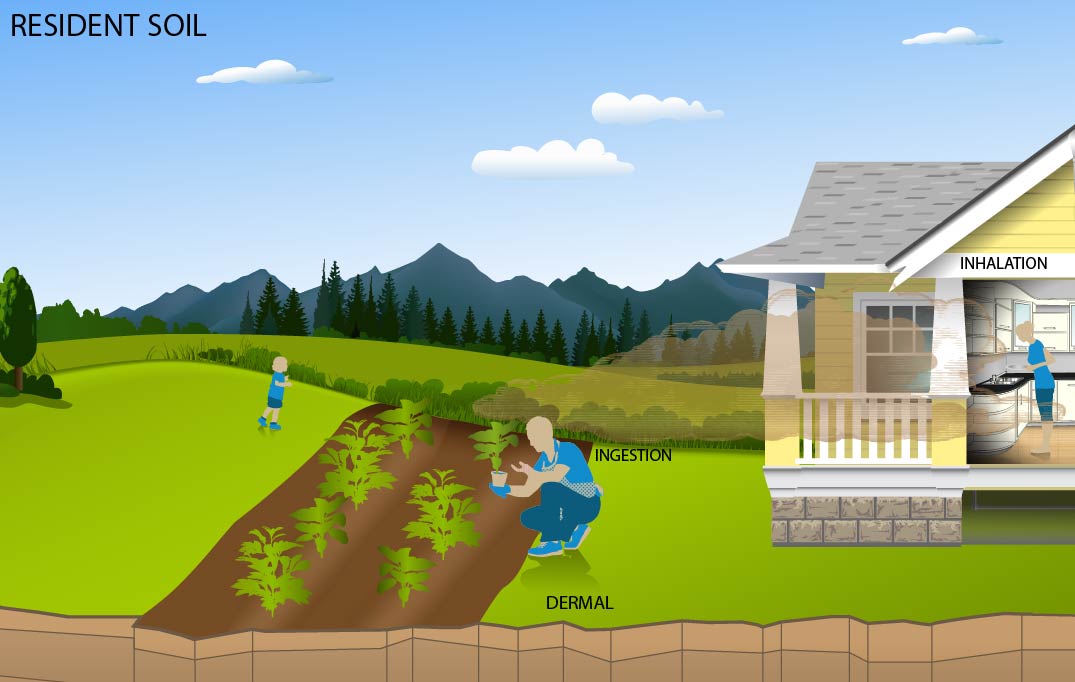
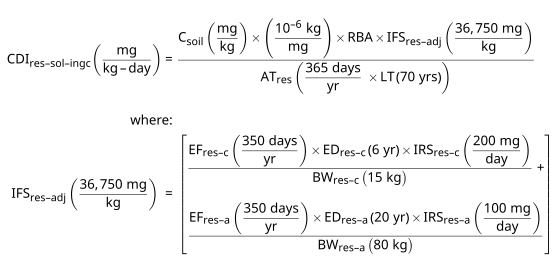

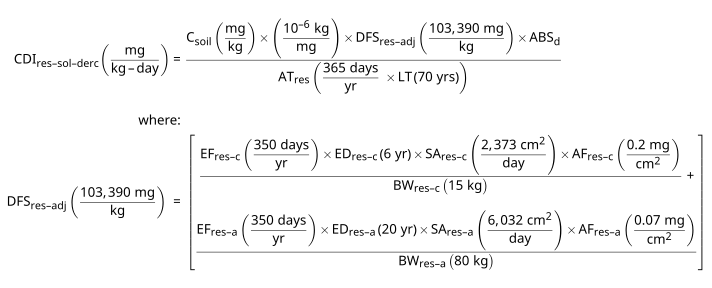
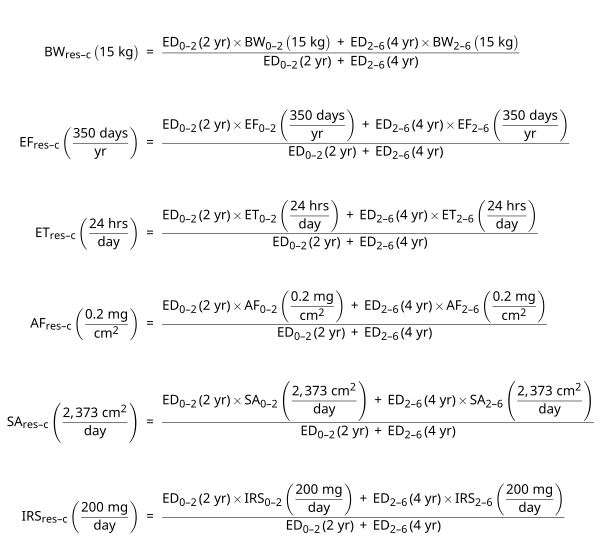
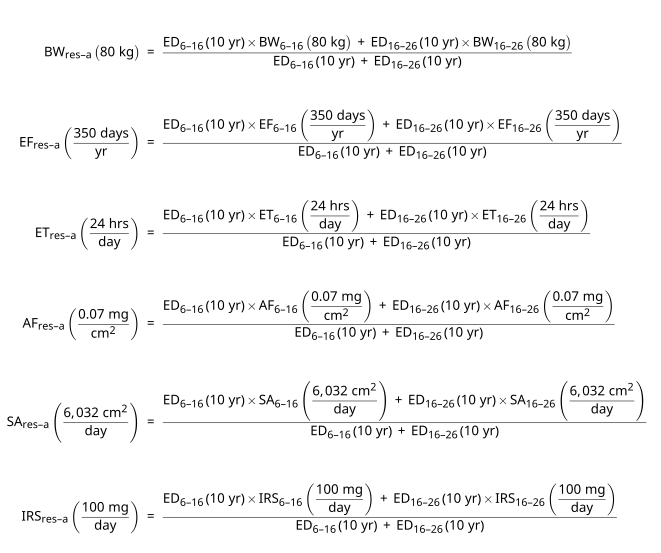
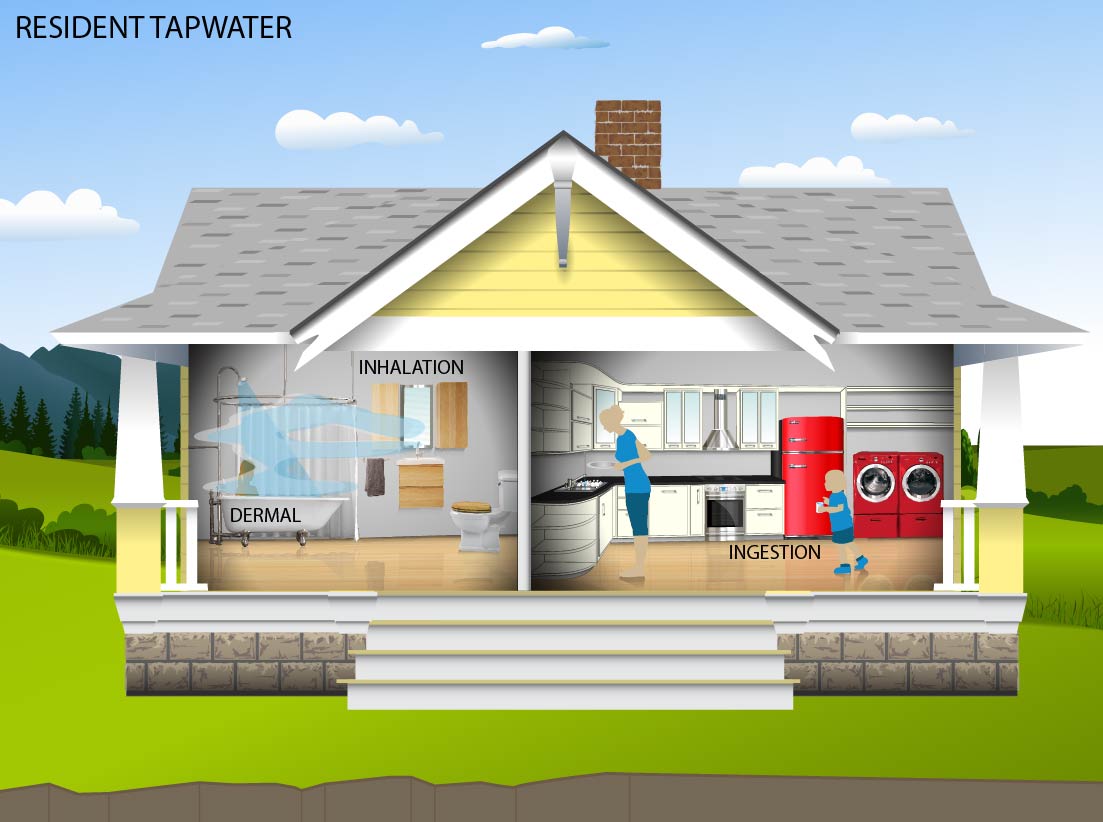
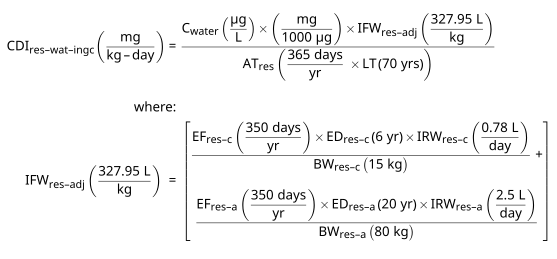
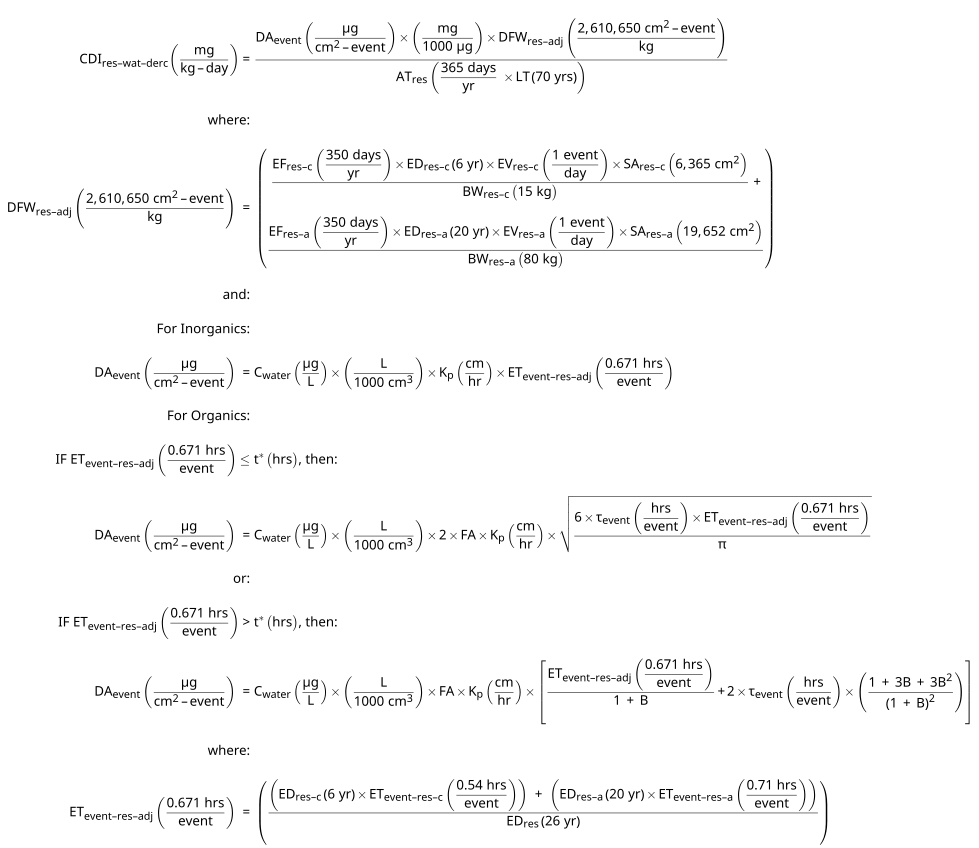

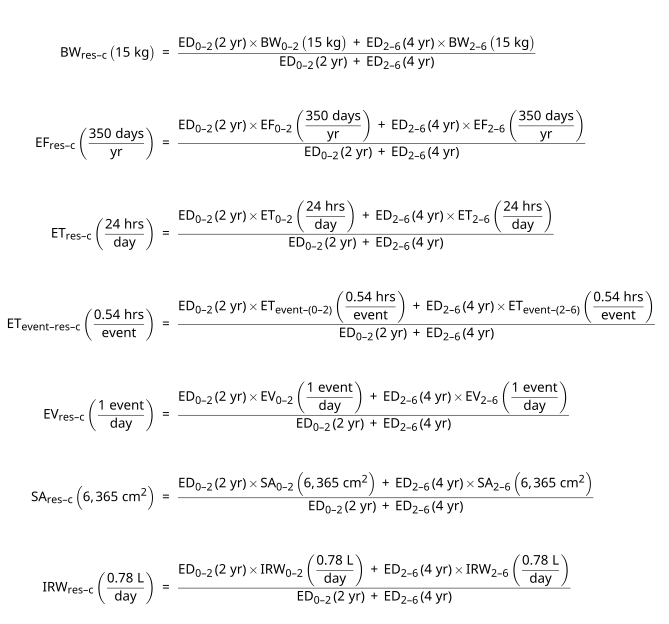
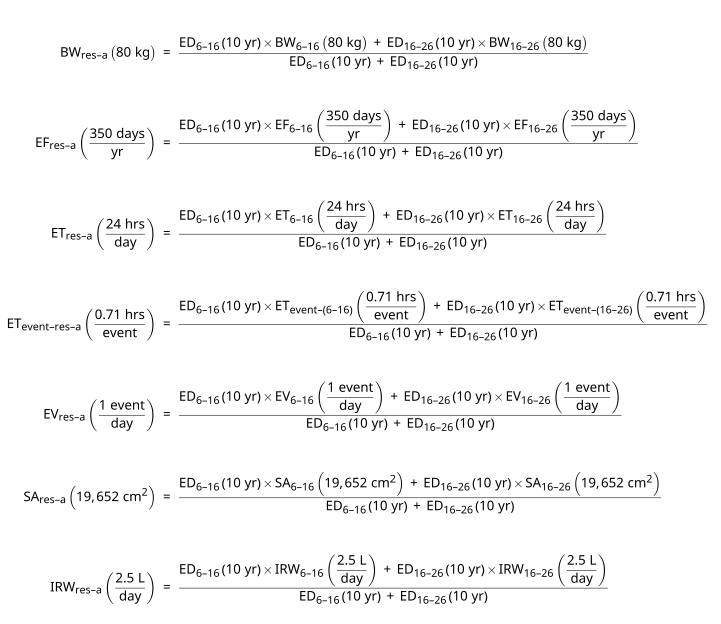
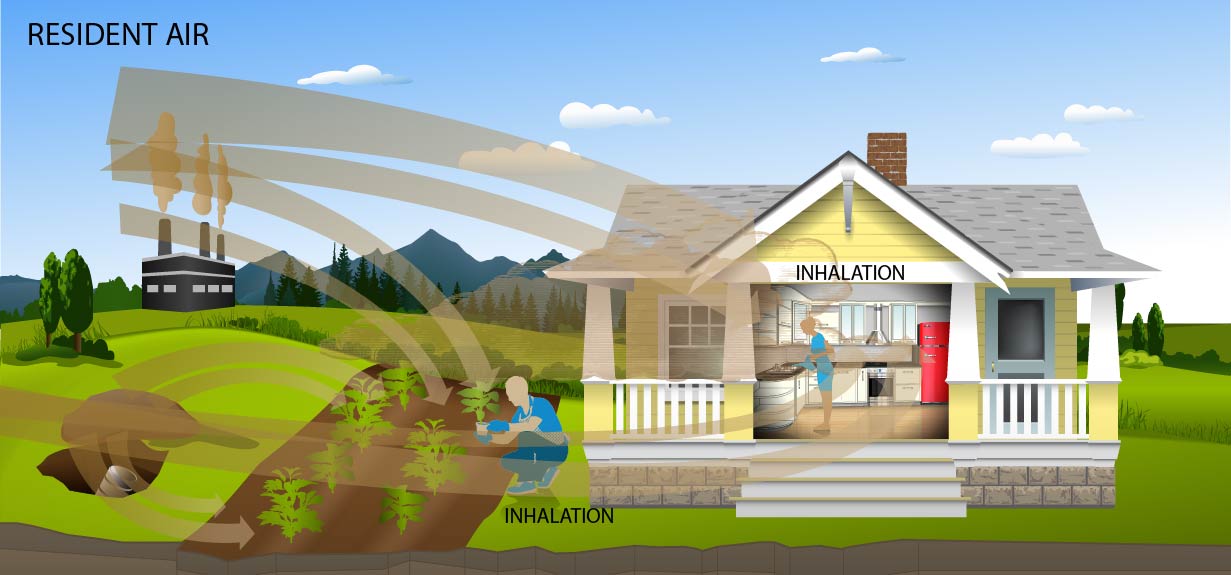


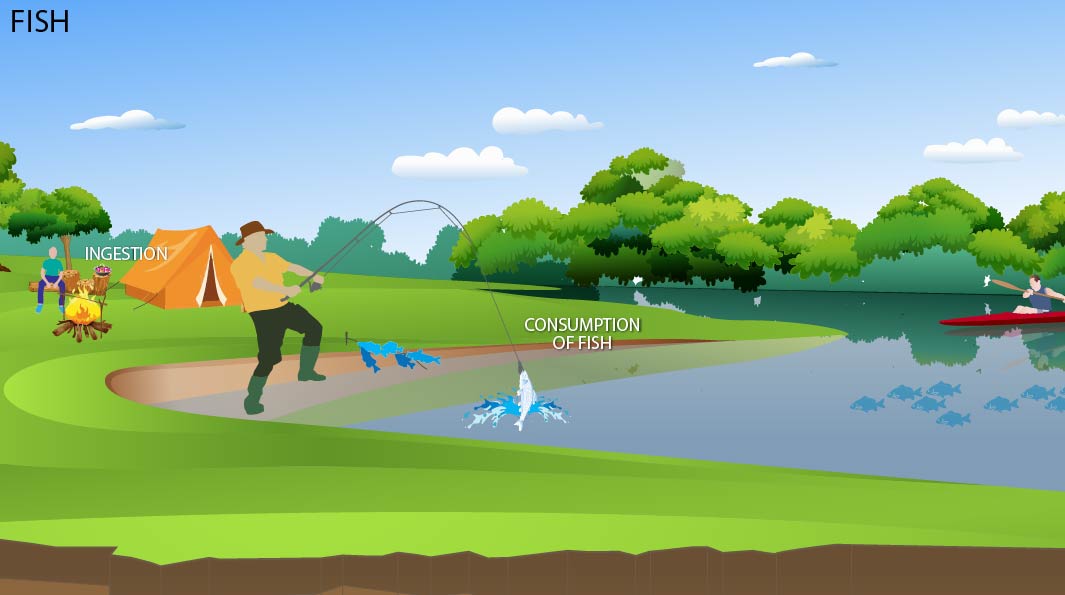


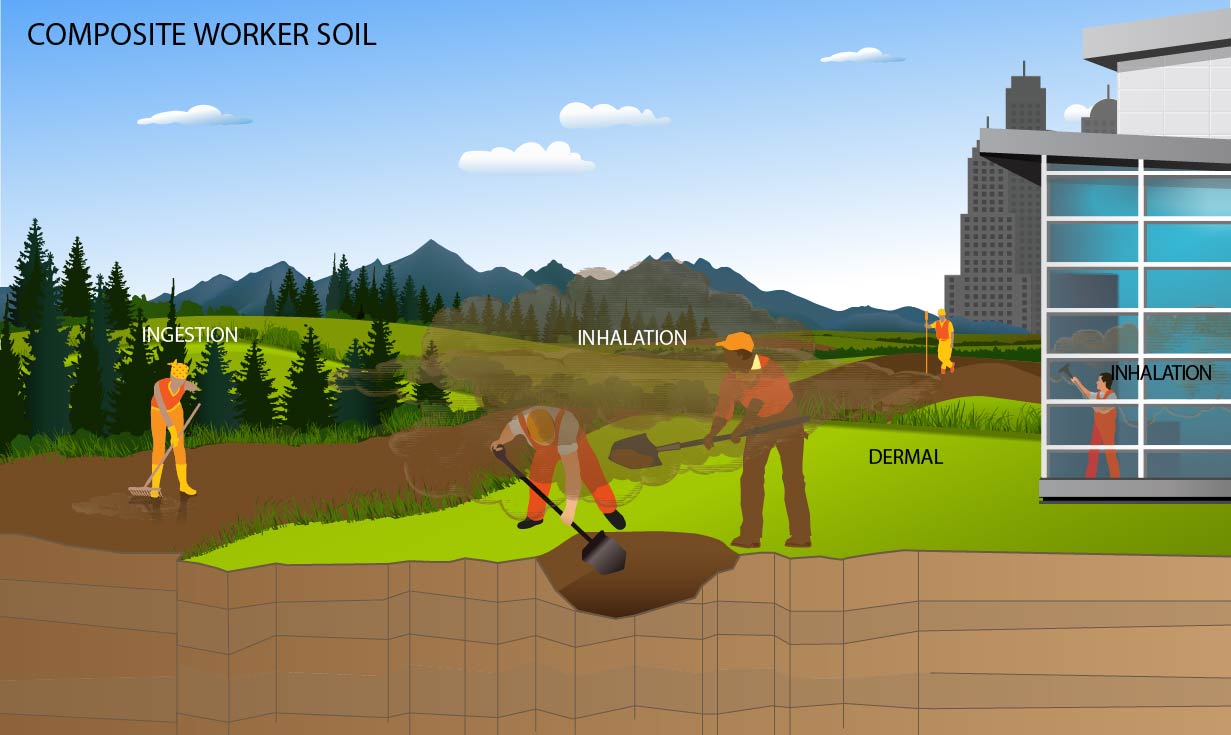






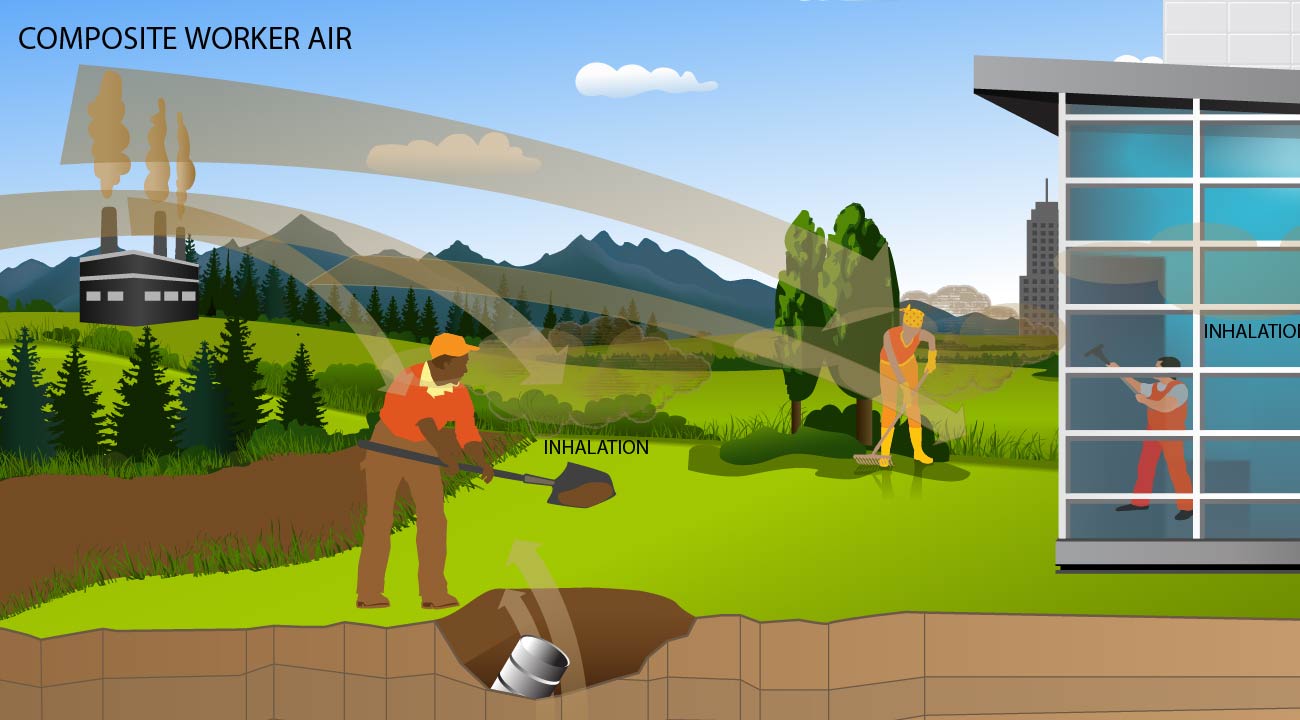


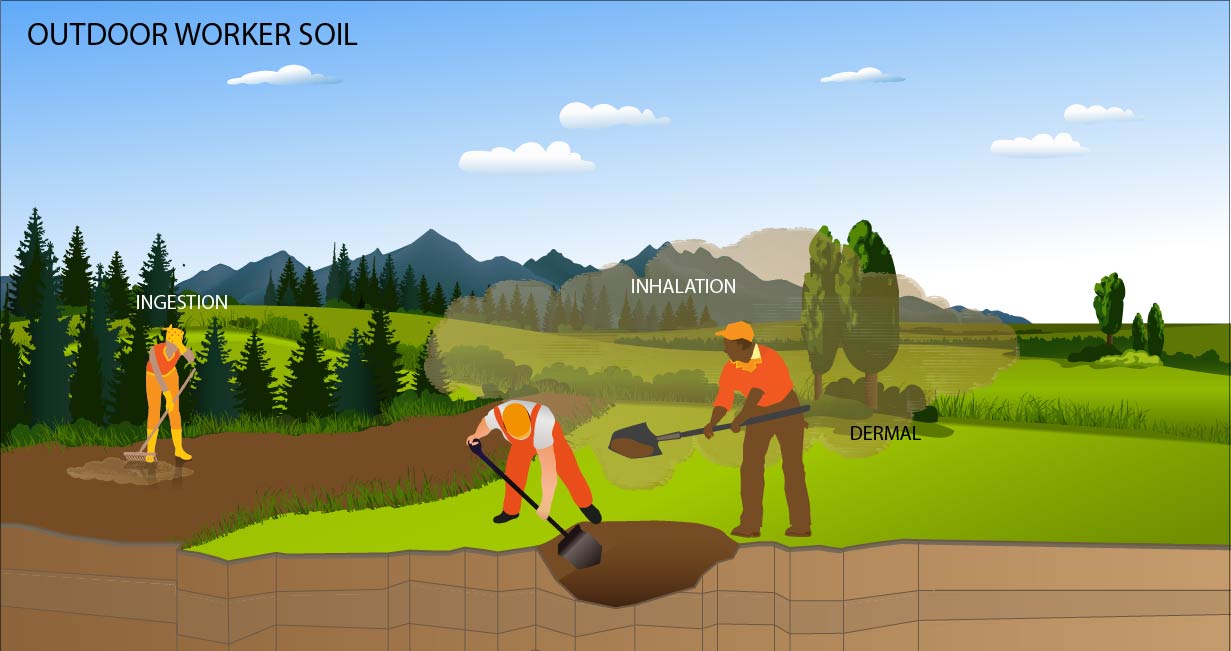






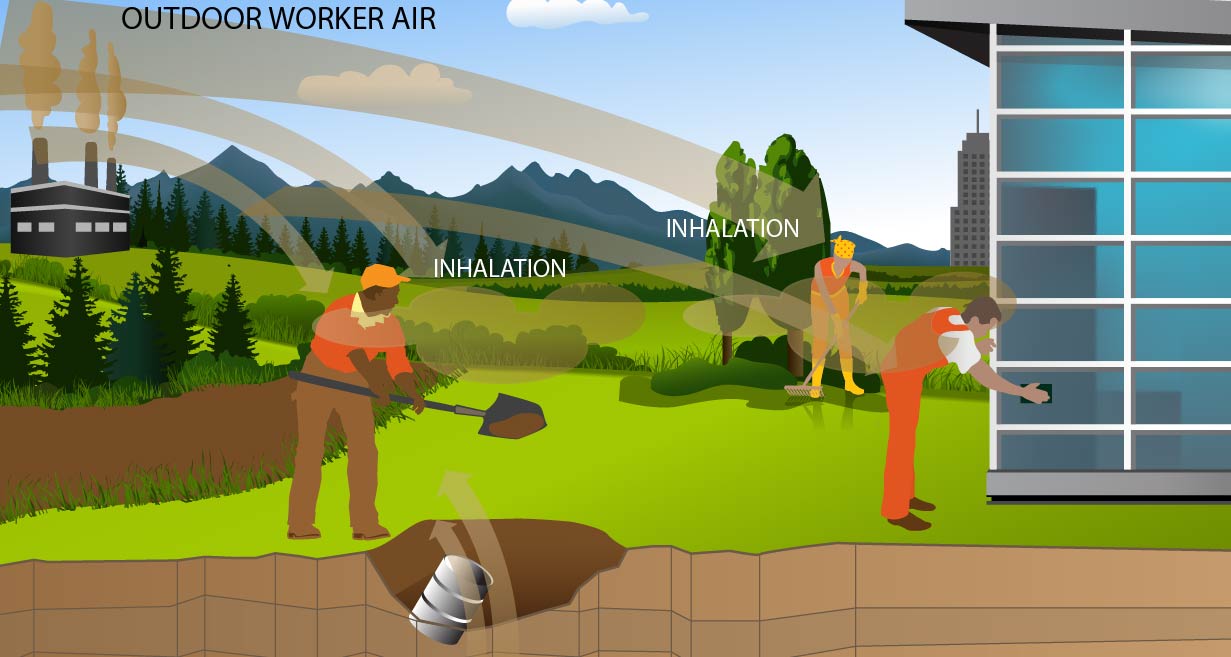


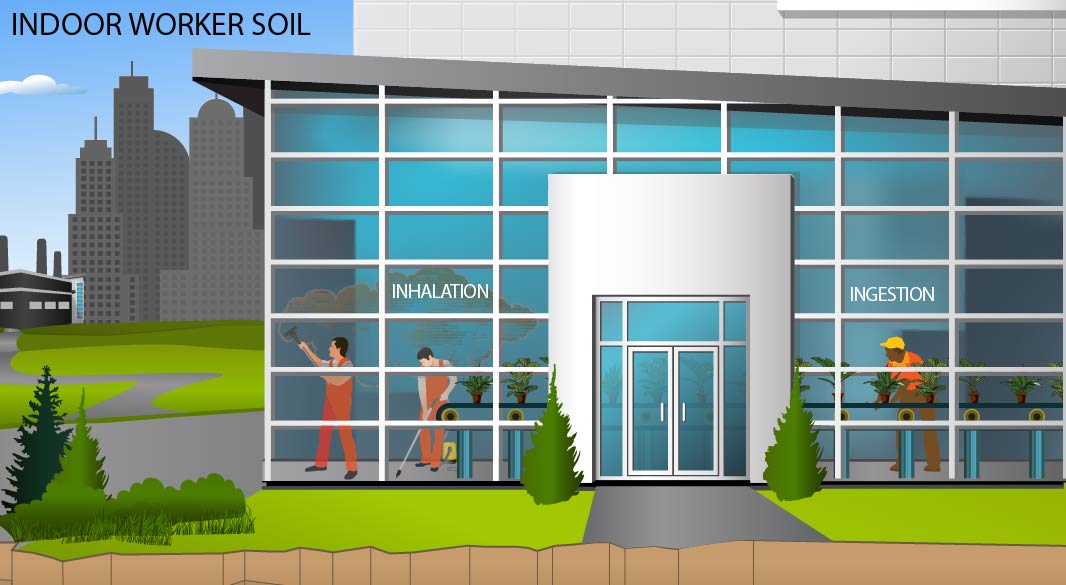




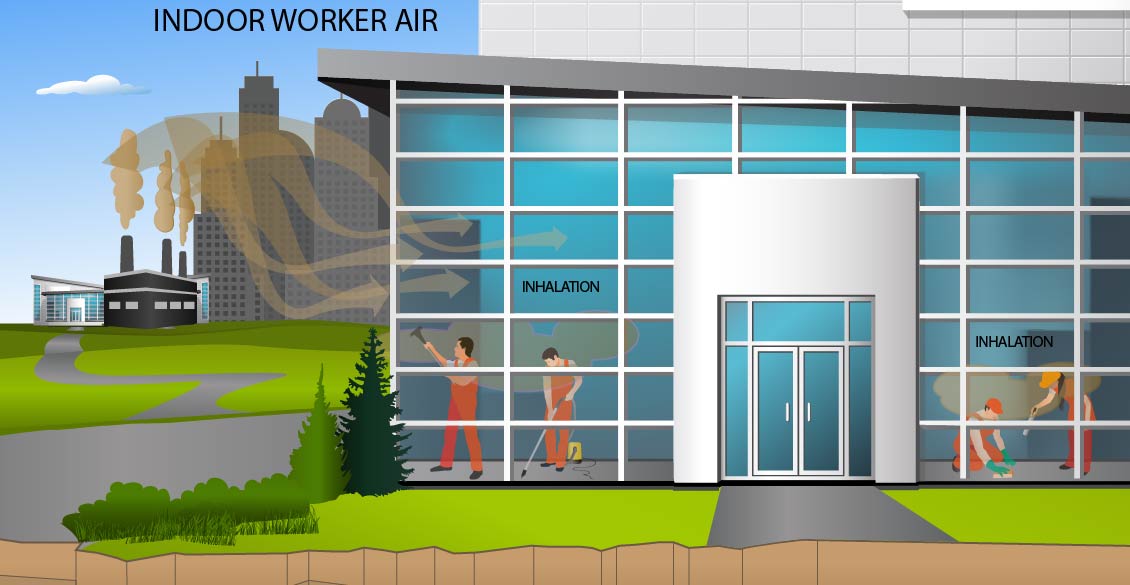




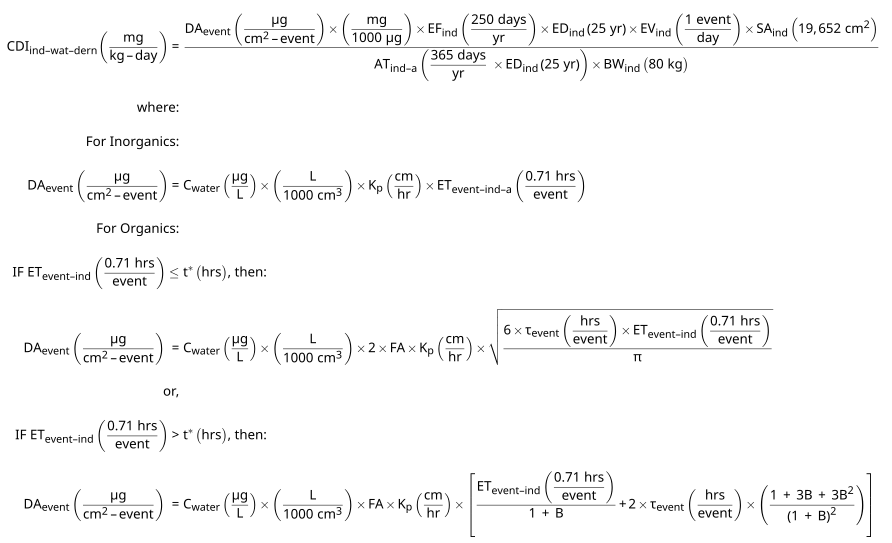


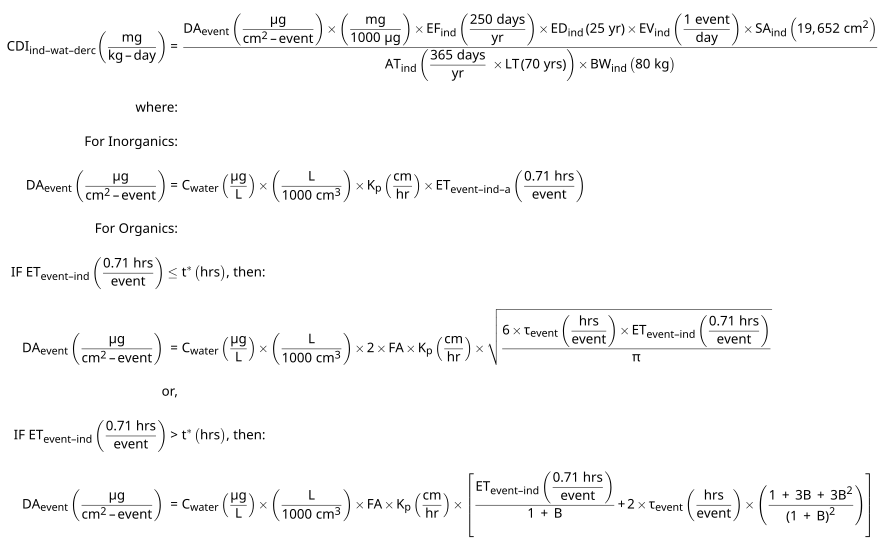


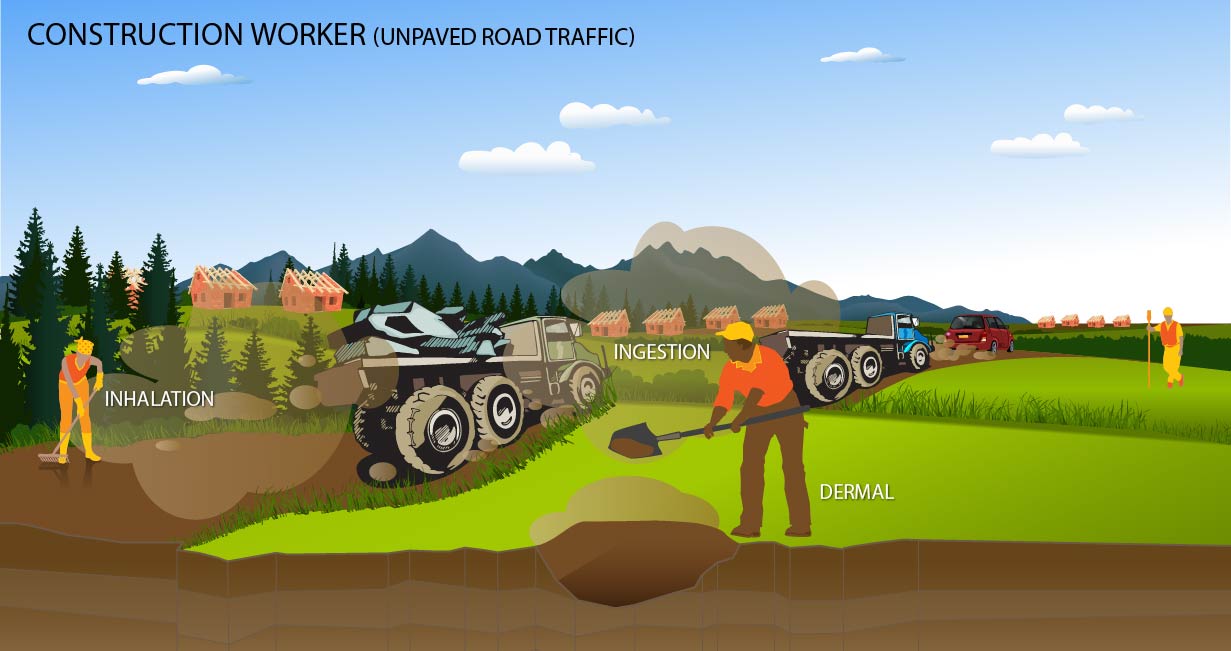






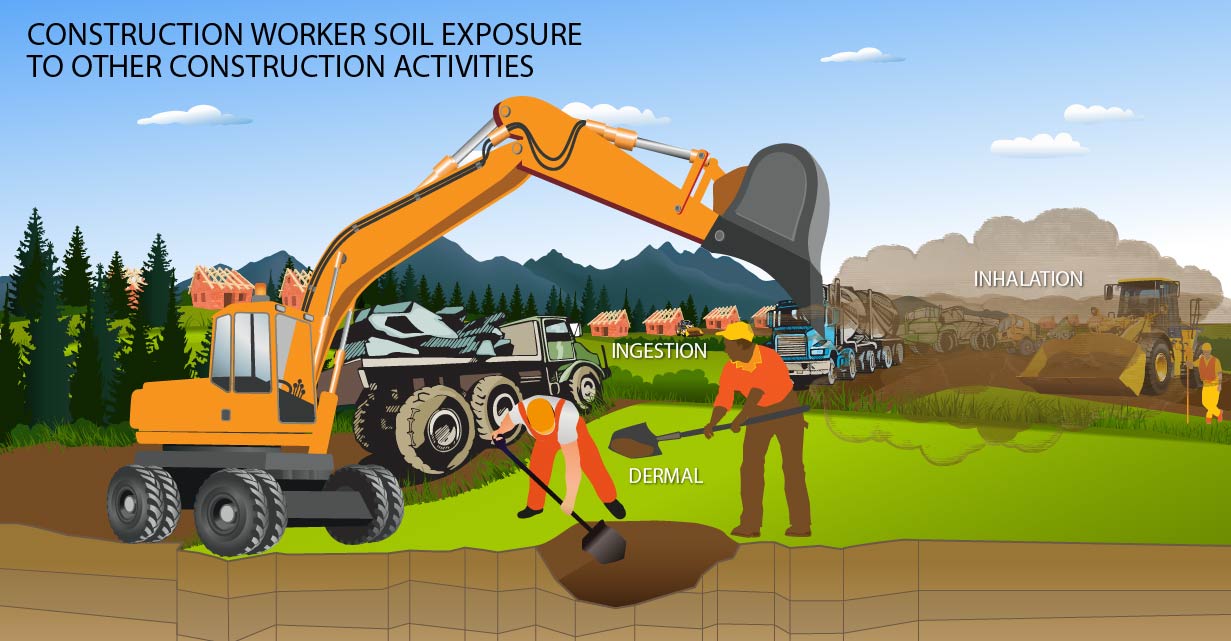
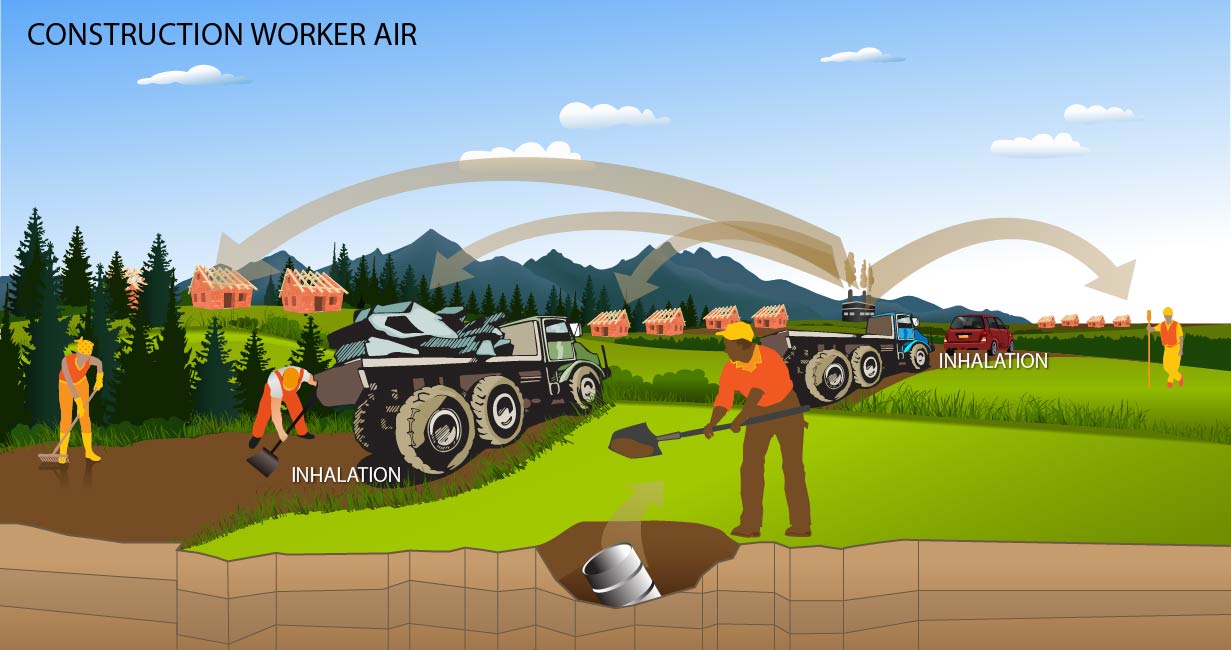


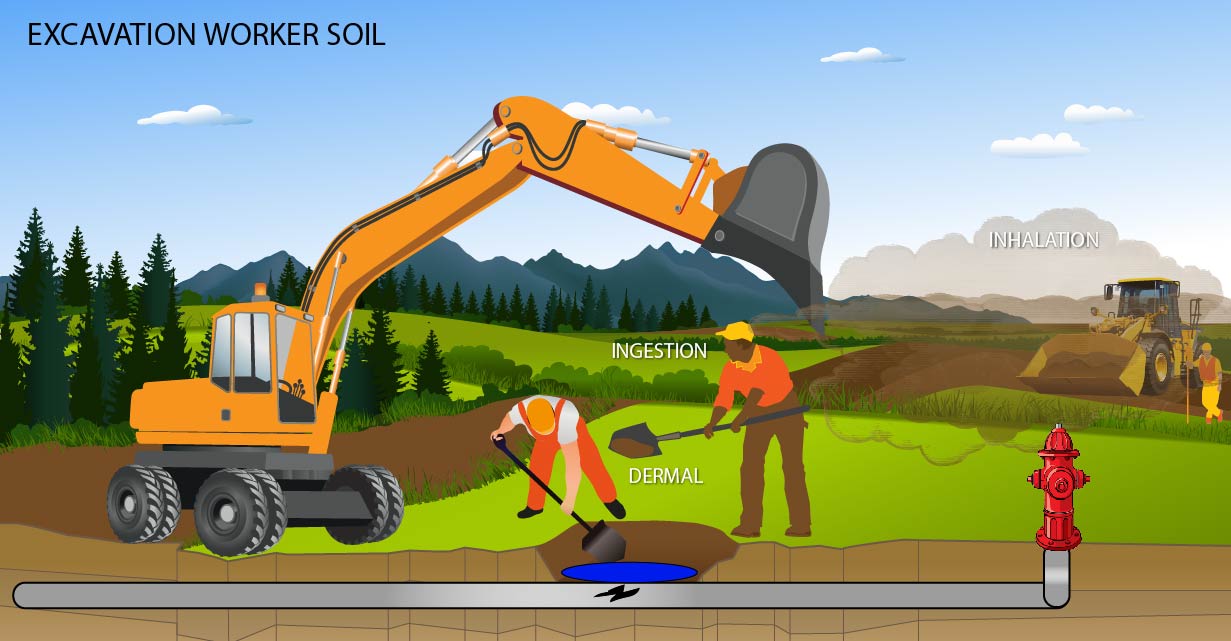






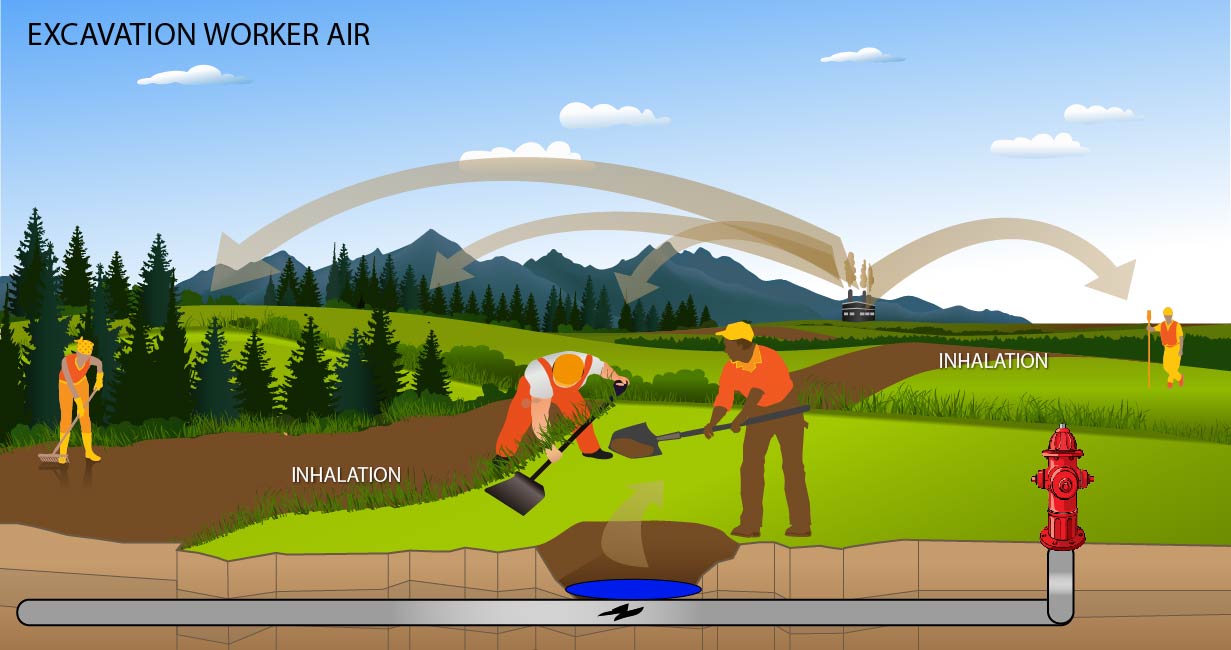


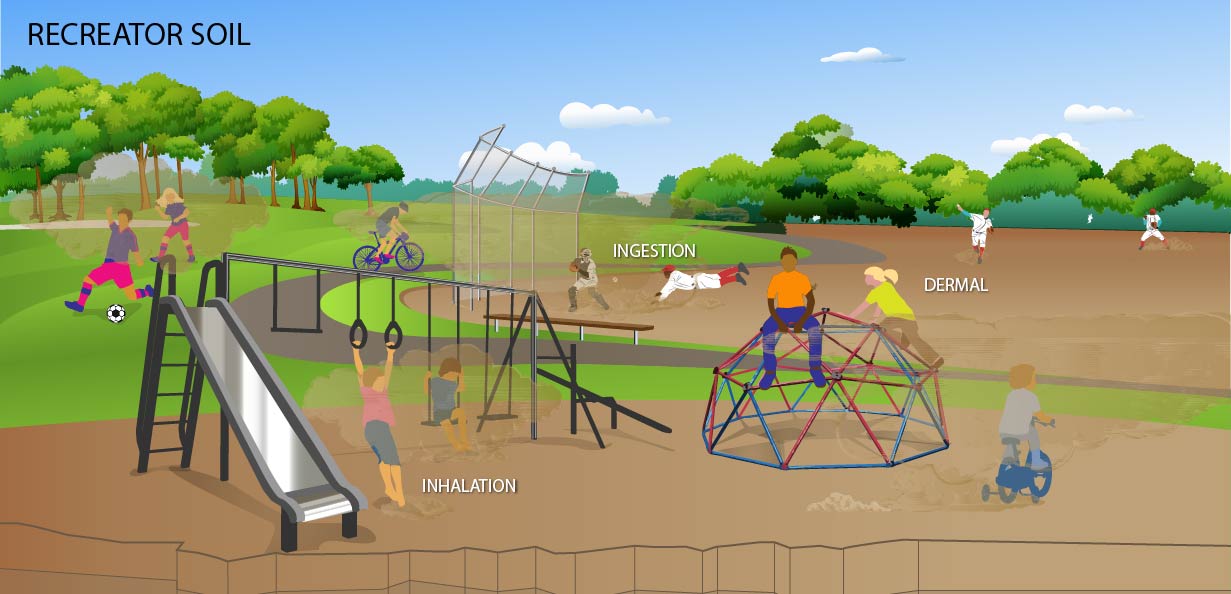
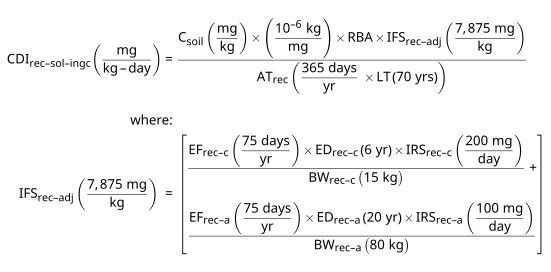

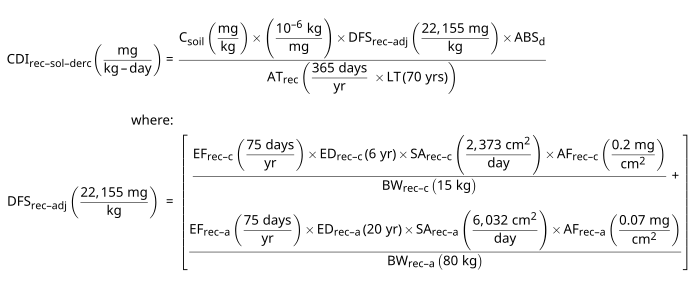
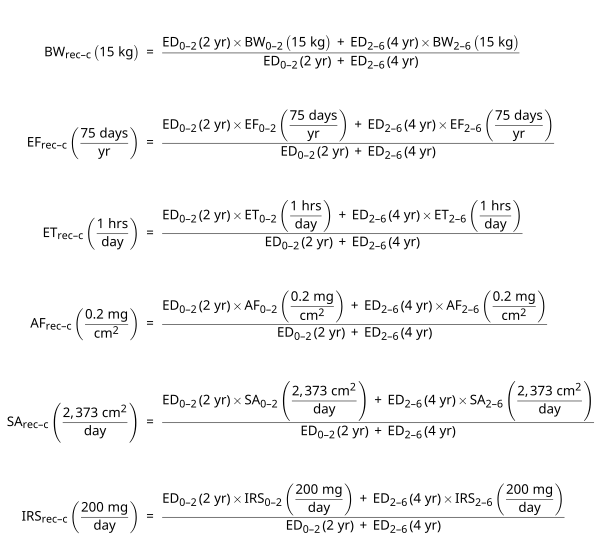
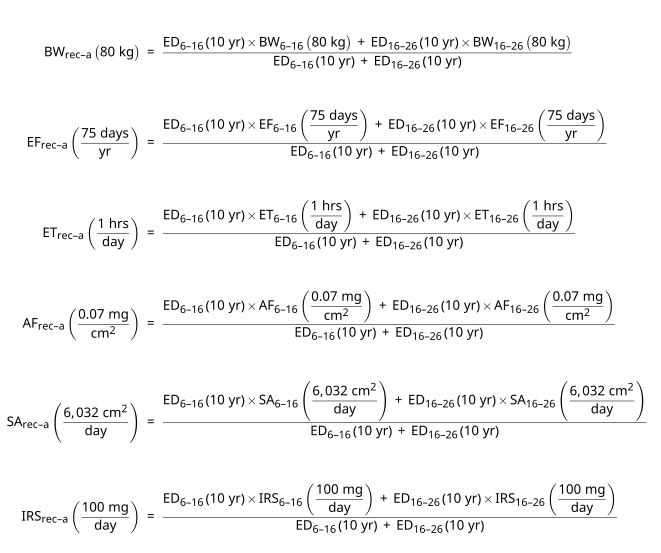
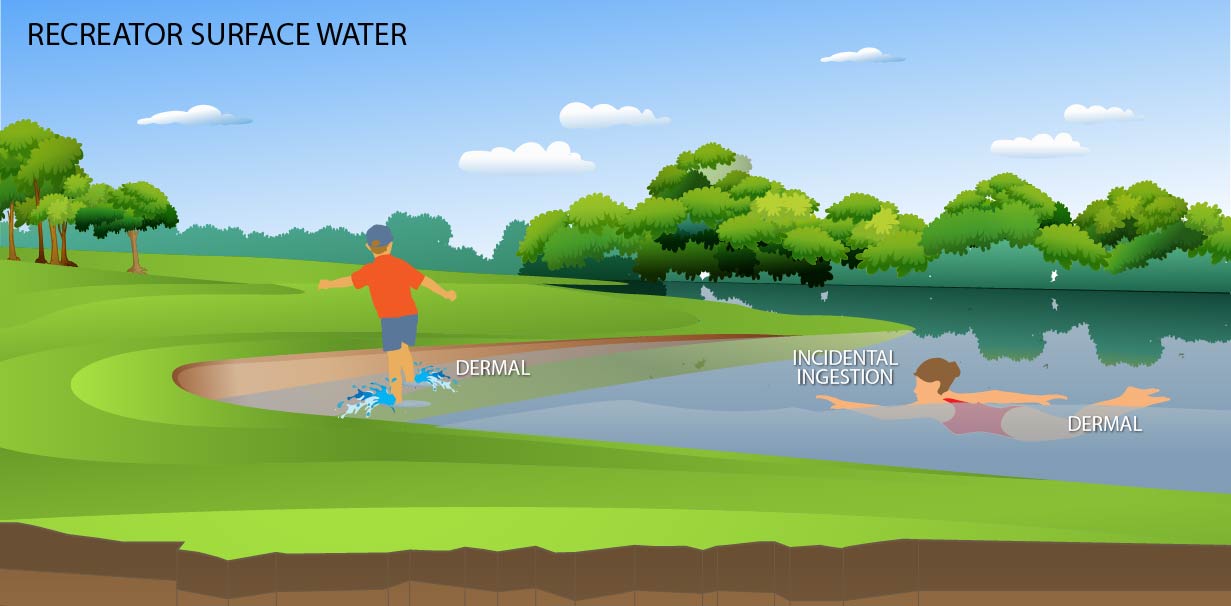
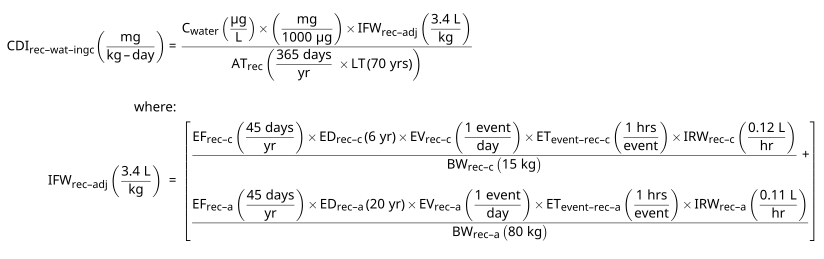
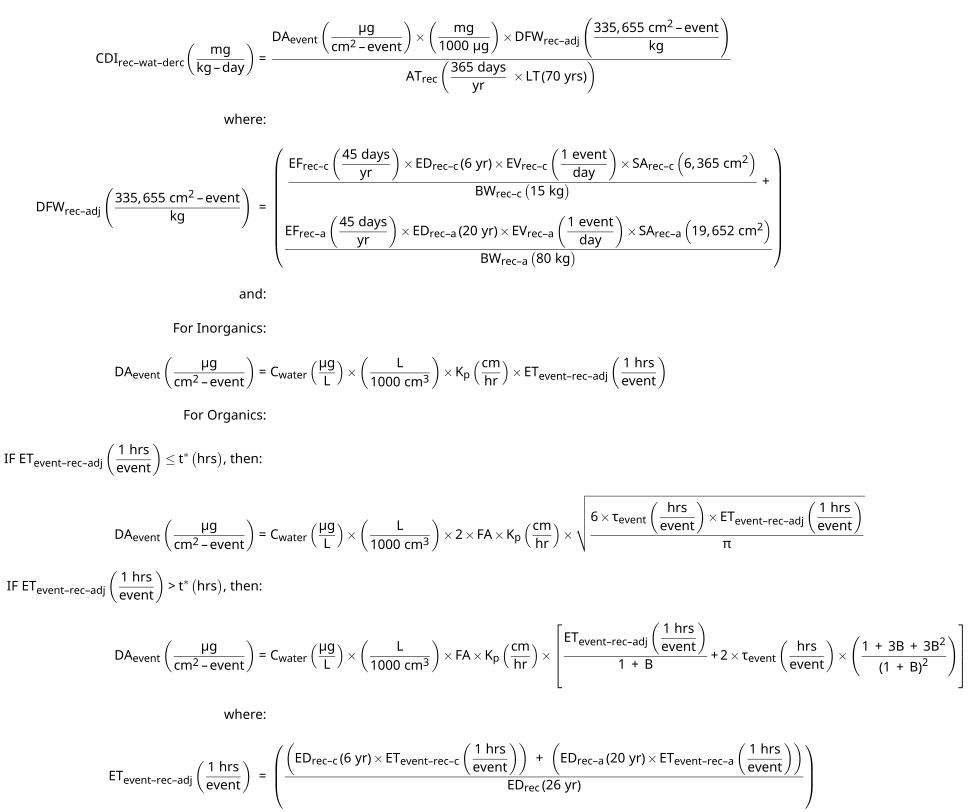
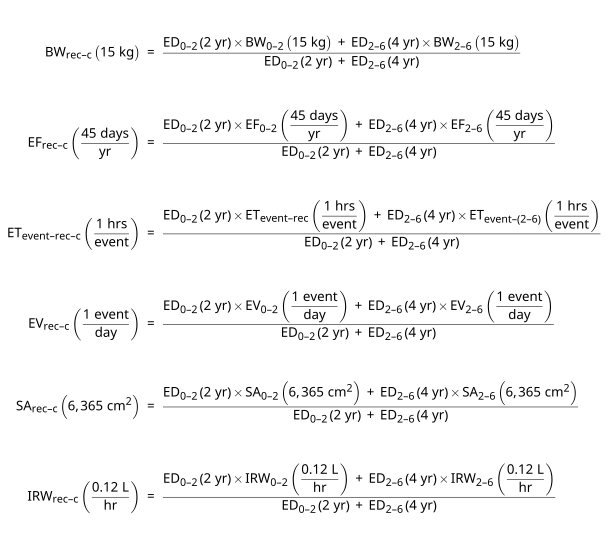
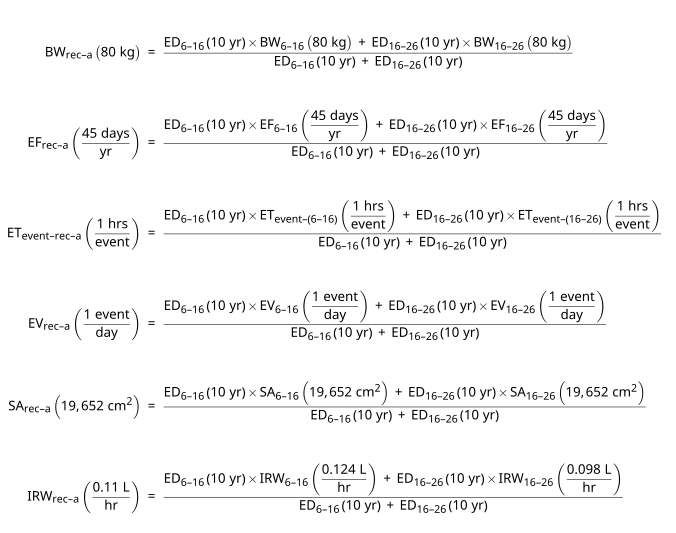
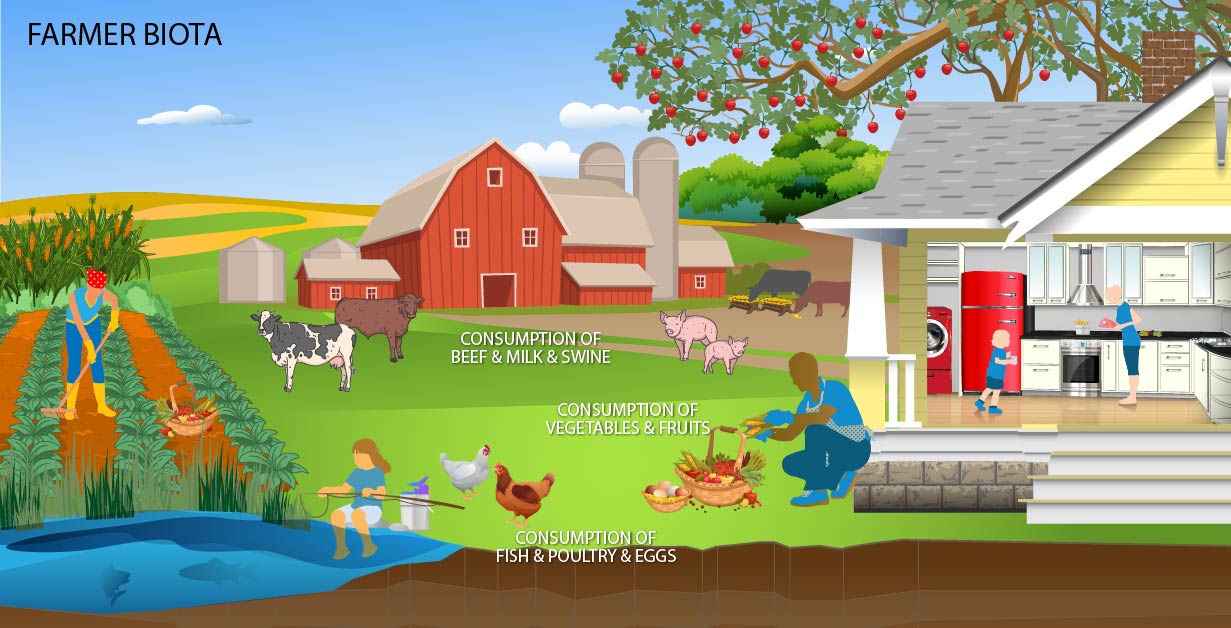
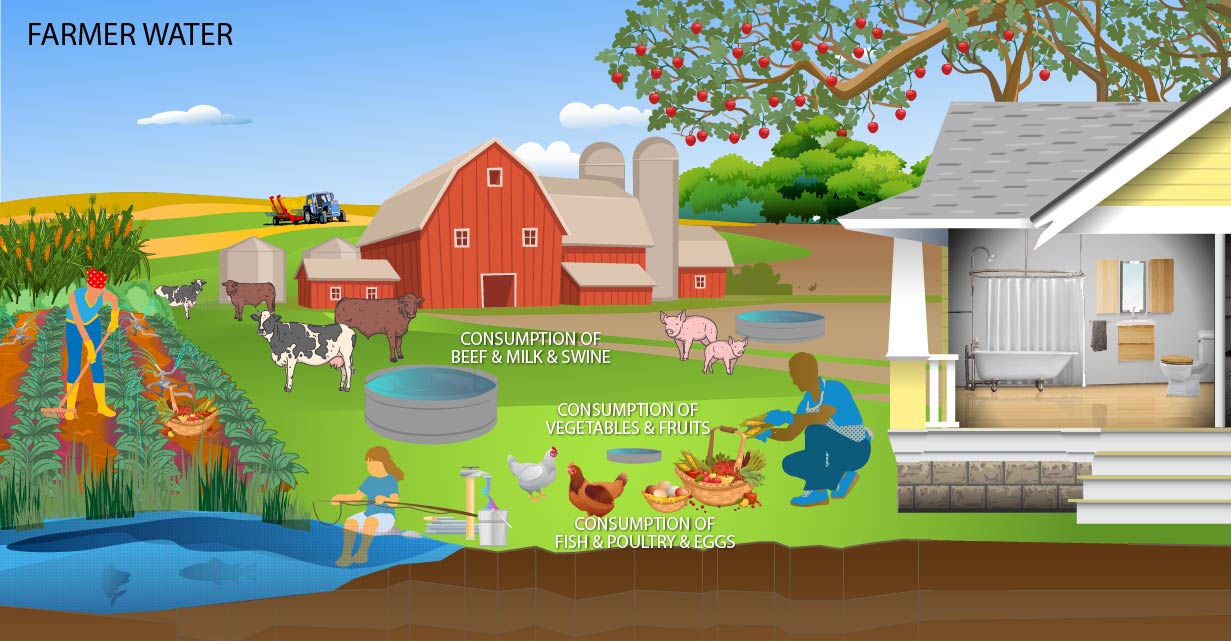
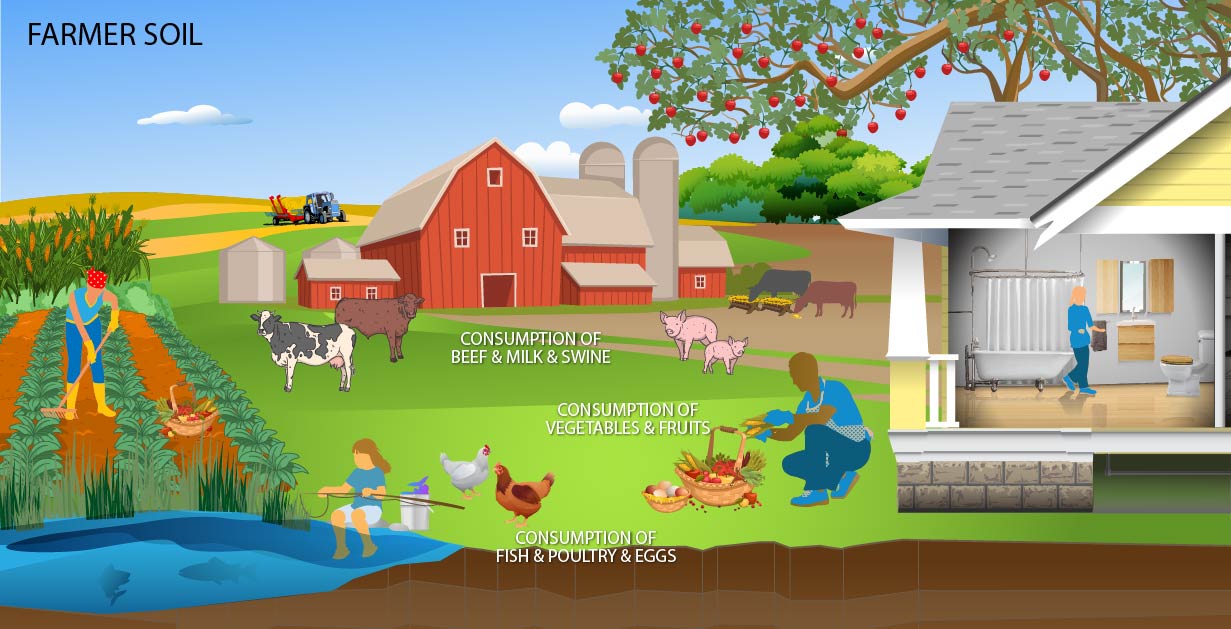

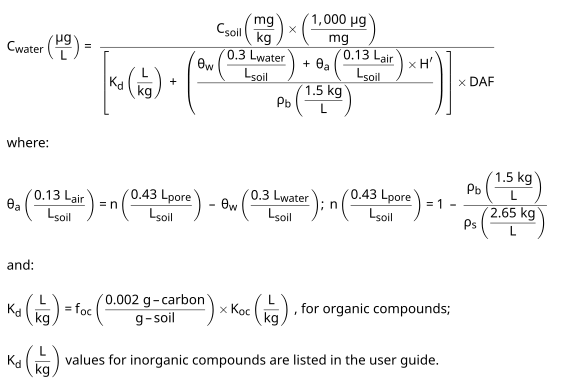

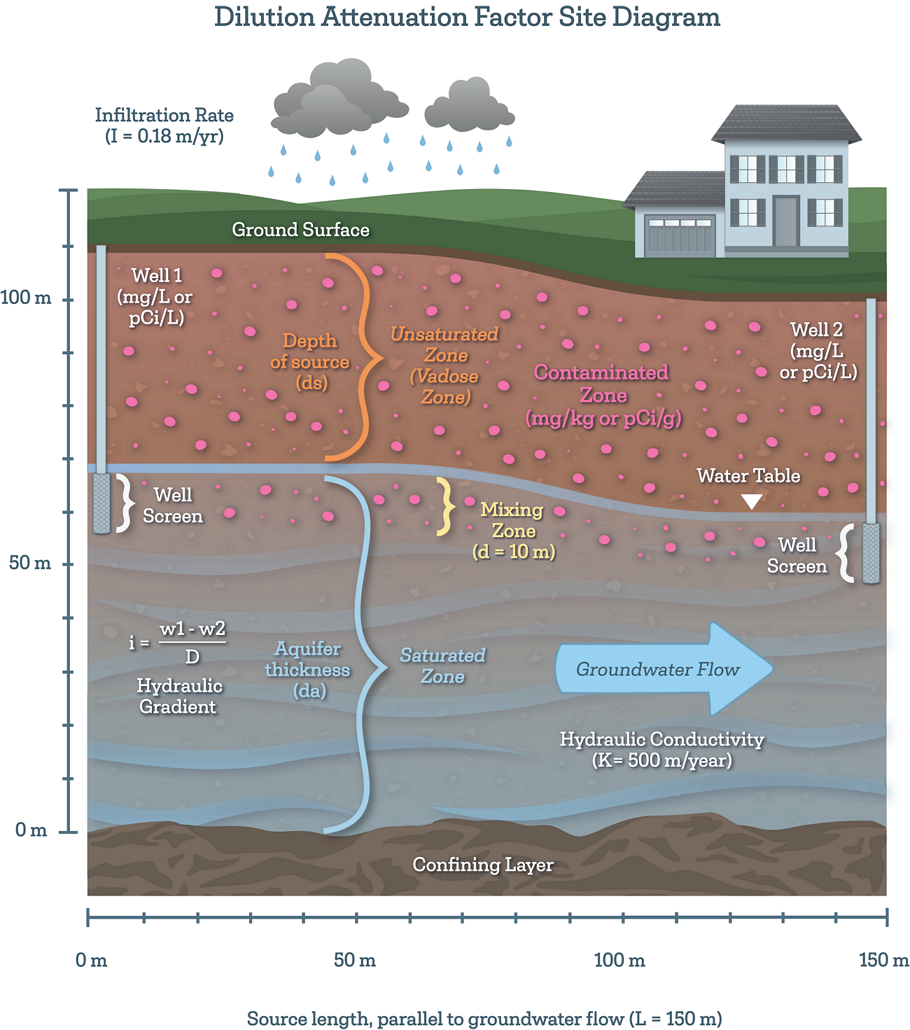
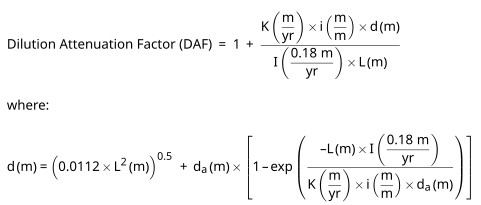
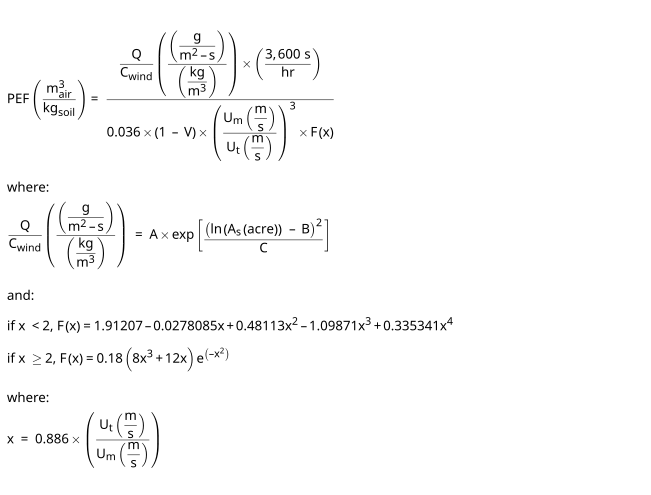
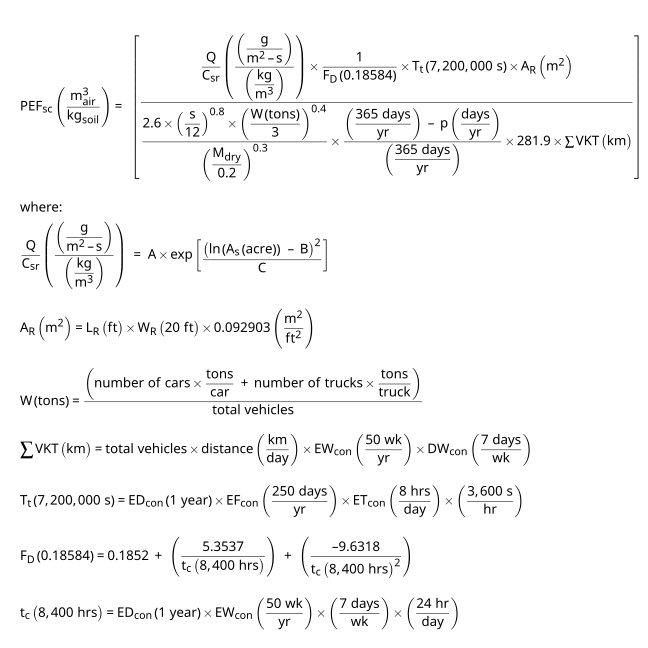
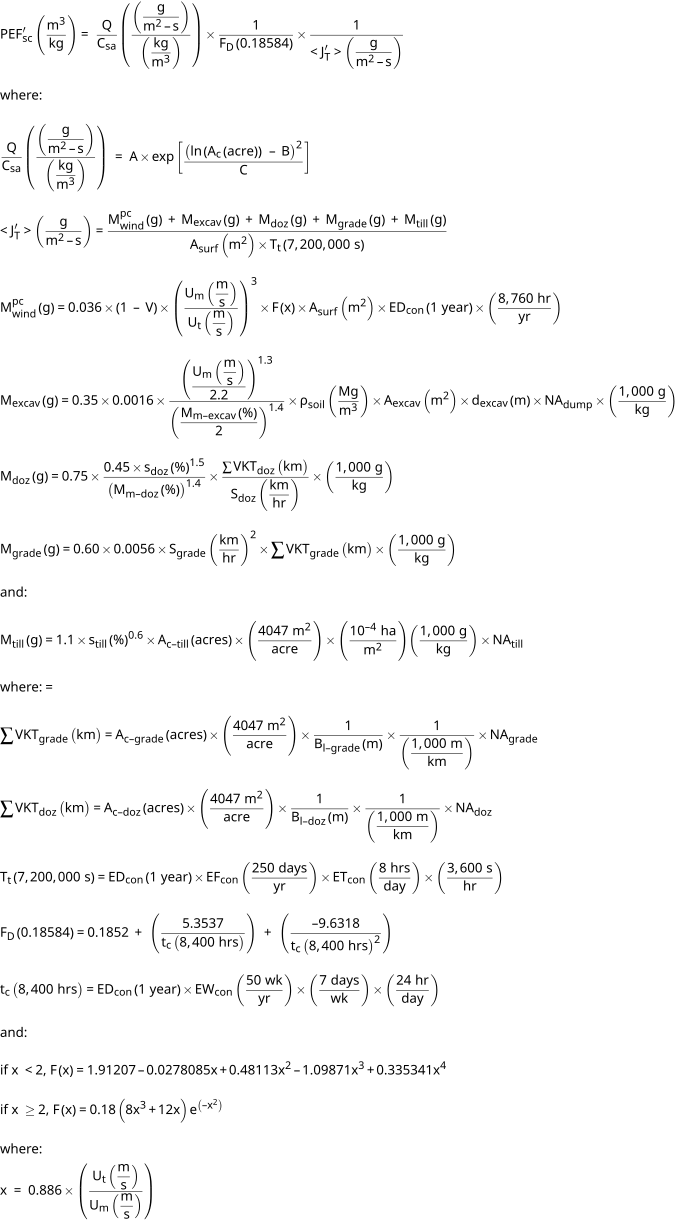
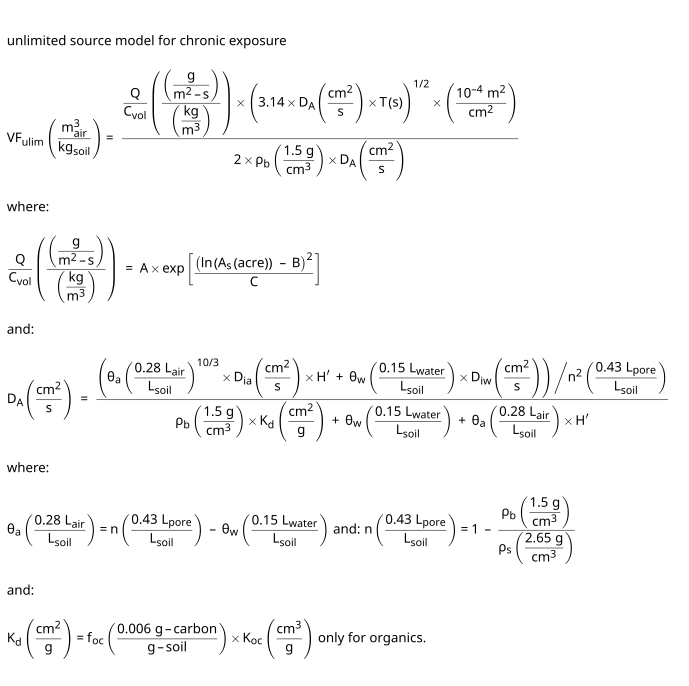
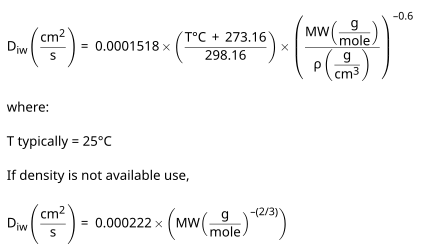
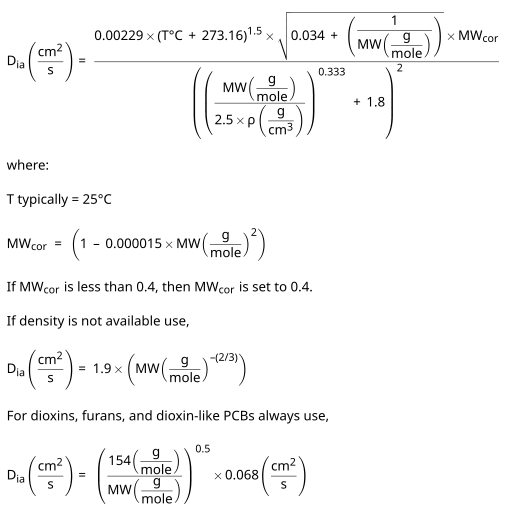
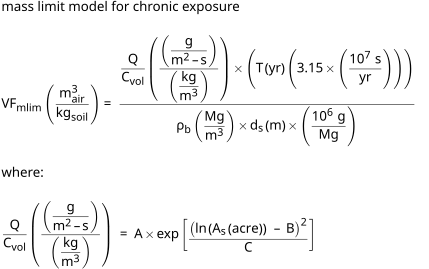
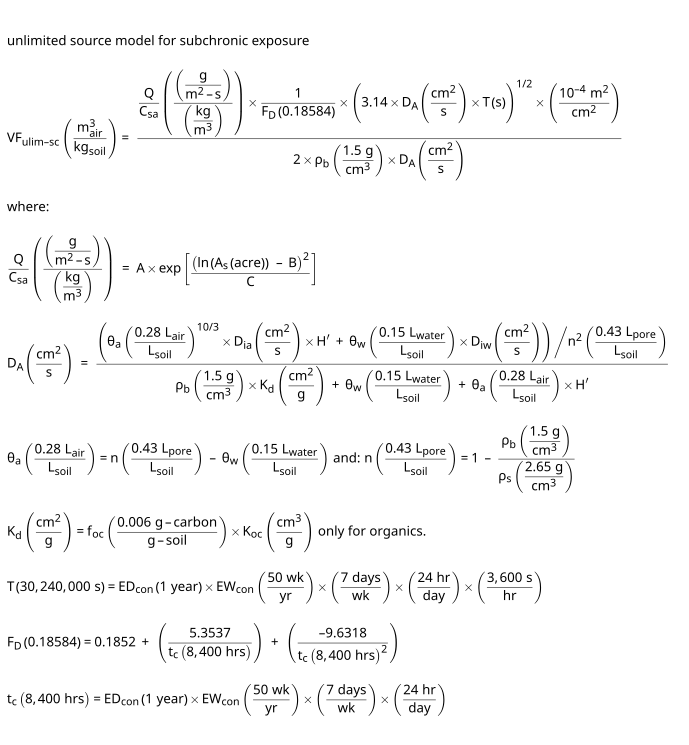
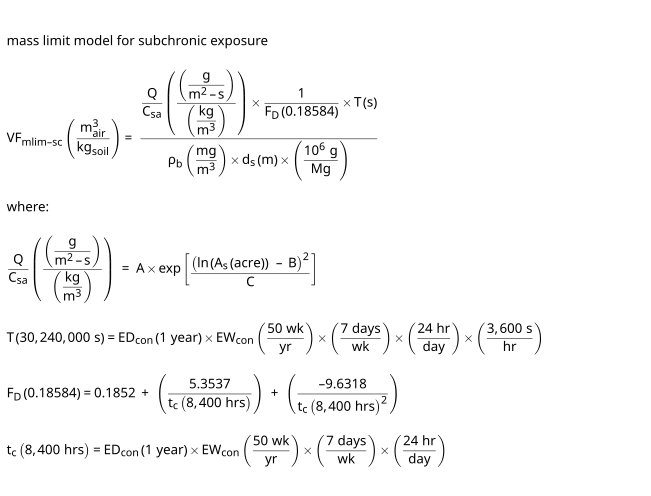
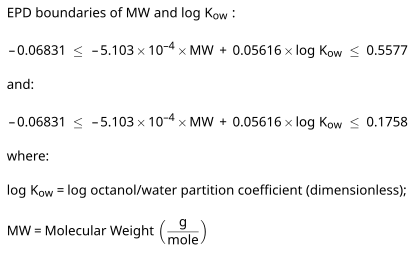
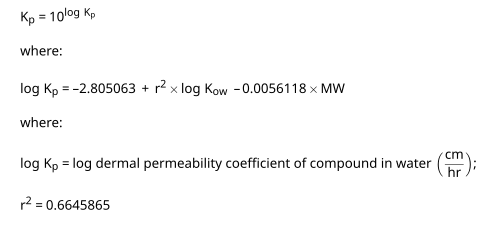
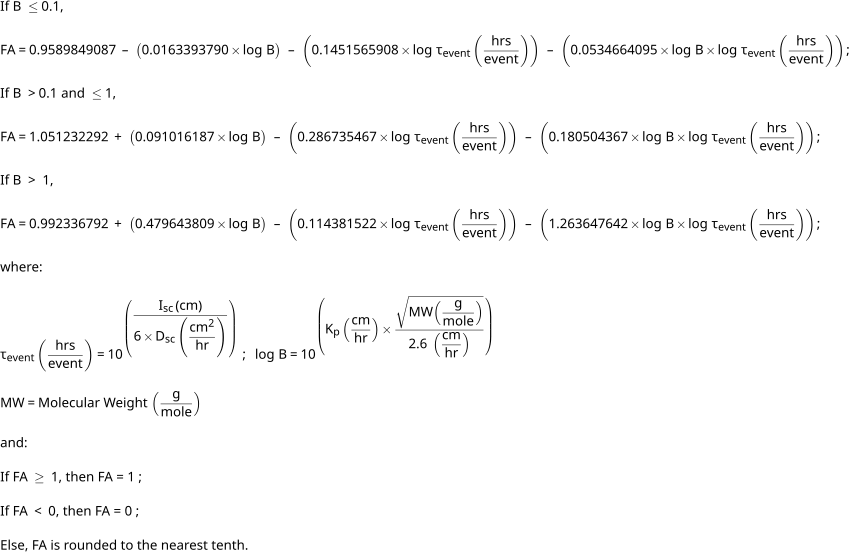
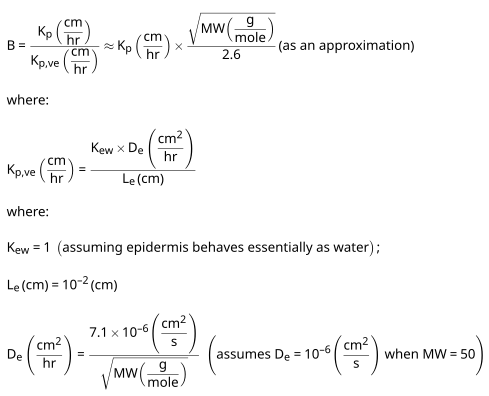
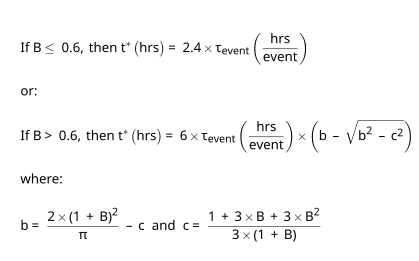
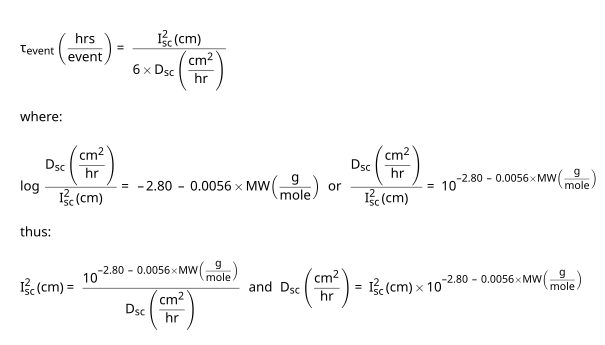
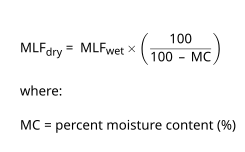
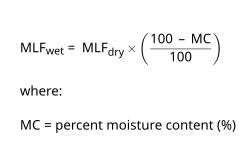

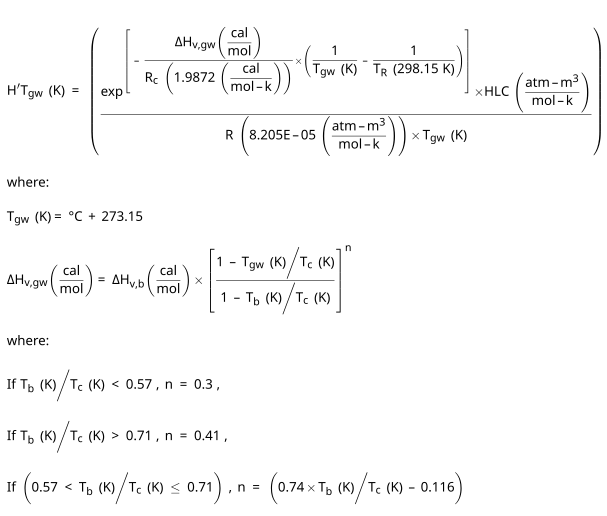
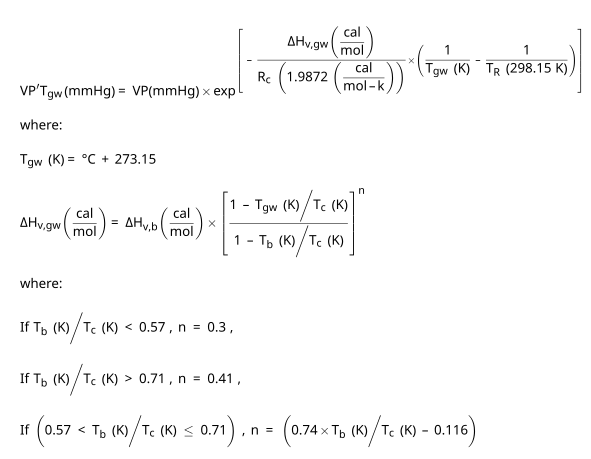
5. Special Considerations
Most of the risks are readily derived by referring to the above equations. However, there are some cases for which the standard equations do not apply and/or external adjustments to the equations are not recommended. These special case chemicals are discussed below.
5.1 Cadmium
"Cadmium (Diet)" is for food and soil use; "Cadmium (Water)" is for water use only. The diet RfD incorporates a 2.5% gastrointestinal absorption (GIABS) adjustment; the water RfD incorporates a 5% GIABS. These GIABS values are used in the RAIS calculations to convert oral RfDs to Dermal RfDs, as directed by EPA Risk Assessment Guidance for Superfund (RAGS) Part E, Supplemental Guidance for Dermal Risk Assessment; July 2004. Document (PDF) and website.
The RAIS uses the chronic MRL from ATSDR as the Cadmium RfD instead of the IRIS value in response to an EPA memo "Recommendations on the Use of Chronic or Subchronic Noncancer Values for Superfund Human Health Risk Assessments" released in May 2021; this memo recommends using lower tier toxicity values that are more recent, credible, and relevant than the values that would be automatically selected from the RAIS toxicity hierarchy. In this memo, it was recommended that the ATSDR chronic RfD of 1E-04 mg/kg-day from 2012 be used over the IRIS values (5E-04 and 1E-03 mg/kg-day for water and diet, respectively) from 1989. The RAIS has adopted this recommendation and retains the GIABS values from RAGS Part E.
5.2 Lead
EPA has no consensus toxicity values for inorganic lead. The RAIS tools use toxicity values from California EPA, making it possible to calculate risks using the same methodology used for other chemicals. EPA considers lead to be a special case because of the difficulty in identifying a level of exposure, or dose, below which adverse effects are unlikely, which is needed to develop a RfD.
EPA evaluates lead exposure in residential scenarios by using models such as the Integrated Exposure-Uptake Biokinetic Model (IEUBK) to estimate a blood-lead concentration. Since 1994, the EPA Office of Land and Emergency Management (formerly known as OSWER) has released several directives on risk assessment and screening levels for residential soil lead. The most recent guidance, Updated Soil Lead Guidance for CERCLA Sites and RCRA Corrective Action Facilities (2024), recommends a residential soil lead screening level of 200 mg/kg (ppm) where children live and play. However, the guidance indicates that for remedial responses, the residential soil screening level should be lowered to 100 mg/kg where there is aggregate exposure and increased risk to children living in communities with multiple sources of lead contamination, such as lead service lines, lead-based paint, or non-attainment areas where the lead concentrations in air exceed the National Ambient Air Quality Standards. A screening level for soil lead at commercial/industrial (non-residential) sites is 800 mg/kg. More information can be found here. EPA recommends using the EPA Action Level of 10 µg/L in water and the National Ambient Air Quality Standard of 0.15 µg/m3 in air for Screening levels.
EPA uses the Adult Lead Methodology (ALM) model to estimate risks for an industrial setting. The risk is intended to protect a fetus of a pregnant worker. A primary assumption of this methodology is that a screening level that is protective of a fetus will also afford protection for male or female adult workers. The ALM model equations were developed to calculate screening levels such that the fetus of a pregnant worker would not likely have an unsafe concentration of lead in blood.
The default values for absolute bioavailability (ABA) in the IEUBK model for lead in children are 0.3 for soil and dust and 0.5 for food and water. This corresponds to an RBA for soil of 0.6 (ABA_soil / ABA_water = 0.6). It's important to note that the ABA values in the IEUBK model are central estimates, and the oral RBA at any given site may be higher or lower than the default oral RBA for lead. For this reason, and because it provides a more comprehensive characterization of exposure at a site, the TRW recommends using EPA SW-846 Method 1340 to estimate the site-specific RBA in soil. Guidance related to these topics can be found in the Soil Bioavailability at Superfund Site Guidance.
For more information on EPA's lead models and other lead-related topics, please go to Addressing Lead at Superfund Sites.
For more information on California’s Lead Spread Model and Cal-Modified risk for lead, please go to: https://dtsc.ca.gov/leadspread-9/.
5.3 Manganese
The IRIS RfD (0.14 mg/kg-day) for manganese is from all sources, including diet. The IRIS assessment for manganese recommends that the dietary contribution from the normal U.S. diet (an upper limit of 5 mg/day) be subtracted when evaluating non-food (e.g. drinking water or soil) exposures to manganese, leading to a RfD of 0.071 mg/kg-day for non-food items. The explanatory text in IRIS further recommends using a modifying factor of 3 when calculating risks associated with non-food sources due to a number of uncertainties that are discussed in the IRIS file for manganese, leading to a RfD of 0.024 mg/kg-day. For more information regarding the Manganese RfD, refer to the IRIS assessment on Manganese.
5.4 Vanadium Compounds
The oral RfD toxicity value for Vanadium used in this website is derived from the IRIS oral RfD for Vanadium Pentoxide by factoring out the molecular weight (MW) of the oxide ion. Vanadium Pentoxide (V205) has a molecular weight of 181.88. The two atoms of Vanadium contribute 56% of the MW. Vanadium Pentoxide's oral RfD of 9E-03 mg/kg-day multiplied by 56% gives a Vanadium oral RfD of 5.04E-03 mg/kg-day.
5.5 Uranium
The Uranium Soluble Salts risk equations use the ATSDR intermediate MRL of 2E-04 mg/kg-day instead of the IRIS oral RfD of 3E-03 mg/kg-day. This is a deviation from the typical toxicity hierarchy. This deviation was justified by the 2003 hierarchy memo (PDF) that acknowledges and "recognizes that EPA should use the best science available on which to base risk assessments". In December 2016, the EPA Office of Superfund Remediation and Technology Innovation (OSRTI) announced its determination that the ATSDR "intermediate MRL generally reflects a better scientific basis for assessing the chronic health risks of soluble uranium than the RfD currently available in IRIS". The rationale for this determination is summarized in an accompanying memorandum (PDF), which recommends use of the ATSDR uranium intermediate MRL for assessing chronic and subchronic human exposures at Superfund sites nationwide.
5.6 Chromium (VI)
It is recommended that valence-specific data for chromium be collected when chromium is likely to be an important contaminant at a site and when hexavalent chromium (Cr (VI)) may exist. For Cr(VI), IRIS shows an air unit risk of 1.2E-2 per (µg/m3). While the exact ratio of Cr(VI) to Cr(III) in the data used to derive the IRIS air unit risk value is not known, it is likely that both Cr(VI) and Cr(III) were present. The PRGs calculated using the IRIS air unit risk assume that the Cr(VI) to Cr(III) ratio is 1:6. Because of various sources of uncertainty, this assumption may overestimate or underestimate the risk calculated. Users are invited to review the document "Toxicological Review of Hexavalent Chromium" on IRIS to determine whether they believe this ratio applies to their projects and to consider consulting with an EPA regional risk assessor. The default Cr(VI) specific value (assuming 100% Cr(VI)) is derived by multiplying the IRIS Cr(VI) value by 7. This is considered to be a health-protective assumption and is also consistent with the State of California's interpretation of the Mancuso study that forms the basis of Cr(VI)'s estimated carcinogenic potency. If you are working on a chromium site, you may want to contact the appropriate regulatory officials in your region to determine what their position is on this issue.
The Maximum Contaminant Level (MCL) of 100 µg/L for "Chromium (total)", from the EPA's MCL listing, is applied to the "Chromium, Total" analyte on this website.
Tier 3 sources were used to derive the screening levels for Cr(VI).
- The State of California Environmental Protection Agency (CalEPA) determined that Cr(VI) by ingestion is likely to be carcinogenic in humans. CalEPA derived an oral cancer slope factor, based on a dose-related increase of tumors of the small intestine in male mice conducted by the National Toxicology Program (PDF) (162 pp, 1.9 MB). CalEPA determined that Cr(VI) was carcinogenic by mutagenic mode of action.
- The New Jersey Department of Environmental Protection (NJDEP) determined that Cr(VI) by ingestion is likely to be carcinogenic in humans. NJDEP derived an oral carcinogenic slope factor, based on carcinogenic bioassays conducted by the National Toxicology Program (https://www.nj.gov/dep/srp/guidance/rs/chrome_criteria.pdf). The New Jersey assessment did not make a determination that Cr(VI) was mutagenic by mode of action for carcinogenesis.
- EPA's Office of Pesticide Programs (OPP) made a determination that Cr(VI) has a mutagenic mode of action for carcinogenesis in all cells, regardless of type, following administration via drinking water. OPP recommended that Age-Dependent Adjustment Factors (ADAFs) be applied when assessing carcinogenic risks from early-life exposure (< 16 years of age). This determination was reviewed by OPP's carcinogenic Assessment Review Committee and published in a peer review journal.
Therefore, in 2009 the RAIS adopted the Tier III NJDEP values and the OPP recommendation with respect to mutagenicity. More recently, in 2011, external peer reviewers provided input on the EPA's Office of Research and Development Integrated Risk Information System draft Toxicological Review of Hexavalent Chromium (http://cfpub.epa.gov/ncea/iris_drafts/recordisplay.cfm?deid=221433). The majority of reviewers questioned the evidence used to support a mutagenic mode of action for carcinogenesis for Cr(VI). Furthermore, in 2011 California Environmental Protection Agency finalized its drinking water Public Health Goal for Cr(VI). CalEPA's Technical Support Document concluded in numerous studies that Cr(VI) is both genotoxic and mutagenic. (http://www.oehha.ca.gov/water/phg/072911Cr6PHG.html)
Therefore, the RAIS acknowledges that there is uncertainty associated with the assessment of hexavalent chromium. However, no updated consensus IRIS assessment (Tier I) has yet appeared and chromium is still under review by the IRIS program. With respect to PRGs, the more health-protective approach of applying ADAFs for early life exposure via ingestion, dermal and inhalation was used to calculate screening levels for all exposure pathways. Application of ADAFs for all exposure pathways results in more health-protective screening levels.
5.7 Aminodinitrotoluenes
The IRIS oral RfD of 2E-03 mg/kg-day for 2,4-Dinitrotoluene is no longer used as a surrogate for 2-Amino-4,6-Dinitrotoluene and 4-Amino-2,6-Dinitrotoluene. Appendix screening values from a new PPRTV assessment are being used instead.
5.8 PCBs and Aroclors
In the RAIS database, there are three distinct types of PCBs: Aroclors, individual PCB congeners, and risk/persistence-based PCBs. The PCB congeners are evaluated as dioxin-like, using dioxin TEFs, as discussed in section 2.3. The risk/persistence-based PCB toxicity values come from the IRIS summary, where high, low, and lowest risk and persistence human oral slope factor tiers are given. Below is the RAIS interpretation of this information.
TIERS OF HUMAN ORAL SLOPE FACTORS FOR ENVIRONMENTAL PCBs Media High Low Lowest Food Yes No No Soil Yes No No Sediment Yes No No Tap Water No Yes No Surface Water No Yes No Air Yes Yes Yes The IRIS Profile offers various criteria for the assignment of Aroclors into risk/persistence tiers. When congeners with more than four chlorines comprise less than one-half of a percent of total PCBs, the lowest risk/persistence tier is appropriate. Aroclor 1016 has virtually no congeners with more than four chlorines and is assigned to the lowest risk/persistence tier (EPA 1996). (Chlorination data and other physicochemical parameters can be found in section 4 of the ATSDR Profile.) Most of the criteria for assignment to the high risk/persistence tier are met by the other Aroclors in the RAIS, as they are typically assessed at environmental sites. In addition to the degree of chlorination, these criteria include: food chain exposure; sediment or soil ingestion; dust or aerosol inhalation; dermal exposure; presence of dioxin-like, tumor-promoting, or persistent congeners; and early-life exposure (all pathways and mixtures). These are default recommendations for purposes of calculating risk. The table below provides the assignment of Aroclors to risk/persistence tiers for the RAIS.
TIERS OF HUMAN ORAL SLOPE FACTORS FOR ENVIRONMENTAL PCBs Aroclor High Low Lowest 1016 No No Yes 1221 Yes No No 1232 Yes No No 1242 Yes No No 1248 Yes No No 1254 Yes No No 1260 Yes No No Aroclor 5460 toxicity is determined in a PPRTV independently from the IRIS assessment.
If risk assessors believe that the form of PCB and the environmental route at a specific site warrant a different assignment of risk/persistence category, they may consult with regional risk assessors on site-specific cases.
5.9 Xylenes
The IRIS oral RfD of 2E-01 mg/kg-day for xylene, mixture is used as a surrogate for the 3 xylene congeners (o-xylene, m-xylene, and p-xylene). The earlier RfD values for some xylene isomers were withdrawn from HEAST. Also, the IRIS inhalation RfC of 1E-01 mg/m3 for xylene, mixture is used as a surrogate for the 3 xylene congeners.
5.10 Arsenic
Arsenic risks for ingestion of soil are now calculated with the relative bioavailability factor (RBA) of 0.6. The RBA can be adjusted using the calculator in site-specific/user-provided mode similar to toxicity values changes. The RBA for soil ingestion is shown in the calculator output. The 2012 document, Compilation and Review of Data on Relative Bioavailability of Arsenic in Soil provides supporting information.
In 2017, the EPA has released a standard operating procedure for an in vitro bioaccessibility assay for arsenic in soil. The in vitro method for predicting oral RBA of arsenic in soil (EPA SW846 Method 1340) has been validated, and it is now recommended that the in vitro method be used to estimate site-specific RBA, when site-specific RBA is needed. This method can provide a more comprehensive characterization of RBA variability at the site. The default value represents the 95th percentile of many arsenic soil samples; since the site-specific RBA will be less than 0.6 at most sites, the default should be protective for screening. This method may also be used for sediments when the incidental ingestion of sediments is being assessed. Site-specific RBAs derived with the in vitro method should be verified with your Regional Risk Assessor. Guidance related to these topics can be found in the Soil Bioavailability at Superfund Sites: Guidance.
Absolute bioavailability can be thought of as the absorption fraction. Relative bioavailability accounts for differences in the bioavailability of a contaminant between the medium of exposure (e.g., soil) and the media associated with the toxicity value (e.g., the arsenic RfD and CSF are derived from drinking water studies). The 60% oral RBA for arsenic in soil is empirically-based. It represents an upper-bound estimate from numerous studies where the oral RBA of soil-borne arsenic in samples collected from across the U.S. was experimentally determined against the water-soluble form. This RBA does not apply to dermal exposures to arsenic in soil, for which the absorbed dose is calculated using a dermal absorption fraction (ABSd) of 0.03 (Exhibit 3-4 of USEPA, 2004).
5.11 Total Petroleum Hydrocarbons (TPHs)
Traditionally, hydrocarbon-impacted soils at sites contaminated by releases of petroleum fuels have been managed based on their total petroleum hydrocarbon (TPH) content. TPH refers to the total mass of hydrocarbons present without identifying individual compounds. In practice, TPH is defined by the analytical method that is used to measure the hydrocarbon content in contaminated media. Since the hydrocarbon extraction efficiency is not identical for each method, the same sample analyzed by different TPH methods will produce different TPH concentrations.
The hazard and health risk assessments that are typically conducted to support risk management decisions at contaminated sites generally require some level of understanding of the hydrocarbon chemical composition present in the contaminated media. Traditional TPH measurement techniques, however, provide no specific information about the detected hydrocarbons. Because TPH is not a consistent entity, the assessment of health effects and development of toxicity values for mixtures of hydrocarbons are problematic. In fact, many risk assessors prefer to analyze and assess the individual chemical constituents rather than rely on TPH data; consult with your regional risk assessor for site-specific recommendations. In cases where TPH data are used, more details about the provisional TPH toxicity values are provided below.
In 2022, the Center for Public Health and Environmental Assessment published a document that provides the data, methods, and assumptions for deriving Provisional Peer-Reviewed Toxicity Values (PPRTVs) for six fractions of petroleum hydrocarbons. The six TPH fractions were assigned representative compounds for determination of toxicity values and chemical-specific parameters to calculate risks.
The PPRTV (PDF) paper was the principal source for the derivation of these values. The carbon ranges and representative compounds for the RfDs, RfCs, and chemical-specific parameters are listed in the table below. An average of the chemical-specific parameters for 1,3,5-trimethylbenzene, 1,2,4-trimethylbenzene, and 1,2,3-trimethylbenzene was calculated for the medium aromatic fraction, since all three are representative compounds for chronic and subchronic RfDs and RfCs. An average of the chemical-specific parameters for n-heptane, n-hexane, and cyclohexene was calculated for the low aliphatic fraction; this is because n-heptane represents the chronic RfC, n-hexane represents the subchronic RfC, and cyclohexene represents the chronic and subchronic RfDs.
The carbon ranges, presented in the PPRTV assessment, may not exactly match the carbon ranges from laboratory results for TPH fractions or the laboratory results for DRO, GRO, ORO, or RRO analysis. The TPH carbon ranges used in the RAIS are not intended to screen against DRO, GRO, ORO and RRO analysis. While the carbon ranges for TPHs and range organics may not exactly match, with direction from your regional risk assessor, reasonable assignment may be achieved.
TPH Fractions Number of Carbons Equivalent Carbon Number Index Representative Compound (RfD/RfC) Representative Compound (Chemical Parameters) Low aliphatic C5-C8 EC5-EC8 cyclohexene/n-heptane and n-hexane average of cyclohexene/n-heptane and n-hexane Medium aliphatic C9-C18 EC > 8-EC16 midrange aliphatic hydrocarbon streams n-nonane* High aliphatic C19-C32 EC > 16-EC35 white mineral oil white mineral oil Low aromatic C6-C8 EC6-EC < 9 benzene benzene Medium aromatic C9-C10 EC9-EC < 11 1,3,5-trimethylbenzene, 1,2,4-trimethylbenzene, 1,2,3-trimethylbenzene average of 1,3,5-trimethylbenzene, 1,2,4-trimethylbenzene, 1,2,3-trimethylbenzene High aromatic C10-C32 EC > 11-EC35 benzo[a]pyrene benzo[a]pyrene *A medium aliphatic representative compound was not listed in the PPRTV paper so n-nonane was selected to represent the chemical-specific parameters.
Note, the EPA only calculates the potential noncancer health effects, but the RAIS will continue to include the cancer risk.
5.12 Mutagens
Some of the carcinogenic analytes in this tool operate by a mutagenic mode of action for carcinogenesis. There is reason to surmise that some chemicals with a mutagenic mode of action, which would be expected to cause irreversible changes to DNA, would exhibit a greater effect in early-life versus later-life exposure. Carcinogenic risk to children in the context of the U.S. Environmental Protection Agency's carcinogenic guidelines (U.S. EPA, 2005) includes both early-life exposures that may result in the occurrence of carcinogenic risk during childhood and early-life exposures that may contribute to carcinogenic risk later in life. In keeping with this guidance, separate carcinogenic risk equations are presented for mutagens. The mutagen vinyl chloride has a unique set of equations. Consult Supplemental Guidance for Assessing Susceptibility from Early-Life Exposure to Carcinogens, EPA/630/R-03/003F, March 2005 for further information on mutagens.
In addition to the contaminants listed in the previous document, Chromium VI; 7,12-Dimethylbenz(a)anthracene; Benz(a)anthracene; Benzo(b)fluoranthene; Benzo(k)fluoranthene; Chrysene; and Indeno(1,2,3-c,d)pyrene are also considered carcinogenic by a mutagenic mode of action.
This table lists the chemicals considered to be carcinogenic by mutagenic mode of action for the purposes of the RAIS. Also provided in the table is a link to the source that defines the chemical as a mutagen.
Chemical CASRN Reference Acrylamide 79-06-1 IRIS Benz[a]anthracene 56-55-3 Benzo[a]pyrene* Benzidine 92-87-5 Supplemental Guidance Benzo[a]pyrene 50-32-8 Supplemental Guidance Benzo[b]fluoranthene 205-99-2 Benzo[a]pyrene* Chromium(VI) 18540-29-9 CalEPA and IRIS Chrysene 218-01-9 Benzo[a]pyrene* Coke Oven Emissions 8007-45-2 70 Federal Register 19992 Dibenz[a,h]anthracene 53-70-3 Supplemental Guidance Dibromo-3-chloropropane, 1,2- 96-12-8 PPRTV Dimethylbenz(a)anthracene, 7,12- 57-97-6 Supplemental Guidance Ethylene Oxide 75-21-8 IRIS Indeno[1,2,3-cd]pyrene 193-39-5 Benzo[a]pyrene* Methylcholanthrene, 3- 56-49-5 Supplemental Guidance Methylene Chloride 75-09-2 IRIS Methylene-bis(2-chloroaniline), 4,4'- 101-14-4 PPRTV Nitrosodiethylamine, N- 55-18-5 Supplemental Guidance Nitrosodimethylamine, N- 62-75-9 Supplemental Guidance Nitroso-N-ethylurea, N- 759-73-9 Supplemental Guidance Nitroso-N-methylurea, N- 684-93-5 supplemental guidance Safrole 94-59-7 Supplemental Guidance Trichloroethylene 79-01-6 IRIS Trichloropropane, 1,2,3- 96-18-4 IRIS Urethane 51-79-6 Supplemental Guidance Vinyl Chloride 75-01-4 Supplemental Guidance * Please see section 2.3.6 of this user guide regarding Relative Potency Factors (RPFs).
5.13 Trichloroethylene (TCE)
It is recommended that a risk assessor be consulted when evaluating TCE in any medium, especially when less than chronic exposure scenarios are considered. The Superfund program issued a Compilation of Information Relating of Early/Interim Actions at Superfund Sites and the TCE IRIS Assessment (PDF) (3 pp, 929 K) memo in August 2014. Several regions have issued their own guidance as well.
In order to make the calculator display the correct results for TCE, the standard carcinogenic and mutagen equations needed to be combined. Since TCE requires the use of different toxicity values for carcinogenic and mutagen equations, it was decided to make a toxicity value adjustment factor for carcinogens (CAF) and mutagens (MAF). The adjustments were done for oral (o) and inhalation (i). These adjustment factors are used in the TCE equation images presented in section 4. The equations used are presented below. The adjustment factors are based on the adult-based toxicity values.
5.14 Mercuric Chloride (and other Mercury salts)
The IRIS RfC for "Mercury (elemental)" is used as a surrogate for "Mercuric Chloride (and other Mercury salts)". Note that the VF for "Mercury (elemental)" is not used as a surrogate for "Mercuric Chloride (and other Mercury salts)". The use of the surrogate RfC would appear to be a violation of the toxicity hierarchy because Cal EPA offers a RfC for Mercuric Chloride. However, the actual form of mercury evaluated for the Cal EPA RfC was elemental mercury. Since IRIS already had an RfC for "Mercury (elemental)", it was decided to use the tier 1 source over a tier 3 source.
5.15 Cyanide (CN-)
The IRIS RfC for "Hydrogen Cyanide" is used as a surrogate for "Cyanide (CN-)".
5.16 Thallic Oxide and Thallium Selenite
The oral RfD for thallic oxide, used in this website, is derived from the PPRTV oral RfD for thallium sulfate by molecular weight (MW) adjustments and stoichiometric calculations. Thallic oxide (Tl203) has a MW of 456.765 and thallium sulfate (Tl2SO4) has a MW of 504.82. To derive the oral RfD of 2E-05 mg/kg-day for thallic oxide, the thallium sulfate RfD of 2E-05 mg/kg-day is multiplied by the MW of thallic oxide (456.765) divided by the MW of thallium sulfate (504.82). The oral RfD for thallium selenite, used in this website, is derived from the PPRTV oral RfD for thallium by molecular weight (MW) adjustments and stoichiometric calculations. Thallium selenite (TlSe) has a MW of 283.34 and thallium (Tl) has a MW of 204.38. To derive the oral RfD of 1E-05 mg/kg-day for thallium selenite, the thallium RfD of 1E-05 mg/kg-day is multiplied by the MW of thallium selenite (283.34) divided by the MW of thallium (204.38).
5.17 Polycyclic Aromatic Hydrocarbons (PAHs)
For PAHs in soil, there is no default value recommendation; which is to say that the default assumption remains that these are 100% bioavailable. There is also no available in vitro method to estimate the oral RBA of PAHs. A small number of sites have elected to run swine or rat models to assess oral RBA, and the technical review workgroup (TRW) has reviewed them before the RBA was accepted for use at the site. Guidance related to these topics can be found in the Soil Bioavailability at Superfund Sites Guidance.
5.18 Refractory Ceramic Fibers
The ATSDR chronic RfC for refractory ceramic fibers is presented in units of fibers/cm3. The RfC presented in the RAIS calculator is converted to units of fibers/m3 (3E+04 fibers/m3), to be consistent with all other chemicals where the RfC unit is mg/m3. When the chronic RfC is used in the standard RAIS air inhalation equations, the resulting units are not in µg/m3 like all the other chemicals, rather the units are in fibers/m3. CDIs are only calculated for air as the medium. The default air Chronic Daily Intake (CDI) and Hazard Quotient (HQ) values in the RAIS Risk calculator are presented below.
Chronic Daily Intakes (CDI) and Hazard Quotient (HQ) at a concentration of 1 (fiber/m3) Land Use CDI (fibers/m3) Inhalation Hazard Quotient Resident 9.59E-01 3.20E-05 Composite Worker 2.28E-01 7.61E-06 Indoor Worker 2.28E-01 7.61E-06 Outdoor Worker 2.05E-01 6.85E-06 Excavation Worker 1.83E-02 6.09E-07 5.19 Lanthanum Salts
The oral chronic RfDs for lanthanum salts, used in this website, are derived from the PPRTV oral chronic RfD for lanthanum by molecular weight (MW) adjustments and stoichiometric calculations. Lanthanum chloride, anhydrous (LaCl3) has a MW of 245.27, and lanthanum (La) has a MW of 138.91. To derive the chronic oral RfD of 2.83E-05 mg/kg-day for lanthanum chloride, anhydrous, the lanthanum RfD of 5E-05 mg/kg-day is multiplied by the MW of lanthanum (138.91) divided by the MW of lanthanum chloride, anhydrous (245.27). To derive the chronic oral RfD of 1.87E-05 mg/kg-day for lanthanum chloride heptahydrate, the lanthanum RfD of 5E-05 mg/kg-day is multiplied by the MW of lanthanum (138.91) divided by the MW of lanthanum chloride heptahydrate (371.37). To derive the chronic oral RfD of 1.60E-05 mg/kg-day for lanthanum nitrate hexahydrate, the lanthanum RfD of 5E-05 mg/kg-day is multiplied by the MW of lanthanum (138.91) divided by the MW of lanthanum nitrate hexahydrate (433.01). To derive the chronic oral RfD of 2.08E-05 mg/kg-day for lanthanum acetate hydrate, the lanthanum RfD of 5E-05 mg/kg-day is multiplied by the MW of lanthanum (138.91) divided by the MW of lanthanum acetate hydrate (334.05).
5.20 MCLs for Trihalomethanes and Haloacetic Acids
The individual trihalomethanes (bromodichloromethane, bromoform, dibromochloromethane, and chloroform) all have the MCL of 80 µg/L listed in the RAIS. However, 80 µg/L is the MCL for Total Trihalomethanes. The individual haloacetic acids (dichloroacetic acid, trichloroacetic acid, chloroacetic acid, bromoacetic acid, and dibromoacetic acid) all have the MCL of 60 µg/L listed in the RAIS. However, 60 µg/L is the MCL for Total haloacetic acids.
5.21 Styrene-acrylonitrile trimer (SAN Trimer)
Styrene-acrylonitrile trimer (SAN Trimer) is a by-product of specific manufacturing processes for polymers of styrene and acrylonitrile and a mixture of isomers formed by the condensation of two moles of acrylonitrile and one mole of styrene and has a molecular weight of 210. The mixture is composed of two structural forms: 4-cyano-1,2,3,4-tetrahydro-a-methyl1-naphthaleneacetonitrile (THNA, CASRN 57964-39-3) and 4-cyano-1,2,3,4-tetrahydro-1-naphthalenepropionitrile (THNP, CASRN 57964-40-6). The THNA form consists of four stereoisomers: cis-R-THNA (CASRN 142759-38-4), cis-S-THNA (CASRN 142759-39-5), trans-R-THNA (CASRN 142759-37-3), and trans-S-THNA (CASRN 142759-40-8). The THNP form consists of two stereoisomers: cis-THNP (CASRN 142681-91-2) and trans-THNP (CASRN 142681-92-3). The NTP report provides details regarding the structure and toxicity study for the mixture.
The SAN Trimer mixture is analyzed in environmental media using gas chromatography that yields three peaks. The total concentration corresponds to the total area of the three peaks. The RAIS provides CDIs based on the oral Reference Dose for the SAN Trimer derived from the toxicity study described above. The PPRTV RfD used to calculate risk is based on the SAN Trimer mixture. The SAN Trimer structural isomers are listed separately in the risk calculator but are the same values for the individual isomers. To evaluate the non-cancer toxicity of the SAN Trimer, use the total concentration calculated based on the total of the three peaks.
5.22 cis- and trans-Chlordane Surrogate
According to an April 7, 2021 memo from the Office of Research and Development,
“..technical chlordane can be considered a suitable surrogate for oral, noncancer screening-level assessments of cis- and trans-chlordane”.
Beginning in May 2021, technical chlordane (12789-03-6) Reference Dose will be used as a surrogate for cis-chlordane (5103-71-9, alpha-chlordane) and trans-chlordane (5103-74-2, gamma-chlordane).
5.23 Asbestos
The IRIS IUR for asbestos is presented in units of per fibers/ml. The IUR presented in the RAIS calculator is converted to units of per fibers/m3 (2.3E-07 per fibers/m3), to be consistent with all other chemicals where the IUR unit is µg/m3. When the IUR is used in the standard RAIS air inhalation equations, the resulting units are not in µg/m3 like all the other chemicals, rather the units are in fibers/m3. CDIs are only calculated for air as the medium. The default air Chronic Daily Intakes (CDI) and Inhalation Risk values in the RAIS Risk calculator are presented below in fibers/m3.
Chronic Daily Intakes (CDI) and Inhalation Risk at a concentration of 1 (fiber/m3) Land Use CDI (fibers/m3) Inhalation Risk Resident 3.56E-01 8.19E-08 Composite Worker 8.15E-02 1.88E-08 Indoor Worker 8.15E-02 1.88E-08 Outdoor Worker 7.34E-02 1.69E-08 Excavation Worker 2.61E-04 6.00E-11
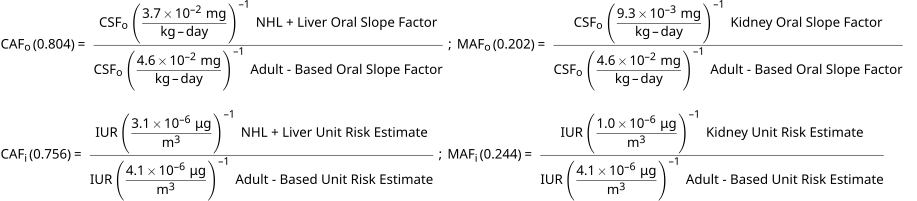
6. Tables of Variables Used in CDI and Risk Equations
Table 1. Toxicity Values
Symbol Definition (units) Default Reference RfDo Chronic Oral Reference Dose (mg/kg-day) Contaminant-specific EPA Superfund hierarchy RfC Chronic Inhalation Reference Concentration (mg/m3) Contaminant-specific EPA Superfund hierarchy CSFo Oral Slope Factor (mg/kg-day)-1 Contaminant-specific EPA Superfund hierarchy IUR Inhalation Unit Risk (µg/m3)-1 Contaminant-specific EPA Superfund hierarchy Table 2. Miscellaneous Variables
Symbol Definition (units) Default Reference Csoil Concentration of contaminant in soil (mg/kg) User-input Entered by user Cg-water Concentration of contaminant in groundwater (ug/L) User-input Entered by user Cs-water Concentration of contaminant in surface water (ug/L) User-input Entered by user Cair Concentration of contaminant in air (ug/m3) User-input Entered by user Cfish Concentration of contaminant in fish (mg/kg) User-input Entered by user Cproduce Concentration of contaminant in produce (mg/kg) User-input Entered by user Cdairy Concentration of contaminant in dairy (mg/kg) User-input Entered by user Cbeef Concentration of contaminant in beef (mg/kg) User-input Entered by user LT Lifetime (years) 70 U.S. EPA 1989 (pg. 6-22) K Andelman Volatilization Factor (L/m3) 0.5 U.S. EPA 1991b (pg. 20) Kp Permeability constant (cm/hour) Chemical-specific hierarchy selection in Section 2.4.2 t* Time to reach steady-state (hours) Chemical-specific U.S. EPA 2004 (Page 3-4) τevent Lag time per event (hours/event) Chemical-specific U.S. EPA 2004 (Page 3-4) B Dimensionless ratio of the permeability coefficient of a compound through the stratum corneum relative to its permeability coefficient across the viable epidermis (unitless) Chemical-specific U.S. EPA 2004 (Page 3-4) FA Fraction absorbed water (unitless) Chemical-specific U.S. EPA 2004 (Page 3-4) ABSd Fraction of contaminant absorbed dermally from soil (unitless) Chemical-specific U.S. EPA 2004 (Exhibit 3-4) GIABS Fraction of contaminant absorbed in gastrointestinal tract (unitless) Note: if the GIABS is >50% then it is set to 100% for the calculation of dermal toxicity values. Chemical-specific U.S. EPA 2004 (Exhibit 4-1) H' Dimensionless Henry's Law Constant Contaminant-specific hierarchy selection in Section 2.4.2 ▵Hv,b Enthalpy of vaporization at the normal boiling point (cal/mol) Contaminant-specific hierarchy selection in Section 2.4.2 ▵Hv,gw Enthalpy of vaporization at temperature of groundwater (cal/mol) Contaminant-specific Determined in this calculator Tw Groundwater Temperatures (Kelvin) Site-specific Site-specific Tc Critical Temperatures (Kelvin) Contaminant-specific hierarchy selection in Section 2.4.2 Tb Normal Boiling Point (Kelvin) Contaminant-specific hierarchy selection in Section 2.4.2 n If (Tb/Tc < 0.57)
If (Tb/Tc > 0.71)
If (0.57 < Tb/Tc ≤ 0.71)n = 0.3
n = 0.41
n = (0.74 x Tb/Tc - 0.116)U.S. EPA VISL 2014 Table 3. Resident Soil Land Use Equation Variables
Symbol Definition (units) Default Reference CDIres-sol-ingnc Resident Child Soil Noncarcinogenic Ingestion (mg/kg-day) Contaminant-specific
Child, Adult and Age-adjusted SpecificDetermined in this calculator CDIres-sol-dernc Resident Child Soil Noncarcinogenic Dermal (mg/kg-day) Contaminant-specific
Child, Adult and Age-adjusted SpecificDetermined in this calculator CDIres-sol-inhnc Resident Child Soil Noncarcinogenic Inhalation (mg/m3) Contaminant-specific
Child, Adult and Age-adjusted SpecificDetermined in this calculator CDIres-sol-ingna Resident Adult Soil Noncarcinogenic Ingestion (mg/kg-day) Contaminant-specific
Child, Adult and Age-adjusted SpecificDetermined in this calculator CDIres-sol-derna Resident Adult Soil Noncarcinogenic Dermal (mg/kg-day) Contaminant-specific
Child, Adult and Age-adjusted SpecificDetermined in this calculator CDIres-sol-inhna Resident Adult Soil Noncarcinogenic Inhalation (mg/m3) Contaminant-specific
Child, Adult and Age-adjusted SpecificDetermined in this calculator CDIres-sol-ingnadj Resident Age-Adjusted Soil Noncarcinogenic Ingestion (mg/kg-day) Contaminant-specific
Child, Adult and Age-adjusted SpecificDetermined in this calculator CDIres-sol-dernadj Resident Age-Adjusted Soil Noncarcinogenic Dermal (mg/kg-day) Contaminant-specific
Child, Adult and Age-adjusted SpecificDetermined in this calculator CDIres-sol-inhnadj Resident Age-Adjusted Soil Noncarcinogenic Inhalation (mg/m3) Contaminant-specific
Child, Adult and Age-adjusted SpecificDetermined in this calculator CDIres-sol-ingc Resident Soil Carcinogenic Ingestion (mg/kg-day) Contaminant-specific Determined in this calculator CDIres-sol-derc Resident Soil Carcinogenic Dermal (mg/kg-day) Contaminant-specific Determined in this calculator CDIres-sol-inhc Resident Soil Carcinogenic Inhalation (ug/m3) Contaminant-specific Determined in this calculator CDIres-sol-ingmu Resident Soil Mutagenic Ingestion (mg/kg-day) Mutagen-specific Determined in this calculator CDIres-sol-dermu Resident Soil Mutagenic Dermal (mg/kg-day) Mutagen-specific Determined in this calculator CDIres-sol-inhmu Resident Soil Mutagenic Inhalation (ug/m3) Mutagen-specific Determined in this calculator CDIres-sol-ingvc Resident Soil Carcinogenic Vinyl Chloride Ingestion (mg/kg-day) Vinyl Chloride-specific Determined in this calculator CDIres-sol-dervc Resident Soil Carcinogenic Vinyl Chloride Dermal (mg/kg-day) Vinyl Chloride-specific Determined in this calculator CDIres-sol-inhvc Resident Soil Carcinogenic Vinyl Chloride Inhalation (ug/m3) Vinyl Chloride-specific Determined in this calculator CDIres-sol-ingtce Resident Soil Carcinogenic and Mutagenic Trichloroethylene Ingestion (mg/kg-day) Trichloroethylene-specific Determined in this calculator CDIres-sol-dertce Resident Soil Carcinogenic and Mutagenic Trichloroethylene Dermal (mg/kg-day) Trichloroethylene-specific Determined in this calculator CDIres-sol-inhtce Resident Soil Carcinogenic and Mutagenic Trichloroethylene Inhalation (ug/m3) Trichloroethylene-specific Determined in this calculator BWres-a Body Weight - adult (kg) 80 U.S. EPA 2014 (Attachment 1) BWres-c Body Weight - child (kg) 15 U.S. EPA 2014 (Attachment 1) BW0-2 Body Weight - 0-2 Years (kg) 15 U.S. EPA 2014 (Attachment 1) BW2-6 Body Weight - 2-6 Years (kg) 15 U.S. EPA 2014 (Attachment 1) BW6-16 Body Weight - 6-16 Years (kg) 80 U.S. EPA 2014 (Attachment 1) BW16-26 Body Weight - 16-26 Years (kg) 80 U.S. EPA 2014 (Attachment 1) EDres Exposure Duration - adult + child (years) 26 U.S. EPA 2014 (Attachment 1) EDres-a Exposure Duration - adult (years) 20 U.S. EPA 2014 (Attachment 1) EDres-c Exposure Duration - child (years) 6 U.S. EPA 2014 (Attachment 1) ED0-2 Exposure Duration - 0-2 Years (years) 2 U.S. EPA 2014 (Attachment 1) ED2-6 Exposure Duration - 2-6 Years (years) 4 U.S. EPA 2014 (Attachment 1) ED6-16 Exposure Duration - 6-16 Years (years) 10 U.S. EPA 2014 (Attachment 1) ED16-26 Exposure Duration - 16-26 Years (years) 10 U.S. EPA 2014 (Attachment 1) EFres Exposure Frequency - adult + child (days/year) 350 U.S. EPA 2014 (Attachment 1) EFres-a Exposure Frequency - adult (days/year) 350 U.S. EPA 2014 (Attachment 1) EFres-c Exposure Frequency - child (days/year) 350 U.S. EPA 2014 (Attachment 1) EF0-2 Exposure Frequency - 0-2 Years (days/year) 350 U.S. EPA 2014 (Attachment 1) EF2-6 Exposure Frequency - 2-6 Years (days/year) 350 U.S. EPA 2014 (Attachment 1) EF6-16 Exposure Frequency - 6-16 Years (days/year) 350 U.S. EPA 2014 (Attachment 1) EF16-26 Exposure Frequency - 16-26 Years (days/year) 350 U.S. EPA 2014 (Attachment 1) ETres-a Resident Exposure Time - adult (hours/day) 24 The whole day ETres-c Resident Exposure Time - child (hours/day) 24 The whole day ETres Resident Exposure Time (hours/day) 24 The whole day ET0-2 Exposure Time - age segment 0-2 (hours/day) 24 The whole day ET2-6 Exposure Time - age segment 2-6 (hours/day) 24 The whole day ET6-16 Exposure Time - age segment 6-16 (hours/day) 24 The whole day ET16-26 Exposure Time - age segment 16-26 (hours/day) 24 The whole day IRSres-c Ingestion Rate - Child (mg/day) 200 U.S. EPA 2014 (Attachment 1) IRSres-a Ingestion Rate - Adult (mg/day) 100 U.S. EPA 2014 (Attachment 1) IRS0-2 Ingestion Rate - 0-2 years (mg/day) 200 U.S. EPA 2014 (Attachment 1) IRS2-6 Ingestion Rate - 2-6 years (mg/day) 200 U.S. EPA 2014 (Attachment 1) IRS6-16 Ingestion Rate - 6-16 years (mg/day) 100 U.S. EPA 2014 (Attachment 1) IRS16-26 Ingestion Rate - 16-26 years (mg/day) 100 U.S. EPA 2014 (Attachment 1) IFSres-adj Ingestion Rate - Age-adjusted (mg/kg) 36,750 Calculated using the age-adjusted intake factors equation IFSMres-adj Mutagenic Ingestion Rate - Age-adjusted (mg/kg) 166,833 Calculated using the mutagenic age-adjusted intake factors equation AFres-c Adherence factor-child (mg/cm2) 0.2 U.S. EPA 2014 (Attachment 1) AFres-a Adherence factor-adult (mg/cm2) 0.07 U.S. EPA 2014 (Attachment 1) AF0-2 Adherence factor 0-2 years (mg/cm2) 0.2 U.S. EPA 2014 (Attachment 1) AF2-6 Adherence factor 2-6 years (mg/cm2) 0.2 U.S. EPA 2014 (Attachment 1) AF6-16 Adherence factor 6-16 years (mg/cm2) 0.07 U.S. EPA 2014 (Attachment 1) AF16-26 Adherence factor 16-26 years (mg/cm2) 0.07 U.S. EPA 2014 (Attachment 1) DFSres-adj Dermal contact factor- age-adjusted (mg/kg) 103,390 Calculated using the age-adjusted intake factors equation DFSMres-adj Mutagenic dermal contact factor- age-adjusted (mg/kg) 428,260 Calculated using the mutagenic age-adjusted intake factors equation SAres-c Surface area - child (cm2) 2373 U.S. EPA 2014 (Attachment 1) SAres-a Surface area - adult (cm2) 6032 U.S. EPA 2014 (Attachment 1) SA0-2 Surface area 0-2 years (cm2) 2373 U.S. EPA 2014 (Attachment 1) SA2-6 Surface area 2-6 years (cm2) 2373 U.S. EPA 2014 (Attachment 1) SA6-16 Surface area 6-16 years (cm2) 6032 U.S. EPA 2014 (Attachment 1) SA16-26 Surface area 16-26 years (cm2) 6032 U.S. EPA 2014 (Attachment 1) ATres Averaging time (days/year) 365 x LT U.S. EPA 2014 (Attachment 1) ATres-c Averaging time - child (days/year) 365 x EDres-c U.S. EPA 2014 (Attachment 1) ATres-a Averaging time - adult (days/year) 365 x EDres U.S. EPA 2014 (Attachment 1) Table 4. Composite Worker Soil Land Use Equation Variables
Symbol Definition (units) Default Reference CDIcom-sol-ingn Composite Worker Soil Noncarcinogenic Ingestion (mg/kg-day) Contaminant-specific Determined in this calculator CDIcom-sol-dern Composite Worker Soil Noncarcinogenic Dermal (mg/kg-day) Contaminant-specific Determined in this calculator CDIcom-sol-inhn Composite Worker Soil Noncarcinogenic Inhalation (mg/m3) Contaminant-specific Determined in this calculator CDIcom-sol-ingc Composite Worker Soil Carcinogenic Ingestion (mg/kg-day) Contaminant-specific Determined in this calculator CDIcom-sol-derc Composite Worker Soil Carcinogenic Dermal (mg/kg-day) Contaminant-specific Determined in this calculator CDIcom-sol-inhc Composite Worker Soil Carcinogenic Inhalation (ug/m3) Contaminant-specific Determined in this calculator BWcom Body Weight (kg) 80 U.S. EPA 2014 (Attachment 1) EDcom Exposure Duration (years) 25 U.S. EPA 2014 (Attachment 1) EFcom Exposure Frequency (days/year) 250 U.S. EPA 2014 (Attachment 1) ETcom Exposure Time (hours/day) 8 U.S. EPA 2014 (Attachment 1) IRScom Ingestion Rate (mg/day) 100 U.S. EPA 2014 (Attachment 1) AFcom Adherence factor (mg/cm2) 0.12 U.S. EPA 2014 (Attachment 1) SAcom Surface Area (cm2) 3527 U.S. EPA 2014 (Attachment 1) ATcom Averaging time (days/year) 365 x LT U.S. EPA 2014 (Attachment 1) ATcom-a Averaging time - adult (days/year) 365 x EDcom U.S. EPA 2014 (Attachment 1) Table 5. Outdoor Worker Soil Land Use Equation Variables
Symbol Definition (units) Default Reference CDIout-sol-ingn Outdoor Worker Soil Noncarcinogenic Ingestion (mg/kg-day) Contaminant-specific Determined in this calculator CDIout-sol-dern Outdoor Worker Soil Noncarcinogenic Dermal (mg/kg-day) Contaminant-specific Determined in this calculator CDIout-sol-inhn Outdoor Worker Soil Noncarcinogenic Inhalation (mg/m3) Contaminant-specific Determined in this calculator CDIout-sol-ingc Outdoor Worker Soil Carcinogenic Ingestion (mg/kg-day) Contaminant-specific Determined in this calculator CDIout-sol-derc Outdoor Worker Soil Carcinogenic Dermal (mg/kg-day) Contaminant-specific Determined in this calculator CDIout-sol-inhc Outdoor Worker Soil Carcinogenic Inhalation (ug/m3) Contaminant-specific Determined in this calculator BWout Body Weight (kg) 80 U.S. EPA 2014 (Attachment 1) EDout Exposure Duration (years) 25 U.S. EPA 2014 (Attachment 1) EFout Exposure Frequency (days/year) 225 U.S. EPA 2014 (Attachment 1) ETout Exposure Time (hours/day) 8 U.S. EPA 2014 (Attachment 1) IRSout Ingestion Rate (mg/day) 100 U.S. EPA 2014 (Attachment 1) AFout Adherence factor (mg/cm2) 0.12 U.S. EPA 2014 (Attachment 1) SAout Surface area (cm2) 3527 U.S. EPA 2014 (Attachment 1) ATout Averaging time (days/year) 365 x LT U.S. EPA 2014 (Attachment 1) ATout-a Averaging time - adult (days/year) 365 x EDout U.S. EPA 2014 (Attachment 1) Table 6. Indoor Worker Soil Land Use Equation Variables
Symbol Definition (units) Default Reference CDIind-sol-ingn Indoor Worker Soil Noncarcinogenic Ingestion (mg/kg-day) Contaminant-specific Determined in this calculator CDIind-sol-inhn Indoor Worker Soil Noncarcinogenic Inhalation (mg/m3) Contaminant-specific Determined in this calculator CDIind-sol-ingc Indoor Worker Soil Carcinogenic Ingestion (mg/kg-day) Contaminant-specific Determined in this calculator CDIind-sol-inhc Indoor Worker Soil Carcinogenic Inhalation (ug/m3) Contaminant-specific Determined in this calculator BWind Body Weight (kg) 80 U.S. EPA 2014 (Attachment 1) EDind Exposure Duration (years) 25 U.S. EPA 2014 (Attachment 1) EFind Exposure Frequency (days/year) 250 U.S. EPA 2014 (Attachment 1) ETind Exposure Time (hours/day) 8 U.S. EPA 2014 (Attachment 1) IRSind Soil Ingestion Rate (mg/day) 50 U.S. EPA 2014 (Attachment 1) ATind Averaging time (days/year) 365 x LT U.S. EPA 2014 (Attachment 1) ATind-a Averaging time - adult (days/year) 365 x EDind U.S. EPA 2014 (Attachment 1) Table 7. Construction Worker Soil Land Use Equation Variables
Symbol Definition (units) Default Reference CDIcon-sol-ingn Construction Worker Soil Noncarcinogenic Ingestion (mg/kg-day) Contaminant-specific Determined in this calculator CDIcon-sol-dern Construction Worker Soil Noncarcinogenic Dermal (mg/kg-day) Contaminant-specific Determined in this calculator CDIcon-sol-inhn Construction Worker Soil Noncarcinogenic Inhalation (mg/m3) Contaminant-specific Determined in this calculator CDIcon-sol-ingc Construction Worker Soil Carcinogenic Ingestion (mg/kg-day) Contaminant-specific Determined in this calculator CDIcon-sol-derc Construction Worker Soil Carcinogenic Dermal (mg/kg-day) Contaminant-specific Determined in this calculator CDIcon-sol-inhc Construction Worker Soil Carcinogenic Inhalation (ug/m3) Contaminant-specific Determined in this calculator BWcon Body Weight (kg) 80 U.S. EPA 2014 (Attachment 1) EDcon Exposure Duration (years) 1 U.S. EPA 2014 (Attachment 1) EWcon Exposure (weeks/year) 50 Based on 50 weeks per year (reasonable work season) DWcon Exposure (days/week) 5 Based on 5 days per week for 50 weeks EFcon Exposure Frequency (days/year) EW x DW Based on 5 days per week for 50 weeks ETcon Exposure Time (hours/day) 8 U.S. EPA 2014 (Attachment 1) IRScon Ingestion Rate (mg/day) 330 U.S. EPA 2002 (Exhibit 1-2) AFcon Adherence factor (mg/cm2) 0.3 U.S. EPA 2002 (Exhibit 1-2) SAcon Surface area (cm2) 3527 U.S. EPA 2014 (Attachment 1) ATcon Averaging time (days/year) 365 x LT U.S. EPA 2014 (Attachment 1) ATcon-a Averaging time - adult (days/year) EW x 7 x ED U.S. EPA 2014 (Attachment 1) Table 8. Excavation Worker Soil Land Use Equation Variables
Symbol Definition (units) Default Reference CDIexc-sol-ingn Excavation Worker Soil Noncarcinogenic Ingestion (mg/kg-day) Contaminant-specific Determined in this calculator CDIexc-sol-dern Excavation Worker Soil Noncarcinogenic Dermal (mg/kg-day) Contaminant-specific Determined in this calculator CDIexc-sol-inhn Excavation Worker Soil Noncarcinogenic Inhalation (mg/m3) Contaminant-specific Determined in this calculator CDIexc-sol-ingc Excavation Worker Soil Carcinogenic Ingestion (mg/kg-day) Contaminant-specific Determined in this calculator CDIexc-sol-derc Excavation Worker Soil Carcinogenic Dermal (mg/kg-day) Contaminant-specific Determined in this calculator CDIexc-sol-inhc Excavation Worker Soil Carcinogenic Inhalation (ug/m3) Contaminant-specific Determined in this calculator BWew Body Weight (kg) 80 U.S. EPA 2014 (Attachment 1) EDew Exposure Duration (years) 1 U.S. EPA 2014 (Attachment 1) EFew Exposure Frequency (days/year) 20 Based on 5 days per week for 4 weeks ETew Exposure Time (hours/day) 8 U.S. EPA 2014 (Attachment 1) IRSew Ingestion Rate (mg/day) 330 U.S. EPA 2002 (Exhibit 1-2) AFew Adherence factor (mg/cm2) 0.3 U.S. EPA 2002 (Exhibit 1-2) SAew Surface area (cm2) 3527 U.S. EPA 2014 (Attachment 1) ATew Averaging time (days/year) 365 x LT U.S. EPA 2014 (Attachment 1) ATexc-a Averaging time - adult (days/year) 365 x EDew U.S. EPA 2014 (Attachment 1) Table 9. Recreator Soil/Sediment Land Use Equation Variables
Symbol Definition (units) Default Reference CDIrec-sol-ingnc Recreator Child Soil Noncarcinogenic Ingestion (mg/kg-day) Contaminant-specific
Child, Adult and Age-adjusted SpecificDetermined in this calculator CDIrec-sol-dernc Recreator Child Soil Noncarcinogenic Dermal (mg/kg-day) Contaminant-specific
Child, Adult and Age-adjusted SpecificDetermined in this calculator CDIrec-sol-inhnc Recreator Child Soil Noncarcinogenic Inhalation (mg/m3) Contaminant-specific
Child, Adult and Age-adjusted SpecificDetermined in this calculator CDIrec-sol-ingna Recreator Adult Soil Noncarcinogenic Ingestion (mg/kg-day) Contaminant-specific
Child, Adult and Age-adjusted SpecificDetermined in this calculator CDIrec-sol-derna Recreator Adult Soil Noncarcinogenic Dermal (mg/kg-day) Contaminant-specific
Child, Adult and Age-adjusted SpecificDetermined in this calculator CDIrec-sol-inhna Recreator Adult Soil Noncarcinogenic Inhalation (mg/m3) Contaminant-specific
Child, Adult and Age-adjusted SpecificDetermined in this calculator CDIrec-sol-ingnadj Recreator Age-Adjusted Soil Noncarcinogenic Ingestion (mg/kg-day) Contaminant-specific
Child, Adult and Age-adjusted SpecificDetermined in this calculator CDIrec-sol-dernadj Recreator Age-Adjusted Soil Noncarcinogenic Dermal (mg/kg-day) Contaminant-specific
Child, Adult and Age-adjusted SpecificDetermined in this calculator CDIrec-sol-inhnadj Recreator Age-Adjusted Soil Noncarcinogenic Inhalation (mg/m3) Contaminant-specific
Child, Adult and Age-adjusted SpecificDetermined in this calculator CDIrec-sol-ingc Recreator Soil Carcinogenic Ingestion (mg/kg-day) Contaminant-specific Determined in this calculator CDIrec-sol-derc Recreator Soil Carcinogenic Dermal (mg/kg-day) Contaminant-specific Determined in this calculator CDIrec-sol-inhc Recreator Soil Carcinogenic Inhalation (ug/m3) Contaminant-specific Determined in this calculator CDIrec-sol-ingmu Recreator Soil Mutagenic Ingestion (mg/kg-day) Mutagen-specific Determined in this calculator CDIrec-sol-dermu Recreator Soil Mutagenic Dermal (mg/kg-day) Mutagen-specific Determined in this calculator CDIrec-sol-inhmu Recreator Soil Mutagenic Inhalation (ug/m3) Mutagen-specific Determined in this calculator CDIrec-soil-ingvc Recreator Soil Carcinogenic Vinyl Chloride Ingestion (mg/kg-day) Vinyl Chloride-specific Determined in this calculator CDIrec-soil-dervc Recreator Soil Carcinogenic Vinyl Chloride Dermal (mg/kg-day) Vinyl Chloride-specific Determined in this calculator CDIrec-soil-inhvc Recreator Soil Carcinogenic Vinyl Chloride Inhalation (ug/m3) Vinyl Chloride-specific Determined in this calculator CDIrec-soil-ingtce Recreator Soil Carcinogenic and Mutagenic Trichloroethylene Ingestion (mg/kg-day) Trichloroethylene-specific Determined in this calculator CDIrec-soil-dertce Recreator Soil Carcinogenic and Mutagenic Trichloroethylene Dermal (mg/kg-day) Trichloroethylene-specific Determined in this calculator CDIrec-soil-inhtce Recreator Soil Carcinogenic and Mutagenic Trichloroethylene Inhalation (ug/m3) Trichloroethylene-specific Determined in this calculator BWrec-a Body Weight - adult (kg) 80 U.S. EPA 2014 (Attachment 1) BWrec-c Body Weight - child (kg) 15 U.S. EPA 2014 (Attachment 1) BW0-2 Body Weight - 0-2 Years (kg) 15 U.S. EPA 2014 (Attachment 1) BW2-6 Body Weight - 2-6 Years (kg) 15 U.S. EPA 2014 (Attachment 1) BW6-16 Body Weight - 6-16 Years (kg) 80 U.S. EPA 2014 (Attachment 1) BW16-26 Body Weight - 16-26 Years (kg) 80 U.S. EPA 2014 (Attachment 1) EDrec Exposure Duration - adult + child (years) 26 U.S. EPA 2014 (Attachment 1) EDrec-a Exposure Duration - adult (years) 20 U.S. EPA 2014 (Attachment 1) EDrec-c Exposure Duration - child (years) 6 U.S. EPA 2014 (Attachment 1) ED0-2 Exposure Duration - 0-2 Years (years) 2 U.S. EPA 2014 (Attachment 1) ED2-6 Exposure Duration - 2-6 Years (years) 4 U.S. EPA 2014 (Attachment 1) ED6-16 Exposure Duration - 6-16 Years (years) 10 U.S. EPA 2014 (Attachment 1) ED16-26 Exposure Duration - 16-26 Years (years) 10 U.S. EPA 2014 (Attachment 1) EFrec Exposure Frequency - adult + child (days/year) 75 Reasonable Estimate. See 4.7.1 EFrec-a Exposure Frequency - adult (days/year) 75 Reasonable Estimate. See 4.7.1 EFrec-c Exposure Frequency - child (days/year) 75 Reasonable Estimate. See 4.7.1 EF0-2 Exposure Frequency - 0-2 Years (days/year) 75 Reasonable Estimate. See 4.7.1 EF2-6 Exposure Frequency - 2-6 Years (days/year) 75 Reasonable Estimate. See 4.7.1 EF6-16 Exposure Frequency - 6-16 Years (days/year) 75 Reasonable Estimate. See 4.7.1 EF16-26 Exposure Frequency - 16-26 Years (days/year) 75 Reasonable Estimate. See 4.7.1 ETrec Exposure Time (hours/day) 1 Reasonable Estimate. See 4.7.1 ETrec-c Exposure time - child (hours/day) 1 Reasonable Estimate. See 4.7.1 ETrec-a Exposure time - adult (hours/day) 1 Reasonable Estimate. See 4.7.1 ET0-2 Exposure time 0-2 years (hours/day) 1 Reasonable Estimate. See 4.7.1 ET2-6 Exposure time 2-6 years (hours/day) 1 Reasonable Estimate. See 4.7.1 ET6-16 Exposure time 6-16 years (hours/day) 1 Reasonable Estimate. See 4.7.1 ET16-26 Exposure time 16-26 years (hours/day) 1 Reasonable Estimate. See 4.7.1 IRSrec-c Ingestion Rate - Child (mg/day) 200 U.S. EPA 2014 (Attachment 1) IRSrec-a Ingestion Rate - Adult (mg/day) 100 U.S. EPA 2014 (Attachment 1) IRS0-2 Ingestion Rate - 0-2 years (mg/day) 200 U.S. EPA 2014 (Attachment 1) IRS2-6 Ingestion Rate - 2-6 years (mg/day) 200 U.S. EPA 2014 (Attachment 1) IRS6-16 Ingestion Rate - 6-16 years (mg/day) 100 U.S. EPA 2014 (Attachment 1) IRS16-26 Ingestion Rate - 16-26 years (mg/day) 100 U.S. EPA 2014 (Attachment 1) IFSrec-adj Ingestion Rate - Age-adjusted (mg/kg) 7,875 Calculated using the age-adjusted intake factors equation IFSMrec-adj Mutagenic Ingestion Rate - Age-adjusted (mg/kg) 35,750 Calculated using the mutagenic age-adjusted intake factors equation AFrec-c Adherence factor-child (mg/cm2) 0.2 U.S. EPA 2014 (Attachment 1) AFrec-a Adherence factor-adult (mg/cm2) 0.07 U.S. EPA 2014 (Attachment 1) AF0-2 Adherence factor 0-2 years (mg/cm2) 0.2 U.S. EPA 2014 (Attachment 1) AF2-6 Adherence factor 2-6 years (mg/cm2) 0.2 U.S. EPA 2014 (Attachment 1) AF6-16 Adherence factor 6-16 years (mg/cm2) 0.07 U.S. EPA 2014 (Attachment 1) AF16-26 Adherence factor 16-26 years (mg/cm2) 0.07 U.S. EPA 2014 (Attachment 1) DFSrec-adj Dermal contact factor- age-adjusted (mg/kg) 22,155 Calculated using the age-adjusted intake factors equation DFSMrec-adj Mutagenic dermal contact factor- age-adjusted (mg/kg) 91,770 Calculated using the mutagenic age-adjusted intake factors equation SArec-c Surface area - child (cm2) 2373 U.S. EPA 2014 (Attachment 1) SArec-a Surface area - adult (cm2) 6032 U.S. EPA 2014 (Attachment 1) SA0-2 Surface area 0-2 years (cm2) 2373 U.S. EPA 2014 (Attachment 1) SA2-6 Surface area 2-6 years (cm2) 2373 U.S. EPA 2014 (Attachment 1) SA6-16 Surface area 6-16 years (cm2) 6032 U.S. EPA 2014 (Attachment 1) SA16-26 Surface area 16-26 (cm2) 6032 U.S. EPA 2014 (Attachment 1) ATrec Averaging time (days/year) 365 x LT U.S. EPA 2014 (Attachment 1) ATrec-c Averaging time - child (days/year) 365 x EDrec-c U.S. EPA 2014 (Attachment 1) ATrec-a Averaging time - adult (days/year) 365 x EDrec U.S. EPA 2014 (Attachment 1) Table 10. Recreator Surface Water Land Use Equation Variables
Symbol Definition (units) Default Reference CDIrec-wat-ingnc Recreator Child Surface Water Noncarcinogenic Ingestion (mg/kg-day) Contaminant-specific
Child, Adult and Age-adjusted SpecificDetermined in this calculator CDIrec-wat-dernc Recreator Child Surface Water Noncarcinogenic Dermal (mg/kg-day) Contaminant-specific
Child, Adult and Age-adjusted SpecificDetermined in this calculator CDIrec-wat-ingna Recreator Adult Surface Water Noncarcinogenic Ingestion (mg/kg-day) Contaminant-specific
Child, Adult and Age-adjusted SpecificDetermined in this calculator CDIrec-wat-derna Recreator Adult Surface Water Noncarcinogenic Dermal (mg/kg-day) Contaminant-specific
Child, Adult and Age-adjusted SpecificDetermined in this calculator CDIrec-wat-ingnadj Recreator Age-Adjusted Surface Water Noncarcinogenic Ingestion (mg/kg-day) Contaminant-specific
Child, Adult and Age-adjusted SpecificDetermined in this calculator CDIrec-wat-dernadj Recreator Age-Adjusted Surface Water Noncarcinogenic Dermal (mg/kg-day) Contaminant-specific
Child, Adult and Age-adjusted SpecificDetermined in this calculator CDIrec-wat-ingc Recreator Surface Water Carcinogenic Ingestion (mg/kg-day) Contaminant-specific Determined in this calculator CDIrec-wat-derc Recreator Surface Water Carcinogenic Dermal (mg/kg-day) Contaminant-specific Determined in this calculator CDIrec-wat-ingmu Recreator Surface Water Mutagenic Ingestion (mg/kg-day) Mutagen-specific Determined in this calculator CDIrec-wat-dermu Recreator Surface Water Mutagenic Dermal (mg/kg-day) Mutagen-specific Determined in this calculator CDIrec-wat-ingvc Recreator Surface Water Carcinogenic Vinyl Chloride Ingestion (mg/kg-day) Vinyl Chloride-specific Determined in this calculator CDIrec-wat-dervc Recreator Surface Water Carcinogenic Vinyl Chloride Dermal (mg/kg-day) Vinyl Chloride-specific Determined in this calculator CDIrec-wat-ingtce Recreator Surface Water Carcinogenic and Mutagenic Trichloroethylene Ingestion (mg/kg-day) Trichloroethylene-specific Determined in this calculator CDIrec-wat-dertce Recreator Surface Water Carcinogenic and Mutagenic Trichloroethylene Dermal (mg/kg-day) Trichloroethylene-specific Determined in this calculator BWrec-a Body Weight - adult (kg) 80 U.S. EPA 2014 (Attachment 1) BWrec-c Body Weight - child (kg) 15 U.S. EPA 2014 (Attachment 1) BW0-2 Body Weight - 0-2 Years (kg) 15 U.S. EPA 2014 (Attachment 1) BW2-6 Body Weight - 2-6 Years (kg) 15 U.S. EPA 2014 (Attachment 1) BW6-16 Body Weight - 6-16 Years (kg) 80 U.S. EPA 2014 (Attachment 1) BW16-26 Body Weight - 16-26 Years (kg) 80 U.S. EPA 2014 (Attachment 1) EDrec-a Exposure Duration - adult (years) 20 U.S. EPA 2014 (Attachment 1) EDrec-c Exposure Duration - child (years) 6 U.S. EPA 2014 (Attachment 1) ED0-2 Exposure Duration - 0-2 Years (years) 2 U.S. EPA 2014 (Attachment 1) ED2-6 Exposure Duration - 2-6 Years (years) 4 U.S. EPA 2014 (Attachment 1) ED6-16 Exposure Duration - 6-16 Years (years) 10 U.S. EPA 2014 (Attachment 1) ED16-26 Exposure Duration - 16-26 Years (years) 10 U.S. EPA 2014 (Attachment 1) EFrec-a Exposure Frequency - adult (days/year) 45 Region 4 Bulletin EFrec-c Exposure Frequency - child (days/year) 45 Region 4 Bulletin EF0-2 Exposure Frequency - 0-2 Years (days/year) 45 Region 4 Bulletin EF2-6 Exposure Frequency - 2-6 Years (days/year) 45 Region 4 Bulletin EF6-16 Exposure Frequency - 6-16 Years (days/year) 45 Region 4 Bulletin EF16-26 Exposure Frequency - 16-26 Years (days/year) 45 Region 4 Bulletin ETevent-rec-c Exposure Time - child (hours/event) 1 Reasonable Estimate. See 4.7.2 ETevent-rec-a Exposure Time - adult (hours/event) 1 Reasonable Estimate. See 4.7.2 ETevent-rec(0-2) Exposure Time (hours/event) 1 Reasonable Estimate. See 4.7.2 ETevent-rec(2-6) Exposure Time (hours/event) 1 Reasonable Estimate. See 4.7.2 ETevent-rec(6-16) Exposure Time (hours/event) 1 Reasonable Estimate. See 4.7.2 ETevent-rec(16-26) Exposure Time (hours/event) 1 Reasonable Estimate. See 4.7.2 EVrec-c Events - child (events/day) 1 Reasonable Estimate. See 4.7.2 EVrec-a Events - adult (events/day) 1 Reasonable Estimate. See 4.7.2 EV0-2 Events (events/day) 1 Reasonable Estimate. See 4.7.2 EV2-6 Events (events/day) 1 Reasonable Estimate. See 4.7.2 EV6-16 Events (events/day) 1 Reasonable Estimate. See 4.7.2 EV16-26 Events (events/day) 1 Reasonable Estimate. See 4.7.2 IRWrec-c Ingestion Rate - Child (L/hour) 0.12 Table 3.5 in EFH 2011 IRWrec-a Ingestion Rate - Adult (L/hour) 0.11 Time weighted average was calculated based on the upper percentile from Table 3.7 of EFH 2019 IRW0-2 Ingestion Rate - 0-2 years (L/hour) 0.12 Table 3.5 in EFH 2011 IRW2-6 Ingestion Rate - 2-6 years (L/hour) 0.12 Table 3.5 in EFH 2011 IRW6-16 Ingestion Rate - 6-16 years (L/hour) 0.124 Time weighted average was calculated based on the upper percentile from Table 3.7 of EFH 2019 IRW16-26 Ingestion Rate - 16-26 years (L/hour) 0.0985 Time weighted average was calculated based on the upper percentile from Table 3.7 of EFH 2019 IFWrec-adj Ingestion Rate - Age-adjusted (L/kg) 3.4 Calculated using the age-adjusted intake factors equation IFWMrec-adj Mutagenic Ingestion Rate - Age-adjusted (L/kg) 14 Calculated using the mutagenic age-adjusted intake factors equation SArec-c Surface area - child (cm2) 6,365 U.S. EPA 2014 (Attachment 1) SArec-a Surface area - adult (cm2) 19,652 U.S. EPA 2014 (Attachment 1) SA0-2 Surface area 0-2 years (cm2) 6,365 U.S. EPA 2014 (Attachment 1) SA2-6 Surface area 2-6 years (cm2) 6,365 U.S. EPA 2014 (Attachment 1) SA6-16 Surface area 6-16 years (cm2) 19,652 U.S. EPA 2014 (Attachment 1) SA16-26 Surface area 16-26 (cm2) 19,652 U.S. EPA 2014 (Attachment 1) DFWrec-adj Dermal contact factor- age-adjusted (cm2-event/kg) 335,655 Calculated using the age-adjusted intake factors equation DFWMrec-adj Mutagenic dermal contact factor- age-adjusted (cm2-event/kg) 1,053,210 Calculated using the mutagenic age-adjusted intake factors equation ATrec Averaging time (days/year) 365 x LT U.S. EPA 2014 (Attachment 1) ATrec-c Averaging time (days/year) 365 x EDrec-c U.S. EPA 2014 (Attachment 1) ATrec-a Averaging time (days/year) 365 x EDrec-a U.S. EPA 2014 (Attachment 1) Table 11. Resident Tap Water Land Use Equation Variables
Symbol Definition (units) Default Reference CDIres-wat-ingnc Resident Child Tap Water (Groundwater) Noncarcinogenic Ingestion (mg/kg-day) Contaminant-specific
Child, Adult and Age-adjusted SpecificDetermined in this calculator CDIres-wat-dernc Resident Child Tap Water (Groundwater) Noncarcinogenic Dermal (mg/kg-day) Contaminant-specific
Child, Adult and Age-adjusted SpecificDetermined in this calculator CDIres-wat-inhnc Resident Child Tap Water (Groundwater) Noncarcinogenic Inhalation (mg/m3) Contaminant-specific
Child, Adult and Age-adjusted SpecificDetermined in this calculator CDIres-wat-ingna Resident Adult Tap Water (Groundwater) Noncarcinogenic Ingestion (mg/kg-day) Contaminant-specific
Child, Adult and Age-adjusted SpecificDetermined in this calculator CDIres-wat-derna Resident Adult Tap Water (Groundwater) Noncarcinogenic Dermal (mg/kg-day) Contaminant-specific
Child, Adult and Age-adjusted SpecificDetermined in this calculator CDIres-wat-inhna Resident Adult Tap Water (Groundwater) Noncarcinogenic Inhalation (mg/m3) Contaminant-specific
Child, Adult and Age-adjusted SpecificDetermined in this calculator CDIres-wat-ingnadj Resident Age-Adjusted Tap Water (Groundwater) Noncarcinogenic Ingestion (mg/kg-day) Contaminant-specific
Child, Adult and Age-adjusted SpecificDetermined in this calculator CDIres-wat-dernadj Resident Age-Adjusted Tap Water (Groundwater) Noncarcinogenic Dermal (mg/kg-day) Contaminant-specific
Child, Adult and Age-adjusted SpecificDetermined in this calculator CDIres-wat-inhnadj Resident Age-Adjusted Tap Water (Groundwater) Noncarcinogenic Inhalation (mg/m3) Contaminant-specific
Child, Adult and Age-adjusted SpecificDetermined in this calculator CDIres-wat-ingc Recreator Tap Water (Groundwater) Carcinogenic Ingestion (mg/kg-day) Contaminant-specific Determined in this calculator CDIres-wat-derc Resident Tap Water (Groundwater) Carcinogenic Dermal (mg/kg-day) Contaminant-specific Determined in this calculator CDIres-wat-inhc Resident Tap Water (Groundwater) Carcinogenic Inhalation (µg/m3) Contaminant-specific Determined in this calculator CDIres-wat-ingmu Resident Tap Water (Groundwater) Mutagenic Ingestion (mg/kg-day) Mutagen-specific Determined in this calculator CDIres-wat-dermu Resident Tap Water (Groundwater) Mutagenic Dermal (mg/kg-day) Mutagen-specific Determined in this calculator CDIres-wat-inhmu Resident Tap Water (Groundwater) Mutagenic Inhalation (µg/m3) Mutagen-specific Determined in this calculator CDIres-wat-ingvc Resident Tap Water (Groundwater) Carcinogenic Vinyl Chloride Ingestion (mg/kg-day) Vinyl Chloride-specific Determined in this calculator CDIres-wat-dervc Resident Tap Water (Groundwater) Carcinogenic Vinyl Chloride Dermal (mg/kg-day) Vinyl Chloride-specific Determined in this calculator CDIres-wat-inhvc Resident Tap Water (Groundwater) Carcinogenic Vinyl Chloride Inhalation (µg/m3) Vinyl Chloride-specific Determined in this calculator CDIres-wat-ingtce Resident Tap Water (Groundwater) Carcinogenic and Mutagenic Trichloroethylene Ingestion (mg/kg-day) Trichloroethylene-specific Determined in this calculator CDIres-wat-dertce Resident Tap Water (Groundwater) Carcinogenic and Mutagenic Trichloroethylene Dermal (mg/kg-day) Trichloroethylene-specific Determined in this calculator CDIres-wat-inhtce Resident Tap Water (Groundwater) Carcinogenic and Mutagenic Trichloroethylene Inhalation (µg/m3) Trichloroethylene-specific Determined in this calculator BWres-a Body Weight - adult (kg) 80 U.S. EPA 2014 (Attachment 1) BWres-c Body Weight - child (kg) 15 U.S. EPA 2014 (Attachment 1) BW0-2 Body Weight - 0-2 Years (kg) 15 U.S. EPA 2014 (Attachment 1) BW2-6 Body Weight - 2-6 Years (kg) 15 U.S. EPA 2014 (Attachment 1) BW6-16 Body Weight - 6-16 Years (kg) 80 U.S. EPA 2014 (Attachment 1) BW16-26 Body Weight - 16-26 Years (kg) 80 U.S. EPA 2014 (Attachment 1) EDres Exposure Duration - adult + child (years) 26 U.S. EPA 2014 (Attachment 1) EDres-a Exposure Duration - adult (years) 20 U.S. EPA 2014 (Attachment 1) EDres-c Exposure Duration - child (years) 6 U.S. EPA 2014 (Attachment 1) ED0-2 Exposure Duration - 0-2 Years (years) 2 U.S. EPA 2014 (Attachment 1) ED2-6 Exposure Duration - 2-6 Years (years) 4 U.S. EPA 2014 (Attachment 1) ED6-16 Exposure Duration - 6-16 Years (years) 10 U.S. EPA 2014 (Attachment 1) ED16-26 Exposure Duration - 16-26 Years (years) 10 U.S. EPA 2014 (Attachment 1) EFres Exposure Frequency - adult + child (days/year) 350 U.S. EPA 2014 (Attachment 1) EFres-a Exposure Frequency - adult (days/year) 350 U.S. EPA 2014 (Attachment 1) EFres-c Exposure Frequency - child (days/year) 350 U.S. EPA 2014 (Attachment 1) EF0-2 Exposure Frequency - 0-2 Years (days/year) 350 U.S. EPA 2014 (Attachment 1) EF2-6 Exposure Frequency - 2-6 Years (days/year) 350 U.S. EPA 2014 (Attachment 1) EF6-16 Exposure Frequency - 6-16 Years (days/year) 350 U.S. EPA 2014 (Attachment 1) EF16-26 Exposure Frequency - 16-26 Years (days/year) 350 U.S. EPA 2014 (Attachment 1) ETres Exposure Time (hours/day) 24 The whole day ETevent-res-c Exposure Time - child (hours/event) 0.54 U.S. EPA 2014 (Attachment 1) ETevent-res-a Exposure Time - adult (hours/event) 0.71 U.S. EPA 2014 (Attachment 1) ETevent-res(0-2) Exposure Time (hours/event) 0.54 U.S. EPA 2014 (Attachment 1) ETevent-res(2-6) Exposure Time (hours/event) 0.54 U.S. EPA 2014 (Attachment 1) ETevent-res(6-16) Exposure Time (hours/event) 0.71 U.S. EPA 2014 (Attachment 1) ETevent-res(16-26) Exposure Time (hours/event) 0.71 U.S. EPA 2014 (Attachment 1) EVres-c Events - child (events/day) 1 U.S. EPA 2004 Exhibit 3-2 EVres-a Events - adult (events/day) 1 U.S. EPA 2004 Exhibit 3-2 EV0-2 Events (events/day) 1 U.S. EPA 2004 Exhibit 3-2 EV2-6 Events (events/day) 1 U.S. EPA 2004 Exhibit 3-2 EV6-16 Events (events/day) 1 U.S. EPA 2004 Exhibit 3-2 EV16-26 Events (events/day) 1 U.S. EPA 2004 Exhibit 3-2 IRWres-c Ingestion Rate - Child (L/day) 0.78 U.S. EPA 2014 (Attachment 1) IRWres-a Ingestion Rate - Adult (L/day) 2.5 U.S. EPA 2014 (Attachment 1) IRW0-2 Ingestion Rate - 0-2 years (L/day) 0.78 U.S. EPA 2014 (Attachment 1) IRW2-6 Ingestion Rate - 2-6 years (L/day) 0.78 U.S. EPA 2014 (Attachment 1) IRW6-16 Ingestion Rate - 6-16 years (L/day) 2.5 U.S. EPA 2014 (Attachment 1) IRW16-26 Ingestion Rate - 16-26 years (L/day) 2.5 U.S. EPA 2014 (Attachment 1) IFWres-adj Ingestion Rate - Age-adjusted (L/kg) 327.95 Calculated using the age-adjusted intake factors equation IFWMres-adj Mutagenic Ingestion Rate - Age-adjusted (L/kg) 1,019.9 Calculated using the mutagenic age-adjusted intake factors equation SAres-c Surface area - child (cm2) 6,365 U.S. EPA 2014 (Attachment 1) SAres-a Surface area - adult (cm2) 19,652 U.S. EPA 2014 (Attachment 1) SA0-2 Surface area 0-2 years (cm2) 6,365 U.S. EPA 2014 (Attachment 1) SA2-6 Surface area 2-6 years (cm2) 6,365 U.S. EPA 2014 (Attachment 1) SA6-16 Surface area 6-16 years (cm2) 19,652 U.S. EPA 2014 (Attachment 1) SA16-26 Surface area 16-26 (cm2) 19,652 U.S. EPA 2014 (Attachment 1) DFWres-adj Dermal contact factor- age-adjusted (L/kg) 2,610,650 Calculated using the age-adjusted intake factors equation DFWMres-adj Mutagenic dermal contact factor- age-adjusted (L/kg) 8,191,633 Calculated using the mutagenic age-adjusted intake factors equation ATres Averaging time (days/year) 365 x LT U.S. EPA 2014 (Attachment 1) ATres-c Averaging time - child (days/year) 365 x EDres-c U.S. EPA 2014 (Attachment 1) ATres-a Averaging time - adult (days/year) 365 x EDres U.S. EPA 2014 (Attachment 1) Table 12. Indoor Worker Tap Water Land Use Equation Variables
Symbol Definition (units) Default Reference CDIind-wat-ingn Indoor Worker Tap Water Air Noncarcinogenic Ingestion (mg/kg-day) Contaminant-specific Determined in this calculator CDIind-wat-dern Indoor Worker Tap Water Noncarcinogenic Dermal (mg/kg-day) Contaminant-specific Determined in this calculator CDIind-wat-inhn Indoor Worker Tap Water Noncarcinogenic Inhalation (mg/m3) Contaminant-specific Determined in this calculator CDIind-wat-ingc Indoor Worker Tap Water Air Carcinogenic Ingestion (mg/kg-day) Contaminant-specific Determined in this calculator CDIind-wat-derc Indoor Worker Tap Water Carcinogenic Dermal (µg/m3) Contaminant-specific Determined in this calculator CDIind-wat-inhc Indoor Worker Tap Water Carcinogenic Inhalation (µg/m3) Contaminant-specific Determined in this calculator BWind Body Weight (kg) 80 U.S. EPA 2014 (Attachment 1) EDind Exposure Duration (years) 25 U.S. EPA 2014 (Attachment 1) EFind Exposure Frequency (days/year) 250 U.S. EPA 2014 (Attachment 1) ETind Exposure Time (hours/event) 8 U.S. EPA 2014 (Attachment 1) ETevent-iw Exposure Time Shower (hours/event) 0.71 U.S. EPA 2014 (Attachment 1) EVind Events (events/day) 1 U.S. EPA 2004 Exhibit 3-2 IRWind Ingestion Rate (L/day) 1.25 U.S. EPA 2014 (FAQ 13) SAind Surface area (cm2) 19,652 U.S. EPA 2014 (Attachment 1) ATind Averaging time (days/year) 365 x LT U.S. EPA 2014 (Attachment 1) ATind-a Averaging time (days/year) 365 x EDind U.S. EPA 2014 (Attachment 1) Table 13. Resident Air Land Use Equation Variables
Symbol Definition (units) Default Reference CDIres-air-inhn Resident Air Noncarcinogenic (mg/m3) Contaminant-specific Determined in this calculator CDIres-air-inhc Resident Air Carcinogenic (µg/m3) Contaminant-specific Determined in this calculator CDIres-air-inhmu Resident Air Mutagenic (µg/m3) Mutagen-specific Determined in this calculator CDIres-air-inhvc Resident Air Carcinogenic Vinyl Chloride (µg/m3) Vinyl Chloride-specific Determined in this calculator CDIres-air-inhtce Resident Air Carcinogenic and Mutagenic Trichloroethylene (µg/m3) Trichloroethylene-specific Determined in this calculator EDres Exposure Duration (years) 26 U.S. EPA 2014 (Attachment 1) ED0-2 Exposure Duration 0-2 years (years) 2 U.S. EPA 2014 (Attachment 1) ED2-6 Exposure Duration 2-6 years (years) 4 U.S. EPA 2014 (Attachment 1) ED6-16 Exposure Duration 6-16 years (years) 10 U.S. EPA 2014 (Attachment 1) ED16-26 Exposure Duration 16-26 years (years) 10 U.S. EPA 2014 (Attachment 1) EFres Exposure Frequency (days/year) 350 U.S. EPA 2014 (Attachment 1) ETres Exposure Time (hours/day) 24 The whole day ATres Averaging time (days/year) 365 x LT U.S. EPA 2014 (Attachment 1) ATres-a Averaging time (days/year) 365 x EDres U.S. EPA 2014 (Attachment 1) Table 14. Composite Worker Air Land Use Equation Variables
Symbol Definition (units) Default Reference CDIcom-air-inhn Composite Worker Air Noncarcinogenic (mg/m3) Contaminant-specific Determined in this calculator CDIcom-air-inhc Composite Worker Air Carcinogenic (µg/m3) Contaminant-specific Determined in this calculator EDcom Exposure Duration (years) 25 U.S. EPA 2014 (Attachment 1) EFcom Exposure Frequency (days/year) 250 U.S. EPA 2014 (Attachment 1) ETcom Exposure Time (hours/day) 8 U.S. EPA 2014 (Attachment 1) ATcom Averaging time (days/year) 365 x LT U.S. EPA 2014 (Attachment 1) ATcom-a Averaging time (days/year) 365 x EDcom U.S. EPA 2014 (Attachment 1) Table 15. Outdoor Worker Air Land Use Equation Variables
Symbol Definition (units) Default Reference CDIout-air-inhn Outdoor Worker Air Noncarcinogenic (mg/m3) Contaminant-specific Determined in this calculator CDIout-air-inhc Outdoor Worker Air Carcinogenic (µg/m3) Contaminant-specific Determined in this calculator EDout Exposure Duration (years) 25 U.S. EPA 2014 (Attachment 1) EFout Exposure Frequency (days/year) 225 U.S. EPA 2014 (Attachment 1) ETout Exposure Time (hours/day) 8 U.S. EPA 2014 (Attachment 1) ATout Averaging time (days/year) 365 x LT U.S. EPA 2014 (Attachment 1) ATout-a Averaging time (days/year) 365 x EDout U.S. EPA 2014 (Attachment 1) Table 16. Indoor Worker Air Land Use Equation Variables
Symbol Definition (units) Default Reference CDIind-air-inhn Indoor Worker Air Noncarcinogenic (mg/m3) Contaminant-specific Determined in this calculator CDIind-air-inhc Indoor Worker Air Carcinogenic (µg/m3) Contaminant-specific Determined in this calculator EDind Exposure Duration (years) 25 U.S. EPA 2014 (Attachment 1) EFind Exposure Frequency (days/year) 250 U.S. EPA 2014 (Attachment 1) ETind Exposure Time (hours/day) 8 U.S. EPA 2014 (Attachment 1) ATind Averaging time (days/year) 365 x LT U.S. EPA 2014 (Attachment 1) ATind-a Averaging time (days/year) 365 x EDind U.S. EPA 2014 (Attachment 1) Table 17. Construction Worker Air Land Use Equation Variables
Symbol Definition (units) Default Reference CDIcon-air-inhn Construction Worker Air Noncarcinogenic (mg/m3) Contaminant-specific Determined in this calculator CDIcon-air-inhc Construction Worker Air Carcinogenic (µg/m3) Contaminant-specific Determined in this calculator EDcon Exposure Duration (years) 1 U.S. EPA 2014 (Attachment 1) EWcon Exposure (weeks/year) 50 Based on 50 weeks per year (reasonable work season) DWcon Exposure (days/week) 5 Based on 5 days per week for 50 weeks EFcon Exposure Frequency (days/year) EW x DW Based on 5 days per week for 50 weeks ETcon Exposure Time (hours/day) 8 U.S. EPA 2014 (Attachment 1) ATcon Averaging time (days/year) 365 x LT U.S. EPA 2014 (Attachment 1) ATcon-a Averaging time (days/year) EW x 7 x ED U.S. EPA 2014 (Attachment 1) Table 18. Excavation Worker Air Land Use Equation Variables
Symbol Definition (units) Default Reference CDIcon-air-inhn Excavation Worker Air Noncarcinogenic (mg/m3) Contaminant-specific Determined in this calculator CDIcon-air-inhc Excavation Worker Air Carcinogenic (µg/m3) Contaminant-specific Determined in this calculator EDew Exposure Duration (years) 1 U.S. EPA 2014 (Attachment 1) EFew Exposure Frequency (days/year) 20 Based on 5 days per week for 4 weeks ETew Exposure Time (hours/day) 8 U.S. EPA 2014 (Attachment 1) ATew Averaging time (days/year) 365 x LT U.S. EPA 2014 (Attachment 1) ATexc-a Averaging time (days/year) 365 x EDew U.S. EPA 2014 (Attachment 1) Table 19. Resident Fish Land Use Equation Variables
Symbol Definition (units) Default Reference CDIres-fsh-ingnc Resident Child Fish Noncarcinogenic (mg/kg) Contaminant-specific Determined in this calculator CDIres-fsh-ingna Resident Adult Fish Noncarcinogenic (mg/kg) Contaminant-specific Determined in this calculator CDIres-fsh-ingnadj Resident Age-Adjusted Fish Noncarcinogenic (mg/kg) Contaminant-specific Determined in this calculator CDIres-fsh-ingc Resident Fish Carcinogenic (mg/kg) Contaminant-specific Determined in this calculator CDIres-fsh-ingmu Resident Fish Mutagenic (mg/kg) Contaminant-specific Determined in this calculator CDIres-fsh-ingvc Resident Fish Carcinogenic Vinyl Chloride (mg/kg) Contaminant-specific Determined in this calculator CDIres-fsh-ingtce Resident Fish Carcinogenic Trichloroethylene (mg/kg) Contaminant-specific Determined in this calculator CDIres-fsh-ingncw Resident Child Surface Water Fish Noncarcinogenic (mg/kg) Contaminant-specific Determined in this calculator CDIres-fsh-ingnaw Resident Adult Surface Water Fish Noncarcinogenic (mg/kg) Contaminant-specific Determined in this calculator CDIres-fsh-ingnadjw Resident Age-Adjusted Surface Water Fish Noncarcinogenic (mg/kg) Contaminant-specific Determined in this calculator CDIres-fsh-ingcw Resident Surface Water Fish Carcinogenic (mg/kg) Contaminant-specific Determined in this calculator CDIres-fsh-ingmuw Resident Surface Water Fish Mutagenic (mg/kg) Contaminant-specific Determined in this calculator CDIres-fsh-ingvcw Resident Surface Water Fish Carcinogenic Vinyl Chloride (mg/kg) Contaminant-specific Determined in this calculator CDIres-fsh-ingtcew Resident Surface Water Fish Carcinogenic Trichloroethylene (mg/kg) Contaminant-specific Determined in this calculator ATres Averaging time (days/year) 365 x LT Determined in this calculator ATres-c Averaging time - child (days/year) 365 x EDres-c Determined in this calculator ATres-a Averaging time - adult (days/year) 365 x EDres-a Determined in this calculator ATres-adj Averaging time - age-adjusted (days/year) 365 x EDres Determined in this calculator BWres-a Body Weight - adult (kg) 80 U.S. EPA 2014 (Attachment 1) BWres-c Body Weight - child (kg) 15 U.S. EPA 2014 (Attachment 1) BW0-2 Body Weight - 0-2 Years (kg) 15 U.S. EPA 2014 (Attachment 1) BW2-6 Body Weight - 2-6 Years (kg) 15 U.S. EPA 2014 (Attachment 1) BW6-16 Body Weight - 6-16 Years (kg) 80 U.S. EPA 2014 (Attachment 1) BW16-26 Body Weight - 16-26 Years (kg) 80 U.S. EPA 2014 (Attachment 1) EDres Exposure Duration - adult + child (years) 26 U.S. EPA 2014 (Attachment 1) EDres-a Exposure Duration - adult (years) 20 U.S. EPA 2014 (Attachment 1) EDres-c Exposure Duration - child (years) 6 U.S. EPA 2014 (Attachment 1) ED0-2 Exposure Duration - 0-2 Years (years) 2 U.S. EPA 2014 (Attachment 1) ED2-6 Exposure Duration - 2-6 Years (years) 4 U.S. EPA 2014 (Attachment 1) ED6-16 Exposure Duration - 6-16 Years (years) 10 U.S. EPA 2014 (Attachment 1) ED16-26 Exposure Duration - 16-26 Years (years) 10 U.S. EPA 2014 (Attachment 1) EFres Exposure Frequency - adult + child (days/year) 350 U.S. EPA 2014 (Attachment 1) EFres-a Exposure Frequency - adult (days/year) 350 U.S. EPA 2014 (Attachment 1) EFres-c Exposure Frequency - child (days/year) 350 U.S. EPA 2014 (Attachment 1) EF0-2 Exposure Frequency - 0-2 Years (days/year) 350 U.S. EPA 2014 (Attachment 1) EF2-6 Exposure Frequency - 2-6 Years (days/year) 350 U.S. EPA 2014 (Attachment 1) EF6-16 Exposure Frequency - 6-16 Years (days/year) 350 U.S. EPA 2014 (Attachment 1) EF16-26 Exposure Frequency - 16-26 Years (days/year) 350 U.S. EPA 2014 (Attachment 1) IRFIres-c Ingestion Rate - Child (mg/day) 84,200 See Section 2.2 IRFIres-a Ingestion Rate - Adult (mg/day) 424,600 See Section 2.2 IRFI0-2 Ingestion Rate - 0-2 years (mg/day) 84,200 See Section 2.2 IRFI2-6 Ingestion Rate - 2-6 years (mg/day) 84,200 See Section 2.2 IRFI6-16 Ingestion Rate - 6-16 years (mg/day) 424,600 See Section 2.2 IRFI16-26 Ingestion Rate - 16-26 years (mg/day) 424,600 See Section 2.2 IFFIres-adj Ingestion Factor - Age-adjusted (days·mg/(kg·meal)) 48,940,500 Calculated using the age-adjusted intake factors equation IFFIMres-adj Mutagenic Ingestion Factor - Age-adjusted (days·mg/(kg·meal)) 137,174,333 Calculated using the mutagenic age-adjusted intake factors equation Table 20. Farmer Land Use Equation Variables
Symbol Definition (units) Default Reference CDIfar-prod-ingn Agriculture Produce Noncarcinogenic Ingestion (mg/kg-day) Contaminant-specific Determined in this calculator CDIfar-prod-ingc Agriculture Produce Carcinogenic Ingestion (mg/kg-day) Contaminant-specific Determined in this calculator CDIfar-wat-ingpn Agriculture Produce Noncarcinogenic Back-calculated Concentration in Water Ingestion (mg/kg-day) Contaminant-specific Determined in this calculator CDIfar-wat-ingpc Agriculture Produce Carcinogenic Back-calculated Concentration in Water Ingestion (mg/kg-day) Contaminant-specific Determined in this calculator CDIfar-sol-ingpn Agriculture Produce Noncarcinogenic Back-calculated Concentration in Soil Ingestion (mg/kg-day) Contaminant-specific Determined in this calculator CDIfar-sol-ingpc Agriculture Produce Carcinogenic Back-calculated Concentration in Soil Ingestion (mg/kg-day) Contaminant-specific Determined in this calculator CDIfar-sw-ingpn Agriculture Produce Noncarcinogenic Back-calculated Concentration in Soil and Water Ingestion (mg/kg-day) Contaminant-specific Determined in this calculator CDIfar-sw-ingpc Agriculture Produce Carcinogenic Back-calculated Concentration in Soil and Water Ingestion (mg/kg-day) Contaminant-specific Determined in this calculator CDIfar-dairy-ingn Agriculture Dairy Noncarcinogenic Ingestion (mg/kg-day) Contaminant-specific Determined in this calculator CDIfar-dairy-ingc Agriculture Dairy Carcinogenic Ingestion (mg/kg-day) Contaminant-specific Determined in this calculator CDIfar-wat-ingdn Agriculture Dairy Noncarcinogenic Back-calculated Concentration in Water Ingestion (mg/kg-day) Contaminant-specific Determined in this calculator CDIfar-wat-ingdc Agriculture Dairy Carcinogenic Back-calculated Concentration in Water Ingestion (mg/kg-day) Contaminant-specific Determined in this calculator CDIfar-sol-ingdn Agriculture Dairy Noncarcinogenic Back-calculated Concentration in Soil Ingestion (mg/kg-day) Contaminant-specific Determined in this calculator CDIfar-sol-ingdc Agriculture Dairy Carcinogenic Back-calculated Concentration in Soil Ingestion (mg/kg-day) Contaminant-specific Determined in this calculator CDIfar-sw-ingdn Agriculture Dairy Noncarcinogenic Back-calculated Concentration in Soil and Water Ingestion (mg/kg-day) Contaminant-specific Determined in this calculator CDIfar-sw-ingdc Agriculture Dairy Carcinogenic Back-calculated Concentration in Soil and Water Ingestion (mg/kg-day) Contaminant-specific Determined in this calculator CDIfar-beef-ingn Agriculture Beef Noncarcinogenic Ingestion (mg/kg-day) Contaminant-specific Determined in this calculator CDIfar-beef-ingc Agriculture Beef Carcinogenic Ingestion (mg/kg-day) Contaminant-specific Determined in this calculator CDIfar-wat-ingbn Agriculture Beef Noncarcinogenic Back-calculated Concentration in Water Ingestion (mg/kg-day) Contaminant-specific Determined in this calculator CDIfar-wat-ingbc Agriculture Beef Carcinogenic Back-calculated Concentration in Water Ingestion (mg/kg-day) Contaminant-specific Determined in this calculator CDIfar-sol-ingbn Agriculture Beef Noncarcinogenic Back-calculated Concentration in Soil Ingestion (mg/kg-day) Contaminant-specific Determined in this calculator CDIfar-sol-ingbc Agriculture Beef Carcinogenic Back-calculated Concentration in Soil Ingestion (mg/kg-day) Contaminant-specific Determined in this calculator CDIfar-sw-ingbn Agriculture Beef Noncarcinogenic Back-calculated Concentration in Soil and Water Ingestion (mg/kg-day) Contaminant-specific Determined in this calculator CDIfar-sw-ingbc Agriculture Beef Carcinogenic Back-calculated Concentration in Soil and Water Ingestion (mg/kg-day) Contaminant-specific Determined in this calculator BWfar-a Body Weight - adult (kg) 80 U.S. EPA 2014 (Attachment 1) BWfar-c Body Weight - child (kg) 15 U.S. EPA 2014 (Attachment 1) EDfar Exposure Duration - adult (years) 40 U.S. EPA 1991a (pg. 15) EDfar-c Exposure Duration - adult (years) 6 U.S. EPA 1991a (pg. 15) EDfar-a Exposure Duration - adult (years) 34 U.S. EPA 1991a (pg. 15) EFfar Exposure Frequency (days/year) 350 U.S. EPA 2014 (Attachment 1) ATfar Averaging Time (days/year) 365 x LT U.S. EPA 2014 (Attachment 1) ATfar-c Averaging Time (days/year) 365 x EDfar-c U.S. EPA 2014 (Attachment 1) IRFfar-c Produce Ingestion Rate - Fruit - Child (mg/day) 68.1×10³ U.S. EPA EPA 2011 (Table 13-5). U.S. EPA 1998 (Table C-1-2) IRFfar-a Produce Ingestion Rate - Fruit - Adult (mg/day) 176.8×10³ U.S. EPA 2011 (Table 13-5). U.S. EPA 1998 (Table C-1-2) IFFfar-adj Produce Ingestion Rate - Fruit - Age-adjusted (mg/kg) 35,833,000 Calculated using the age adjusted intake factors equation IRVfar-c Produce Ingestion Rate - Vegetables - Child (mg/day) 41.7×10³ U.S. EPA EPA 2011 (Table 13-10). U.S. EPA 1998 (Table C-1-2) IRVfar-a Produce Ingestion Rate - Vegetables - Adult (mg/day) 125.7×10³ U.S. EPA EPA 2011 (Table 13-10). U.S. EPA 1998 (Table C-1-2) IFVfar-adj Produce Ingestion Rate - Vegetables - Age-adjusted (mg/kg) 24,535,875 Calculated using the age adjusted intake factors equation IRDfar-c Dairy Ingestion Rate - Child (mg/day) 349.5×10³ U.S. EPA 2011 (Table 13-25). U.S. EPA 1998 (Table C-1-3) IRDfar-a Dairy Ingestion Rate - Adult (mg/day) 445.6×10³ U.S. EPA 2011 (Table 13-25). U.S. EPA 1998 (Table C-1-3) IFDfar-adj Dairy Ingestion Rate - Age-adjusted (mg/kg) 115,213,000 Calculated using the age adjusted intake factors equation IRBfar-c Beef Ingestion Rate - Child (mg/day) 40.1×10³ U.S. EPA 2011 (Table 13-33). U.S. EPA 1998 (Table C-1-3) IRBfar-a Beef Ingestion Rate - Adult (mg/day) 178×103 U.S. EPA 2011 (Table 13-33). U.S. EPA 1998 (Table C-1-3) IFBfar-adj Beef Ingestion Rate - Age-adjusted (mg/kg) 30,091,500 Calculated using the age adjusted intake factors equation Irrrup root uptake from irrigation multiplier (L/kg) contaminant-specific Calculated Irrres resuspension from irrigation multiplier (L/kg) contaminant-specific Calculated Irrdep aerial deposition from irrigation multiplier (L/kg) contaminant-specific Calculated Rupp dry root uptake for pasture multiplier (unitless) =BVdry Rupv wet root uptake for vegetables multiplier (unitless) =BVwet Qp-beef Beef Fodder Intake Rate (kg/day) 11.77 U.S. EPA 2005 (pg. B-138), U.S. EPA 1997b. Qp-dairy Dairy Fodder Intake Rate (kg/day) 20.3 U.S. EPA 2005 (pg. B-145), U.S. EPA 1997b. Qw-dairy Dairy Water Intake Rate (kg/day) 92 U.S. EPA 1999a (pg 10-23). Qw-beef Beef Water Intake Rate (kg/day) 53 U.S. EPA 1999a (pg 10-23). Qs-dairy Dairy Soil Intake Rate (kg/day) 0.4 U.S. EPA 2005 (pg. B-146), U.S. EPA 1997b. Qs-beef Beef Soil Intake Rate (kg/day) 0.5 U.S. EPA 2005 (pg. B-139), U.S. EPA 1997b. fp-beef Fraction of Time Animal is On-Site (unitless) 1 Maximum value used (100%) fp-dairy Fraction of Time Animal is On-Site (unitless) 1 Maximum value used (100%) fs-beef Fraction of Animal's Food from Site when On-Site (unitless) 1 Maximum value used (100%) fs-dairy Fraction of Animal's Food from Site when On-Site (unitless) 1 Maximum value used (100%) TFdairy Dairy Transfer Factor (day/kg) Contaminant-specific hierarchy selection in Section 2.4.2 TFbeef Beef Transfer Factor (day/kg) Contaminant-specific hierarchy selection in Section 2.4.2 BCF Fish Bioconcentration Factor (L/kg) Contaminant-specific hierarchy selection in Section 2.4.2 CFfar-produce Fraction of Produce Consumed that is Contaminated 1 U.S. EPA 1998 CFfar-dairy Fraction of Dairy Consumed that is Contaminated 1 U.S. EPA 1998 CFfar-beef Fraction of Beef Consumed that is Contaminated 1 U.S. EPA 1998 Ir Irrigation rate (L/m2-day) 3.62 Personal communication with agricultural extension agent F irrigation period (unitless) 0.25 (based on 3 months per year) Personnal communication with agricultural extension agent λB effective rate for removal (1/day) λi+ λHL NCRP 1996 λE decay for removal on produce (1/day) λi+ (0.693/tw) NCRP 1996 λHL soil leaching rate (1/day) 0.000027 NCRP 1996 λi decay (1/day) 0.693/TR- radionuclides, 0 - non-radionuclides NCRP 1996 tW weathering half -life (day) 14 NCRP 1996 TR half-life (days) Contaminant-specific MLFpasture Pasture plant mass loading factor (unitless) 0.25 Hinton, T. G. 1992 MLFproduce Produce plant mass loading factor (unitless) 0.26 x 0.052 = 0.0135 Hinton, 1992. U.S. EPA SSG 1996 table G-1. Dry weight to wet weight conversion equation from section 4.10.9. tb long term deposition and buildup (day) 10950 NCRP 1996 tv above ground exposure time (day) 60 NCRP 1996 If interception fraction (unitless) 0.42 Miller, C. W. 1980 Yv plant yield (wet) (kg/m2) 2 NCRP 1996 P area density for root zone (kg/m2) 240 Hoffman, F. O., R. H. Gardner, and K. F. Eckerman. 1982; Peterson, H. T., Jr. 1983; McKone, T. E. 1994 T translocation factor (unitless) 1 NCRP 1996 Res Soil resuspension multiplier = MLF (produce or pasture) Hinton, T.G. 1992 Table 21. Soil to Groundwater SSL Factor Variables
Symbol Definition (units) Default Reference Cw Target soil leachate concentration (pCi/L) nonzero MCL or RSL × DAF U.S. EPA. 2002 Equation 4-14 DAF Dilution attenuation factor (unitless) 20 (or site-specific) U.S. EPA. 2002 Equation 4-11 EDgw Exposure duration 70 U.S. EPA. 2002 Equation 4-14 I Infiltration Rate (m/year) 0.18 U.S. EPA. 2002 Equation 4-11 L source length parallel to ground water flow (m) site-specific U.S. EPA. 2002 Equation 4-11 i hydraulic gradient (m/m) site-specific U.S. EPA. 2002 Equation 4-11 K aquifer hydraulic conductivity (m/year) site-specific U.S. EPA. 2002 Equation 4-11 θw water-filled soil porosity (Lwater/Lsoil) 0.3 U.S. EPA. 2002 Equation 4-10 θa air-filled soil porosity (Lair/Lsoil) = n-θw U.S. EPA. 2002 Equation 4-10 n total soil porosity(Lpore/Lsoil) = 1-(ρb/ρs) U.S. EPA. 2002 Equation 4-10 ρs soil particle density (Kg/L) 2.65 U.S. EPA. 2002 Equation 4-10 ρb dry soil bulk density (kg/L) 1.5 U.S. EPA. 2002 Equation 4-10 Kd soil-water partition coefficient (L/kg) = Koc*foc for organics U.S. EPA. 2002 Equation 4-10 da aquifer thickness (m) site-specific U.S. EPA. 2002 Equation 4-10 ds depth of source (m) site-specific U.S. EPA. 2002 Equation 4-10 d mixing zone depth (m) site-specific U.S. EPA. 2002 Equation 4-12 Table 22. Wind Particulate Emission Factor Equation Variables
Symbol Definition (units) Default Reference PEFwind Particulate Emission Factor - Minneapolis (m3/kg) 1.36 × 10⁹(region-specific) U.S. EPA 2002 Exhibit D-2 Q/Cwind Inverse of the Mean Concentration at the Center of a 0.5-Acre-Square Source (g/m2-s per kg/m3) 93.77 (region-specific) U.S. EPA 2002 Exhibit D-2 V Fraction of Vegetative Cover (unitless) 0.5 U.S. EPA. 2002 Equation 4-5 Um Mean Annual Wind Speed (m/s) 4.69 U.S. EPA. 2002 Equation 4-5 Ut Equivalent Threshold Value of Wind Speed at 7m (m/s) 11.32 U.S. EPA. 2002 Equation 4-5 F(x) Function Dependent on Um/Ut(unitless) 0.194 U.S. EPA. 2002 Equation 4-5 A Dispersion constant unitless PEF and region-specific U.S. EPA 2002 (pg. D-2) As Areal extent of the site or contamination (acres) 0.5 (range 0.5 to 500) U.S. EPA 2002 (pg. D-2) B Dispersion constant unitless PEF and region-specific U.S. EPA 2002 (pg. D-2) C Dispersion constant unitless PEF and region-specific U.S. EPA 2002 (pg. D-2) Table 23. Mechanical Particulate Emission Factor Variables from Vehicle Traffic
Symbol Definition (units) Default Reference PEFsc Particulate Emission Factor - subchronic (m3/kg) Contaminant-specific U.S. EPA 2002 Equation 5-5 Q/Csr Inverse of the ratio of the 1-h geometric mean concentration to the emission flux along a straight road segment bisecting a square site (g/m2-s per kg/m3) 23.02 (for 0.5 acre site) U.S. EPA 2002 Equation 5-5 FD Dispersion correction factor (unitless) 0.185 U.S. EPA 2002 Equation 5-5 T Total time over which construction occurs (s) 7,200,000 U.S. EPA 2002 Equation 5-5 AR Surface area of contaminated road segment (m2) AR = LR x WR x 0.092903m2 /ft2) U.S. EPA. 2002 Equation 5-5 LR Length of road segment (ft) site-specific U.S. EPA. 2002 Equation 5-5 WR Width of road segment (ft) 20 U.S. EPA. 2002 Equation E-18 W Mean vehicle weight (tons) (number of cars x tons/car + number of trucks x tons/truck) / total vehicles) U.S. EPA. 2002 Equation 5-5 p Number of days with at least 0.01 inches of precipitation (days/year) site-specific U.S. EPA. 2002 Equation 5-5 ∑VKT Sum of fleet vehicle kilometers traveled during the exposure duration (km) ∑VKT = total vehicles x distance (km/day) x frequency (weeks/year) x (days/year) U.S. EPA 2002 Equation 5-5 A Dispersion constant unitless 12.9351 U.S. EPA 2002 Equation 5-6 As Areal extent of site surface soil contamination (acres) 0.5 (range 0.5 to 500) U.S. EPA 2002 Equation 5-6 B Dispersion constant unitless 5.7383 U.S. EPA. 2002 Equation 5-6 C Dispersion constant unitless 71.7711 U.S. EPA 2002 Equation 5-6 tc Total time over which construction occurs (hours) 8400 U.S. EPA. 2002 Equation 5-5 Table 24. Mechanical Particulate Emission Factor Variables from other than Vehicle Traffic
Symbol Definition (units) Default Reference PEF'sc Particulate Emission Factor - subchronic (m3/kg) Contaminant-specific U.S. EPA 2002 Equation E-26 Q/Csa Inverse of the ratio of the 1-h geometric mean air concentration and the emission flux at the center of the square emission source (g/m2-s per kg/m3) site-specific U.S. EPA 2002 Equation E-15 FD Dispersion correction factor (unitless) 0.185 U.S. EPA 2002 Equation 5-5 T Total time over which construction occurs (s) 7,200,000 U.S. EPA 2002 Equation 5-5 Ac Areal extent of site surface soil contamination (acres) (range 0.5 to 500) U.S. EPA. 2002 Equation E-15 J'T Total time-averaged PM10 unit emission flux for construction activities other than traffic on unpaved roads (g/m2-s) site-specific U.S. EPA. 2002 Equation E-25 MPCwind Unit mass emitted from wind erosion (g) site-specific U.S. EPA. 2002 Equation E-20 V Fraction of Vegetative Cover (unitless) 0 U.S. EPA. 2002 Equation E-20 Um Mean Annual Wind Speed (m/s) 4.69 U.S. EPA 2002 Equation E-20 Ut Equivalent Threshold Value of Wind Speed at 7m (m/s) 11.32 U.S. EPA 2002 Equation E-20 F(x) Function Dependent on Um/Ut (unitless) 0.194 U.S. EPA 2002 Equation E-20 Asurf Areal extent of site surface soil contamination (m2) (range 0.5 to 500) U.S. EPA 2002 Equation E-20 ED Exposure duration (years) Site-specific U.S. EPA 2002 Equation E-20 Mexcav Unit mass emitted from excavation soil dumping (g) site-specific U.S. EPA 2002 Equation E-21 0.35 PM10 particle size multiplier (unitless) 0.35 U.S. EPA 2002 Equation E-21 Um Mean annual wind speed during construction (m/s) 4.69 U.S. EPA 2002 Equation E-21 Mm-excav Gravimetric soil moisture content (%) 12 (mean value for municipal landfill cover) U.S. EPA 2002 Equation E-21 ρsoil In situ soil density (includes water) (Mg/m3) 1.68 U.S. EPA 2002 Equation E-21 Aexcav Areal extent of excavation (m2) (range 0.5 to 500) U.S. EPA 2002 Equation E-21 dexcav Average depth of excavation (m) Site-specific U.S. EPA 2002 Equation E-21 NA-dump Number of times soil is dumped (unitless) 2 U.S. EPA 2002 Equation E-21 Mdoz Unit mass emitted from dozing operations (g) site-specific U.S. EPA 2002 Equation E-22 0.75 PM10 scaling factor (unitless) 0.75 U.S. EPA 2002 Equation E-22 sdoz Soil silt content (%) 6.9 U.S. EPA 2002 Equation E-22 Mm-doz Gravimetric soil moisture content (%) 7.9 (mean value for overburden) U.S. EPA 2002 Equation E-22 ∑VKTdoz Sum of dozing kilometers traveled (km) Site-specific U.S. EPA 2002 Equation E-22 Sdoz Average dozing speed (kph) 11.4 (mean value for graders) U.S. EPA 2002 Equation E-22 NA-doz Number of times site is dozed (unitless) Site-specific U.S. EPA 2002 Equation E-22 Bd Dozer blade length (m) Site-specific U.S. EPA 2002 Page E-28 Mgrade Unit mass emitted from grading operations (g) site-specific U.S. EPA 2002 Equation E-23 0.60 PM10 scaling factor (unitless) 0.60 U.S. EPA 2002 Equation E-23 ∑VKTgrade Sum of grading kilometers traveled (km) site-specific U.S. EPA 2002 Equation E-23 Sgrade Average grading speed (kph) 11.4 (mean value for graders) U.S. EPA 2002 Equation E-23 NA-grade Number of times site is graded (unitless) Site-specific U.S. EPA 2002 Equation E-23 Bg Grader blade length (m) Site-specific U.S. EPA 2002 Page E-28 Mtill Unit mass emitted from tilling operations (g) site-specific U.S. EPA 2002 Equation E-24 still Soil silt content (%) 18 U.S. EPA 2002 Equation E-24 Ac-till Areal extent of tilling (acres) Site-specific U.S. EPA 2002 Equation E-24 Ac-grade Areal extent of grading (acres) Site-specific Necessary to solve ∑VKTgrade in U.S. EPA 2002 Equation E-23 Ac-doz Areal extent of dozing (acres) Site-specific Necessary to solve ∑VKTdoz in U.S. EPA 2002 Equation E-22 NA-till Number of times soil is tilled (unitless) 2 U.S. EPA 2002 Equation E-24 A Dispersion constant unitless 2.4538 U.S. EPA 2002 Equation E-15 As Areal extent of site surface soil contamination (acres) 0.5 (range 0.5 to 500) U.S. EPA 2002 Equation 5-6 B Dispersion constant unitless 17.5660 U.S. EPA 2002 Equation E-15 C Dispersion constant unitless 189.0426 U.S. EPA 2002 Equation E-15 tc Total time over which construction occurs (hours) 8400 U.S. EPA. 2002 Equation 5-5 Table 25. Volatilization Factor Equation Variables
Symbol Definition (units) Default Reference VFulim Unlimited Source Volatilization Factor - Minneapolis (m3/kg) Contaminant-specific U.S. EPA. 2002 Equation 4-8 Q/Cvol Inverse of the Mean Concentration at the Center of a 0.5-Acre-Square Source (g/m2-s per kg/m3) 68.81 U.S. EPA. 2002 Equation 4-8 DA Apparent Diffusivity (cm2/s) Contaminant-specific U.S. EPA. 2002 Equation 4-8 T Exposure interval (s) 819,936,000 U.S. EPA. 2002 Equation 4-8 ρb Dry soil bulk density (g/cm3) 1.5 U.S. EPA. 2002 Equation 4-8 θa Air-filled soil porosity (Lair/Lsoil) 0.28 U.S. EPA. 2002 Equation 4-8 n Total soil porosity (Lpore/Lsoil) 0.43 U.S. EPA. 2002 Equation 4-8 θw Water-filled soil porosity (Lwater/Lsoil) 0.15 U.S. EPA. 2002 Equation 4-8 ρs Soil particle density (g/cm3) 2.65 U.S. EPA. 2002 Equation 4-8 Dia Diffusivity in air (cm2/s) Contaminant-specific U.S. EPA. 2001 Diw Diffusivity in water (cm2/s) Contaminant-specific U.S. EPA. 2001 Kd Soil-water partition coefficient (Koc×foc) Contaminant-specific U.S. EPA. 2002 Equation 4-8 Koc Soil organic carbon-water partition coefficient Contaminant-specific EPI Suite foc Organic carbon content of soil (g/g) 0.006 U.S. EPA. 2002 Equation 4-8 As Areal extent of the site contamination (acres) 0.5 (range 0.5 to 500) U.S. EPA. 2002 Equation 4-8 A Dispersion Constant 11.911 U.S. EPA 2002 Exhibit D-3 B Dispersion Constant 18.4385 U.S. EPA 2002 Exhibit D-3 C Dispersion Constant 209.7845 U.S. EPA 2002 Exhibit D-3 Table 26. Mass Limit Volatilization Factor Equation Variables
Symbol Definition (units) Default Reference VFmlim Mass Limit Volatilization Factor - Minneapolis (m3/kg) Contaminant-specific U.S. EPA. 2002 Equation 4-8 Q/Cvol Inverse of the Mean Concentration at the Center of a 0.5-Acre-Square Source (g/m2-s per kg/m3) 68.81 U.S. EPA. 2002 Equation 4-8 Ds Average Source Depth (m) site-specific U.S. EPA. 2002 Equation 4-13 T Exposure interval (years) 26 U.S. EPA. 2002 Equation 4-8 ρb Dry soil bulk density (Mg/m3) 1.5 U.S. EPA. 2002 Equation 4-8 As Areal extent of the site contamination (acres) 0.5 (range 0.5 to 500) U.S. EPA. 2002 Equation 4-8 A Dispersion Constant 11.911 U.S. EPA 2002 Exhibit D-3 B Dispersion Constant 18.4385 U.S. EPA 2002 Exhibit D-3 C Dispersion Constant 209.7845 U.S. EPA 2002 Exhibit D-3 Table 27. Subchronic Volatilization Factor Equation Variables
Symbol Definition (units) Default Reference VFulim-sc Volatilization Factor - Minneapolis (m3/kg) Contaminant-specific U.S. EPA. 2002 Equation 5-14 Q/Csa Inverse of the ratio of the 1-h geometric mean air concentration to the volatilization flux at the center of a square source (g/m2-s per kg/m3) 14.31 (for 0.5 acre site) U.S. EPA. 2002 Equation 5-14 DA Apparent Diffusivity (cm2/s) Contaminant-specific U.S. EPA. 2002 Equation 5-15 T Exposure interval (s) 30,240,000 U.S. EPA. 2002 Equation 5-17 ρb Dry soil bulk density (g/cm3) 1.5 U.S. EPA. 2002 Equation 5-14 FD Dispersion correction factor (unitless) 0.185 U.S. EPA. 2002 Equation 5-14 θa Air-filled soil porosity (Lair/Lsoil) 0.28 U.S. EPA. 2002 Equation 5-14 n Total soil porosity (Lpore/Lsoil) 0.43 U.S. EPA. 2002 Equation 5-14 θw Water-filled soil porosity (Lwater/Lsoil) 0.15 U.S. EPA. 2002 Equation 5-14 ρs Soil particle density (g/cm3) 2.65 U.S. EPA. 2002 Equation 5-14 Dia Diffusivity in air (cm2/s) Contaminant-specific U.S. EPA. 2001 Diw Diffusivity in water (cm2/s) Contaminant-specific U.S. EPA. 2001 Kd Soil-water partition coefficient (Koc×foc) Contaminant-specific U.S. EPA. 2002 Equation 4-8 Koc Soil organic carbon-water partition coefficient Contaminant-specific EPI Suite foc Organic carbon content of soil (g/g) 0.006 U.S. EPA. 2002 Equation 4-8 Ac Areal extent of the site contamination (acres) 0.5 (range 0.5 to 500) U.S. EPA. 2002 Equation 4-8 A Dispersion Constant 2.4538 U.S. EPA 2002 Exhibit 5-15 B Dispersion Constant 17.5560 U.S. EPA 2002 Exhibit 5-15 C Dispersion Constant 189.0426 U.S. EPA 2002 Exhibit 5-15 tc Total time over which construction occurs (hours) 8400 U.S. EPA. 2002 Equation 5-5 Table 28. Subchronic Mass Limit Volatilization Factor Equation Variables
Symbol Definition (units) Default Reference VFmlim-sc Volatilization Factor - Minneapolis (m3/kg) Contaminant-specific U.S. EPA. 2002 Equation 5-14 Q/Csa Inverse of the ratio of the 1-h geometric mean air concentration to the volatilization flux at the center of a square source (g/m2-s per kg/m3) 14.31 (for 0.5 acre site) U.S. EPA. 2002 Equation 5-14 ds Average source depth (m) site-specific U.S. EPA. 2002 Equation 5-17 FD Dispersion correction factor (unitless) 0.185 U.S. EPA. 2002 Equation 5-14 T Exposure interval (s) 30,240,000 U.S. EPA. 2002 Equation 5-17 ρb Dry soil bulk density (Mg/m3) 1.5 U.S. EPA. 2002 Equation 5-14 Ac Areal extent of the site contamination (acres) 0.5 (range 0.5 to 500) U.S. EPA. 2002 Equation 4-8 A Dispersion Constant 2.4538 U.S. EPA 2002 Exhibit 5-15 B Dispersion Constant 17.5560 U.S. EPA 2002 Exhibit 5-15 C Dispersion Constant 189.0426 U.S. EPA 2002 Exhibit 5-15 tc Total time over which construction occurs (hours) 8400 U.S. EPA. 2002 Equation 5-5
7. Calculator Quality Control Procedures and Verification
This section describes the multi-layer quality control (QC) and verification processes used to ensure the Human Risk calculator produces accurate, consistent, and reliable results. Verification is performed through: (1) independent internal verification spreadsheets used to confirm the correctness of calculations; (2) automated end-to-end webpage testing that validates both functionality and outputs; and (3) unit testing of server-side code that generates dynamic content and files. Together, these controls provide assurance that calculator outputs match verified reference results and that changes are detected promptly.
After initial verification against internal spreadsheets confirms the calculator is performing correctly, an automated nightly verification routine runs. Each night, a Python/Selenium script checks webpage functionality and compares new outputs to previously verified baseline outputs for default, site-specific, and user-provided scenarios. Any unexpected differences are flagged for review. The most recent automated verification summary is provided in Section 7.2.
7.1 Internal Verification Sheets
Independent internal verification spreadsheets are currently in development and will be listed and linked here upon completion. These spreadsheets replicate the variables, equations, and logic used in the risk calculator to independently verify webpage outputs.
7.2 Webpage Quality Control
To ensure the reliability of calculator results and the user interface, an automated end-to-end QC testing framework has been implemented. Selenium is used to simulate user interactions with all form inputs, verifying both computational integrity and webpage usability (e.g., correct form behavior and absence of UI-breaking bugs).
Calculator outputs are compared against the verified reference outputs (derived from the internal verification spreadsheets once finalized). Deviations outside acceptable tolerances are flagged for review.
The automated framework is configured to test a wide range of combinations, including target risk levels, hazard quotients, media types, data sources, and reference dose types, to ensure robust coverage.
The results of the nightly automated run can be found here.
7.3 Unit Testing Code Verification
To ensure the reliability of the server-side code responsible for dynamic webpage functions, a unit testing framework has been implemented. Unit tests are run regularly and are planned for integration into the nightly automated QC routine.
For security reasons, detailed implementation specifics of the unit testing framework are not documented here.
8. References
ANL 1993. Manual for Implementing Residual Radioactive Materials Guidelines Using RESRAD, Version 5.0. Argonne National Laboratory, Argonne, IL. ANL/EAD/LD-2
Hinton, T. G. 1992. Contamination of plants by resuspension: a review, with critique of measurement methods. Sci. Total Environ. 121:171-193.
Hoffman, F. O., R. H. Gardner, and K. F. Eckerman. 1982. Variability in dose estimates associated with the food chain transport and ingestion of selected radionuclides. NUREG/CR-2612, U. S. Nuclear Regulatory Commission.
McKone, T. E. (1994), Uncertainty and Variability in Human Exposures to Soil Contaminants Through Home-Grown Food: A Monte Carlo Assessment. Risk Analysis, 14: 449-463. DOI: 10.1111/j.1539-6924.1994.tb00263.x
Miller, C. W. (1980). An analysis of measured values for the fraction of a radioactive aerosol intercepted by vegetation. Health Phys., 38, 705-719.
NCRP 1996. Screening Models for Releases of Radionuclides to Atmosphere, Surface Water, and Ground, Vols. 1 and 2, NCRP Report No. 123. National Council on Radiation Protection and Measurements. NCRP 123
Peterson, H. T., Jr. 1983. Terrestrial and aquatic food chain pathways. pp. 5-1 to 5-156 in J. E. Till and H. R. Meyer, eds., Radiological Assessment: A Textbook on Environmental Dose Analysis. United States Nuclear Regulatory Commission, Washington, D.C.
Pinder, J. E., III, and K. W. McLeod. 1989. Mass loading of soil particles on plant surfaces. Health Physics 57:935-942.
U.S. EPA 1988. U.S. Environmental Protection Agency (U.S. EPA). Superfund Exposure Assessment Manual (SEAM). Office of Solid Waste and Emergency Response. OSWER Directive 9285.5-1. EPA/540/1-881001.
U.S. EPA 1989. U.S. Environmental Protection Agency (U.S. EPA). Risk assessment guidance for Superfund. Volume I: Human health evaluation manual (Part A). Interim Final. Office of Emergency and Remedial Response. EPA/540/1-89/002.
U.S. EPA 1991a. U.S. Environmental Protection Agency (U.S. EPA). Human health evaluation manual, supplemental guidance: "Standard default exposure factors". OSWER Directive 9285.6-03.
U.S. EPA 1991b. Risk Assessment Guidance for Superfund, Volume I: Human Health Evaluation Manual (Part B, Development of Risk-Based Preliminary Remediation Goals). Office of Emergency and Remedial Response. EPA/540/R-92/003. December 1991
U.S. EPA. 1996a. Soil Screening Guidance: User's Guide. Office of Emergency and Remedial Response. Washington, DC. OSWER No. 9355.4-23.
U.S. EPA. 1996b. Soil Screening Guidance: Technical Background Document. Office of Emergency and Remedial Response. Washington, DC. OSWER No. 9355.4-17A.
U.S. EPA. 1997a. Exposure Factors Handbook. Office of Research and Development, Washington, DC. EPA/600/P-95/002Fa.
U.S. EPA. 1997b. Parameter Guidance Document. National Center for Environmental Assessment, NCEA-0238.
U.S. EPA. 1998. Human Health Risk Assessment Protocol for Hazardous Waste Combustion Facilities. Office of Solid Waste, Washington, DC. Draft EPA530-D-98-001A
U.S. EPA. 1999a. Data Collection for the Hazardous Waste Identification Rule. Office of Solid Waste, Washington, DC. Data Collection for the Hazardous Waste Identification Rule The section on cattle fodder, soil and water intakes is here.
U.S. EPA, 2001. WATER9. Version 1.0.0. Office of Air Quality Planning and Standards, Research Triangle Park, NC. Web site at WATER9 or pdf here Appendix B
U.S. EPA 2002. Supplemental Guidance for Developing Soil Screening Levels for Superfund Sites. OSWER 9355.4-24. December 2002.
U.S. EPA 2004. Risk Assessment Guidance for Superfund Volume I: Human Health Evaluation Manual (Part E, Supplemental Guidance for Dermal Risk Assessment) Final. OSWER 9285.7-02EP.July 2004.
U.S. EPA. 2005. Human Health Risk Assessment Protocol for Hazardous Waste Combustion Facilities. Office of Solid Waste, Washington, DC. Human Health Risk Assessment Protocol for Hazardous Waste Combustion Facilities 2005. The pdf is available here Final EPA530-D-98-001A.
U.S. EPA. 2011. Exposure Factors Handbook. Office of Research and Development, Washington, DC. EPA/600/R-090/052F
U.S. EPA. 2014. OSWER Directive 9200.1-120 and FAQ. Office of Solid Waste and Emergency Response, Washington, DC.
U.S. EPA. 2018. Region 4 Human Health Risk Assessment Supplemental Guidance. EPA Region 4. March, 2018.
U.S. EPA. 2019. Exposure Factors Handbook Chapter 3 Updates. Office of Research and Development, Washington, DC. EPA/600/R-090/052F.